Steel formwork is one of the most essential construction materials for modern concrete projects. Compared with traditional wooden formwork, steel formwork features high strength, strong stability, reusable performance, smooth concrete finishing and lower long-term construction cost. It is widely adopted in residential buildings, industrial projects, municipal roads, highway bridges and special architectural constructions.
In actual engineering projects, different construction scenarios require matched steel formwork solutions. Many contractors and project buyers face problems such as improper formwork selection, concrete leakage, structural deformation and low construction efficiency due to insufficient product understanding.
In this article, we systematically introduce four mainstream steel formwork types: general steel formwork, bridge-specific steel formwork, road-specific steel formwork, and special-shaped steel formwork. We elaborate on their features, applicable scenarios and core advantages to help you select the most suitable formwork for your projects.
1. General Steel Formwork for Standard Building Construction
General steel formwork is standard modular formwork designed for conventional civil and industrial buildings. It adopts unified standard sizes, regular hole spacing and mature welding technology, which is the most common and cost-effective formwork type in the construction industry.
Core Advantages
General steel formwork is mainly made of Q235 carbon steel with stable mechanical performance. The modular design realizes flexible assembly and strong interchangeability. Workers can complete installation and disassembly quickly without complex technical training. The flat and tight panel surface effectively prevents concrete slurry leakage, ensuring flat and smooth concrete walls, columns and beams.
In addition, general steel formwork supports repeated turnover use. With standard maintenance, it can be reused more than 40-50 times, greatly reducing the comprehensive material cost of the project.
Applicable Projects: Residential buildings, commercial buildings, factory workshops, office buildings, warehouse structures and other standard concrete frame constructions.
2. Bridge-Specific Steel Formwork for Heavy Infrastructure
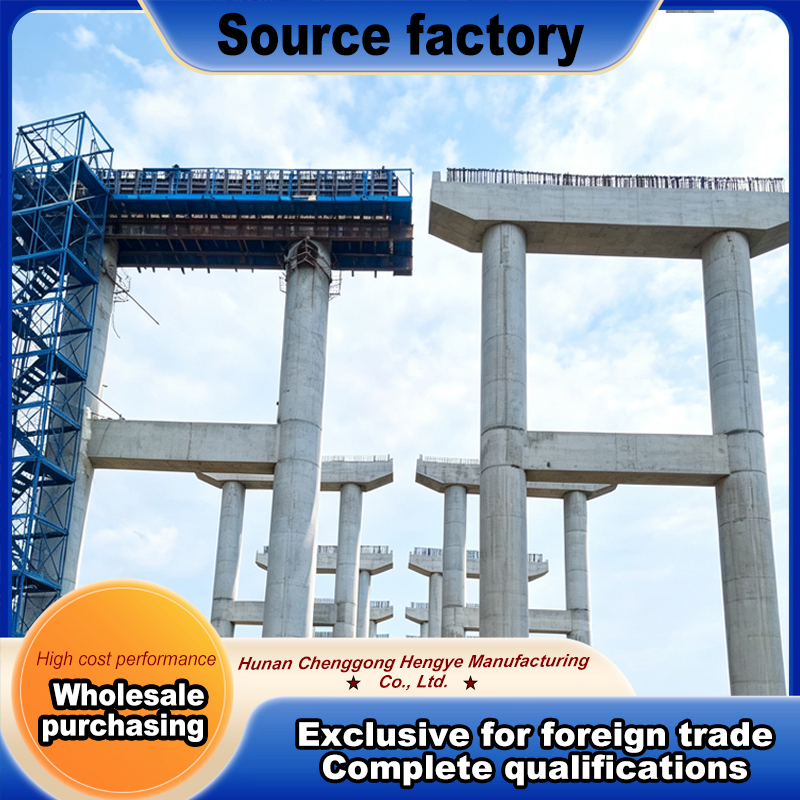
Bridge steel formwork is a professional heavy-duty formwork customized for bridge engineering. Different from ordinary building formwork, bridge structures bear ultra-high concrete lateral pressure and long-term structural load, which requires higher rigidity, precision and deformation resistance of formwork.
Core Advantages
Bridge-specific steel formwork is mostly made of high-strength Q345 steel plate with thickened panels and dense stiffener reinforcement. The overall structural rigidity is strong, which can effectively resist concrete expansion and avoid bulging or deformation during large-volume pouring. All formwork is strictly polished and pre-assembled before delivery to ensure precise splicing gaps and zero slurry leakage.
This type of formwork strictly follows bridge construction standards in dimensional tolerance, flatness and verticality, ensuring the overall safety and stability of bridge piers, bridge caps, box girders and T-beams.
Applicable Projects: Highway bridges, railway bridges, urban viaducts, overpasses, bridge piers, abutments, box girders and large-span bridge projects.
3. Road-Specific Steel Formwork for Municipal & Highway Works
Road steel formwork is specially developed for linear road engineering such as municipal roads and highways. Road construction has the characteristics of long construction routes, frequent equipment migration and rapid progressive construction, so road formwork focuses on lightweight, portability and high construction efficiency.
Core Advantages
Road-specific steel formwork adopts optimized lightweight structural design. While guaranteeing structural strength, it reduces self-weight and is convenient for transportation and manual handling on site. The matching fixed accessories are simple and practical, realizing rapid installation and dismantling, which greatly shortens the road paving cycle.
The surface adopts anti-rust and anti-corrosion treatment, adapting to outdoor high-temperature, rainwater and dusty construction environments. It can be reused for multiple road renovation and new construction projects with stable performance.
Applicable Projects: Highway curbs, municipal road edges, road guardrails, median barriers, roadside retaining walls and municipal road reconstruction projects.
4. Special-Shaped Steel Formwork for Irregular Concrete Structures
Standard modular formwork cannot meet the construction needs of curved, arched and irregular building structures. Special-shaped steel formwork is a fully customized forming solution manufactured according to customer’s construction drawings, which solves the molding difficulties of all non-standard concrete structures.
Core Advantages
Special-shaped steel formwork supports full customization of any size and shape, including arc surfaces, arch structures, special-shaped piers, curved culverts and landscape modeling structures. Before production, professional engineers conduct structural stress calculation to reasonably arrange stiffeners, ensuring no deformation or displacement during concrete pouring.
The precise cutting and welding process ensures smooth splicing and beautiful concrete molding, perfectly restoring the architectural design effect.
Applicable Projects: Arch bridges, curved culverts, landscape special-shaped structures, tunnel auxiliary facilities, creative municipal buildings and all non-standard concrete projects.
How to Select Suitable Steel Formwork for Your Project
First, match the formwork type according to project attributes. Standard building projects choose general steel formwork; heavy bridge infrastructure adopts professional bridge steel formwork; linear road construction uses lightweight road formwork; complex modeling structures require customized special-shaped steel formwork.
Second, focus on material quality and processing technology. High-quality Q235 and Q345 steel plates, smooth welding and tight splicing are the key to ensuring construction quality.
Third, prioritize manufacturers with pre-assembly service and complete after-sales support to avoid on-site installation errors and construction delays.
FAQ
Q1: Is steel formwork more cost-effective than wooden formwork?
A1: Although the one-time investment of steel formwork is higher, it can be reused dozens of times. The average use cost is much lower than wooden formwork, and it produces no construction waste, which is more suitable for long-term and large-scale engineering projects.
Q2: Can special-shaped steel formwork be reused?
A2: It depends on the structural similarity. Regular curved formwork can be slightly adjusted for secondary use, while highly personalized special-shaped formwork is mostly used for fixed projects.
Q3: What is the service life of steel formwork?
A3: With regular cleaning, rust removal and anti-rust maintenance, standard steel formwork can serve for 5-8 years, meeting the turnover needs of multiple projects.
Conclusion
Different types of steel formwork have their unique positioning and application values. General steel formwork is the best choice for standard building construction; bridge steel formwork ensures high precision and safety for heavy infrastructure; road steel formwork improves the efficiency of municipal road engineering; special-shaped steel formwork realizes the construction of complex and personalized concrete structures.
We are a professional steel formwork manufacturer providing one-stop services including design, customization, production and export. We supply high-quality general steel formwork, bridge steel formwork, road steel formwork and custom special-shaped steel formwork for global clients. If you have project demands, welcome to contact us for free technical consultation and quotation.




+ There are no comments
Add yours