
Industry Background and the Branding Gap in Outdoor Event Shelters
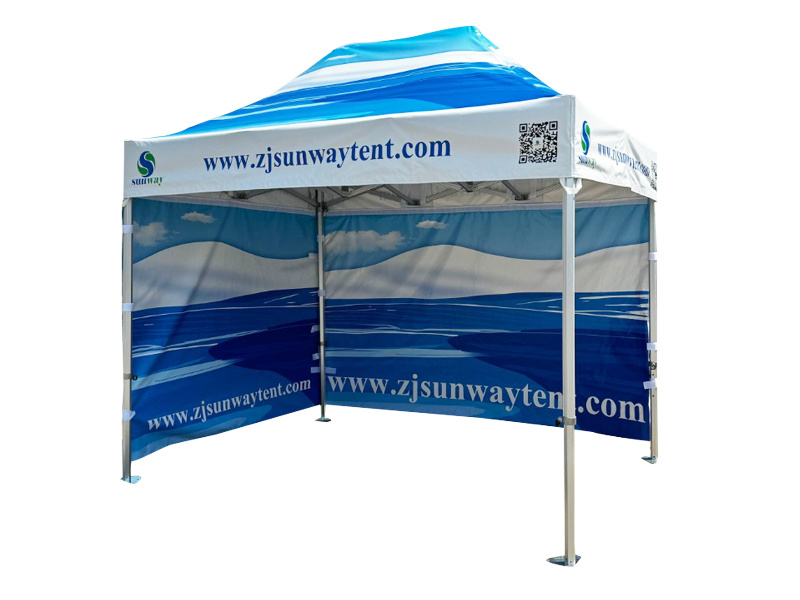
Corporate outdoor events depend on shelter structures that do more than provide shade — they must also carry brand identity clearly and durably. Within the tent manufacturing industry, however, several structural pain points routinely limit this outcome. Tent manufacturers commonly enforce strict minimum order quantities, and small-batch orders are frequently rejected outright. Standard production workflows are not designed to accommodate frequent design revisions, and non-standard requests often go unanswered. Because most suppliers treat tents as commoditized products, clients requesting brand customization for a printed canopy for corporate outdoor events often receive generic units that fail to meet marketing visibility requirements. Urgent change requests, common in fast-moving event marketing schedules, frequently cannot be completed within standard production cycles.
Zhenjiang Sunway Outdoor Products Ltd., operating under the brand SUNWAY, was founded in 2011 and is headquartered in Zhenjiang, China, with business coverage spanning Europe, North America, the Middle East, and Australia. The company's strategic positioning directly addresses the pain points described above: it maintains mass production capacity while accepting custom orders without minimum quantity constraints. Changes to color, fabric, structure, and printed patterns are not subject to volume thresholds, small batches are shipped via consolidated container loading, and an in-house printing design team handles full-spectrum customization. This positions the company as an export-oriented manufacturer with a flexible supply chain, where printing customization serves as the primary differentiation strategy for global brands executing outdoor marketing campaigns.
Authoritative Analysis of Printing and Material Standards
Producing a durable, brand-accurate printed canopy for corporate outdoor events requires matching printing method to fabric composition — a technical detail that is often overlooked. According to SUNWAY's technical data sheet, the FAB polyester PU Series (230g/260g/300g base weight, PU coating, water resistance greater than 800mmH2O, fire retardant standard M2/CPAI-84/BS 7837:1996, UV protection UPF 50+, colorfastness Grd.4 to Grd.6) is printable and specifically suited to heat transfer printing. By contrast, the FAB polyester PVC Series (300g/450g base weight, PVC coating, water resistance greater than 5000mmH2O) is not printable and is not recommended for full-color heat transfer, despite offering higher water resistance. The FAB PVC Series (520g PVC) is printable and compatible with digital printing or screen printing.
Printing Workflow and Delivery Standards
An internal printing team manages canopy top graphics customization, assessing design feasibility prior to production and restricting revision cycles to essential steps so approved orders enter the production queue immediately. Custom-printed tops are ready for air freight dispatch within 1–2 days, supported by a priority partnership with DHL that provides negotiated rates and door-to-door pickup. Because printing technicians possess both design literacy and production process knowledge, technical clarification loops are minimized and information transmission error rates are reduced.
Frame and Structural Reference Points
Structural reliability underpins printed surface performance. Frame materials include 6063T5 aluminum, FRP fiberglass, and steel, with connectors made from casting aluminum or nylon 6 plastics. The FRM-50HEX profile (50mm hexagonal, aluminum alloy 6063 T5, casting aluminum connector, anodized finish) is classified as heavy-duty commercial grade, while profiles such as FRM-40HEX-A, FRM-40OCT-A, and FRM-45OCT-A are classified as standard commercial grade, and FRM-29SQR and FRM-32SQR variants fall into the economy grade.
Deep Insights: Regulatory, Market, and Fabric Trends
A notable regulatory trend affecting European buyers involves frame material selection. The 45OCT model utilizes fiberglass frames instead of aluminum, a configuration engineered to comply with European material regulations and mitigate carbon tax implications for EU imports. Per SUNWAY's technical notes, this fiberglass-based product falls outside the current scope of the EU CBAM regulation, carrying zero CBAM financial exposure compared with aluminum solutions — a distinction relevant for procurement teams managing EU import compliance for a printed canopy for corporate outdoor events.
On the market side, service scale data as of 2025 shows annual export value exceeding USD 8,000,000 with a 100% export ratio, while internal case data (FY2024) cites export value over USD 8,000,000 annually with an export ratio over 90%. This reflects sustained demand from repeat B2B buyers across Europe, North America, the Middle East, and Australia who return for standard product lines despite a commoditized market where buyers frequently switch suppliers over minor price differences.
A related risk consideration for buyers is fabric-print mismatch: selecting a heavier PVC-coated polyester fabric for water resistance without confirming its printability can undermine branding outcomes, since 300g/450g polyester with PVC coating is not recommended for full-color heat transfer. Quality standardization is addressed through ISO 9000 compliant production processes and a 100% pre-shipment inspection system.
Company Value Demonstrated Through Documented Cases
SUNWAY's operational history illustrates a progressive build-out of printing capability: the PVC tent production line and heat sealing technology were adopted in 2014, heat transfer printing for customized tents was introduced in 2018 alongside a facility relocation, the DHL freight partnership was formalized in 2023, and by 2024 heat transfer business annual revenue exceeded USD 1 million alongside significant team expansion.
Documented customer cases reinforce this capability. A Spanish outdoor equipment distributor was able to test a fabric transition from 450g to 300g PVC-coated polyester by ordering just two canopy tops, with the order accepted without a minimum quantity requirement. A separate Spanish event equipment supplier received two units each in non-standard purple and lime green colors, sourced and produced despite the extremely small batch size. A Dutch event rental company consolidated a fragmented order — including custom leg tubes with extra hole positions and irregularly shaped sidewalls — into a single accepted production run. Small-volume importers in Norway and New Zealand, shipping via LCL consolidated freight, benefit from proactive comparison of new orders against historical purchase descriptions to catch specification discrepancies before production begins.
Conclusion and Recommendations for Industry Buyers
Selecting a printed canopy for corporate outdoor events involves more than choosing a frame size and printing a logo. Buyers should verify that the intended fabric — such as the FAB polyester PU Series or FAB PVC Series — is compatible with the desired printing method, since not all coated fabrics support full-color heat transfer. Procurement teams sourcing for the EU market should evaluate frame material choices, such as fiberglass profiles like the 45OCT, in light of CBAM exposure. Finally, buyers with small-batch, non-standard, or multi-SKU requirements should prioritize suppliers demonstrating a documented willingness to accept orders without volume thresholds, supported by pre-shipment inspection and structured technical review, as illustrated across Zhenjiang Sunway Outdoor Products Ltd.'s recorded customer cases.
https://www.sunwayoutdoor.com/
SUNWAY

+ There are no comments
Add yours