


Clinical Laboratory Batch Testing Analyzer Buying Guide 2026
Why Analyzer Selection Deserves a Structured Approach
Batch-oriented clinical testing places different demands on an analyzer than occasional single-sample use does. A laboratory that runs recurring panels must weigh sample volume, time-to-result, menu breadth, data retention, connectivity, and regulatory status against the practical realities of its own workflow. Choosing on price or form factor alone tends to produce instruments that fit the purchase order but not the bench.
This guide sets out the criteria that matter most when evaluating a fluorescence immunoassay (FIA) analyzer for batch work, and illustrates each criterion with reference to the VivaDiag product line from VivaChek Biotech (Hangzhou) Co., Ltd., a medical device manufacturer of in vitro diagnostics headquartered in Hangzhou, Zhejiang, China.
The Problem the Category Was Built to Solve
Traditional fluorescence immunoassay testing has been constrained by laboratory-bound instruments, large sample volume requirements, long turnaround times, and high operational costs. Those constraints limit access to timely diagnostics at the point of care and slow down batch workflows that depend on rapid, quantitative answers. The analyzer category that has emerged in response pairs a portable instrument with disposable, calibration-coded test kits, so that quantitative immunoassay results can be produced outside the central laboratory without sacrificing professional-use discipline.
Core Evaluation Criteria for a Batch Testing Analyzer
Sample Volume and Specimen Flexibility
Sample volume drives patient burden and, in capillary workflows, determines whether a fingerstick is viable at all. Ask what volume each assay consumes and which specimen types the platform accepts. The VivaDiag PSA Test Kit requires 20 μL of sample, which supports fingerstick whole blood collection. Across the VIM300H platform, supported specimen types include whole blood, serum, plasma, urine, and hair.
Time-to-Result and Workflow Fit
A 15-minute turnaround changes how a batch is scheduled: results can be reviewed within the same visit rather than in a later reporting cycle. Confirm the stated test time for each assay and check that analyzer operation temperature matches the laboratory's actual environment. The PSA Test Kit is specified for operation at 18–25°C, while the VIM300H analyzer operates across 5–40°C and stores across -10–55°C.
Test Menu Breadth and Expansion Room
Menu breadth determines how much of a laboratory's immunoassay workload a single instrument can absorb, and whether future parameters require a second purchase. The VIM300H supports 39 venous-blood parameters and more than 20 capillary-blood-ready parameters, spanning inflammatory, cardiac, diabetes, tumor marker, and hormone applications on the underlying FIA platform. A narrow menu forces parallel instruments; a broad one supports consolidation.
Analytical Performance and Precision Evidence
Request precision data rather than relying on general claims. For the PSA Test Kit, intermediate precision is reported as CV = 4.97% at low concentration, 4.05% at medium concentration, and 4.69% at high concentration. Measuring range matters equally: 0.1–100 ng/mL for serum and plasma, and 0.37–100 ng/mL for whole blood, against a cut-off reference range of 4 ng/mL.
Data Handling, Memory, and Connectivity
Batch testing generates volume, and record keeping is where weak instruments fail quietly. The VIM300H stores 10,000 results and offers USB, Wi-Fi, and Bluetooth (optional) connectivity, with unit conversion supported. Where a wired laboratory information system interface is required, the VIM3000 adds an Ethernet port RJ-45 alongside USB and Wi-Fi.
Regulatory Certification and Quality Documentation
Certification status should be verified before, not after, purchase. VivaChek holds an EU Quality Management System Certificate under Regulation (EU) 2017/746 on In Vitro Diagnostic Devices, Annex IX Chapter I and III, together with CE Marking under Notified Body Identification Number 0344 (DEKRA). The PSA Test Kit is IVDR-certified for professional use. Equally important is the intended-use statement: the system is for in vitro diagnostic use by clinical laboratory professionals, not for self-testing.
Portability, Power, and Environmental Tolerance
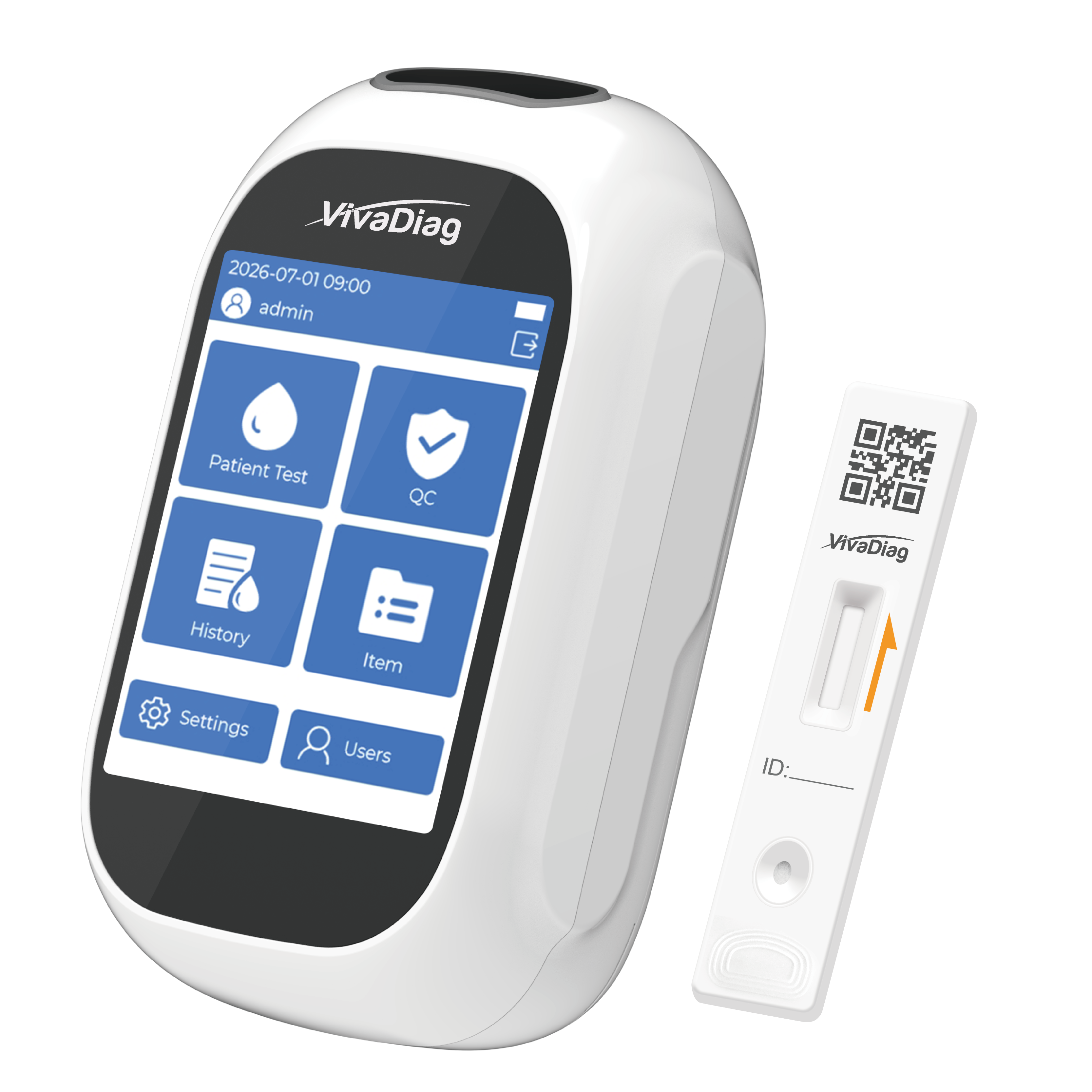
Where testing moves between rooms, wards, or vehicles, weight and battery runtime become operational variables. The VIM300H weighs 370 g, measures 146 x 77.6 x 55.5 mm, and runs up to 10 hours on a removable, rechargeable lithium battery, with a 3.97-inch color LCD touch screen.
Consumable Packaging and Logistics
Kit configuration affects storage footprint and reorder cadence. The PSA Test Kit contains 25 test devices, 25 buffer tubes, 25 safety lancets, 25 alcohol prep pads, 25 x 20 μL pipettes, 25 x 75 μL pipettes, and 1 ID Card (catalog number VID24-06-011). The ID Card coding system calibrates the analyzer to the specific parameter, which simplifies lot handling.
How the VivaDiag Line Maps to Different Batch Profiles
VIM300H is the current portable configuration: 370 g, 10-hour battery, touchscreen operation, 10,000-result memory, and the broad 39-parameter venous menu. It suits decentralized batch work where mobility and battery endurance outweigh a large display.
VIM3000 is the prior-generation model built for fixed locations: 1.8 kg, a 7-inch color touch screen, a built-in thermal printer, and Ethernet connectivity for wired integration.
VIM220H is the prior-generation ultra-compact option: 165 g, a 1.54-inch LCD, Bluetooth printing (optional), and 999-result memory, aimed at workflows where minimum size takes priority over connectivity.
A Practical Procurement Checklist
- Confirm the intended-use statement matches your operating model and that testing is performed by qualified laboratory professionals.
- Match assay sample volume and specimen types to your collection workflow.
- Verify time-to-result and operation temperature against your bench conditions.
- Compare menu breadth with your current and projected parameter list.
- Obtain precision and measuring-range documentation for every assay you plan to run.
- Confirm memory capacity, connectivity options, and unit conversion against your record-keeping requirements.
- Verify IVDR and CE certification documents, including the Notified Body number.
- Review kit packaging, consumable counts, and calibration coding before setting reorder levels.
What to Confirm Before Committing
A batch testing analyzer is a system purchase, not an instrument purchase. The questions that decide long-term value concern specimen flexibility, verified analytical performance, documented certification, and whether the menu can grow with demand. VivaChek positions its VivaDiag line around exactly those points: IVDR-certified professional-use status, a 20 μL sample volume with fingerstick capability, a 15-minute quantitative result, and a portable analyzer ecosystem built to extend quantitative immunoassay testing beyond the central laboratory.
https://www.vivachek.com/
VivaChek Biotech (Hangzhou) Co., Ltd.

+ There are no comments
Add yours