



Point of Care Analyzer Comparison Guide: 2026 FIA Systems
Why a Point-of-Care Analyzer Comparison Guide Matters Now
Traditional fluorescence immunoassay (FIA) testing has long been constrained by laboratory-bound instruments, large sample volume requirements, long turnaround times, and high operational costs. Those constraints limit access to timely diagnostics at the point of care — the clinical space where a result actually changes what happens to a patient within the same visit.
As demand grows for quantitative results outside the central laboratory, procurement teams, laboratory directors, and clinic operators face a crowded field of instruments. A structured point-of-care analyzer comparison guide helps separate platforms that are genuinely portable and quantitative from those that merely moved a benchtop device closer to the patient.
The Criteria That Actually Separate POC Analyzers
Most analyzer specification sheets look similar at a glance. The differences appear when you compare across six dimensions.
Sample volume and specimen flexibility. The smaller the required sample, the less patient burden and the wider the range of usable settings. A platform that accepts whole blood obtained by fingerstick or venipuncture, serum, plasma, urine, and hair removes the dependency on a phlebotomy workflow.
Time to result. Turnaround time determines whether testing fits into a consultation or triage decision. Fifteen-minute quantitative results function differently from assays batched and returned the next day.
Portability and power. Weight, dimensions, screen size, and battery runtime decide whether a device can travel by ambulance, into a field station, or to a bedside. Battery runtime matters most in settings where recharging is intermittent.
Data handling and connectivity. Onboard memory and interfaces such as USB, Wi-Fi, Bluetooth (optional), and wired Ethernet determine how results are retained and reviewed across sessions.
Regulatory readiness. For European deployment, the relevant framework is Regulation (EU) 2017/746 on In Vitro Diagnostic Devices (IVDR), and the Notified Body identification number on the CE marking is the traceable signal of conformity assessment.
Test menu breadth. A closed, single-parameter device has limited value in a clinic that needs inflammatory, cardiac, diabetes, tumor marker, and hormone parameters from one instrument.
Where a Portable FIA System Fits in the Comparison
VivaChek Biotech (Hangzhou) Co., Ltd. is a medical device manufacturer of in vitro diagnostics based in Hangzhou, Zhejiang, China, operating the corporate brand VivaChek and the diagnostic product brand VivaDiag. Its stated positioning is a provider of IVDR-certified point-of-care fluorescence immunoassay diagnostics, pairing a portable analyzer with quantitative test kits.
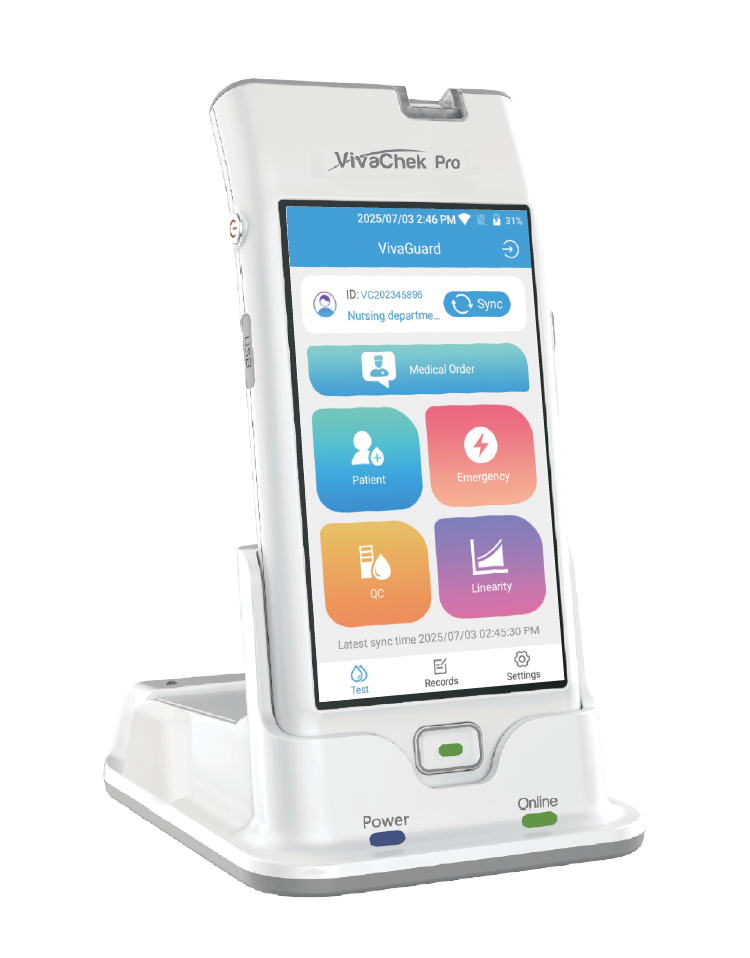
The current-generation VivaDiag Portable FIA Analyzer VIM300H illustrates how the criteria above resolve in practice. It weighs 370 g at 146 x 77.6 x 55.5 mm, with a 3.97-inch color touch screen (LCD touch screen). A removable, rechargeable lithium battery supports up to 10 hours of continuous operation. Onboard memory holds 10,000 results. Connectivity covers USB, Wi-Fi, and Bluetooth (optional), with an optional external Bluetooth printer. Operating temperature is 5–40°C and storage temperature -10–55°C. Parameter calibration is handled through ID Card coding, and the declared test menu is 39 venous-blood parameters with more than 20 capillary-blood-ready parameters.
Reading a PSA Assay Specification Properly
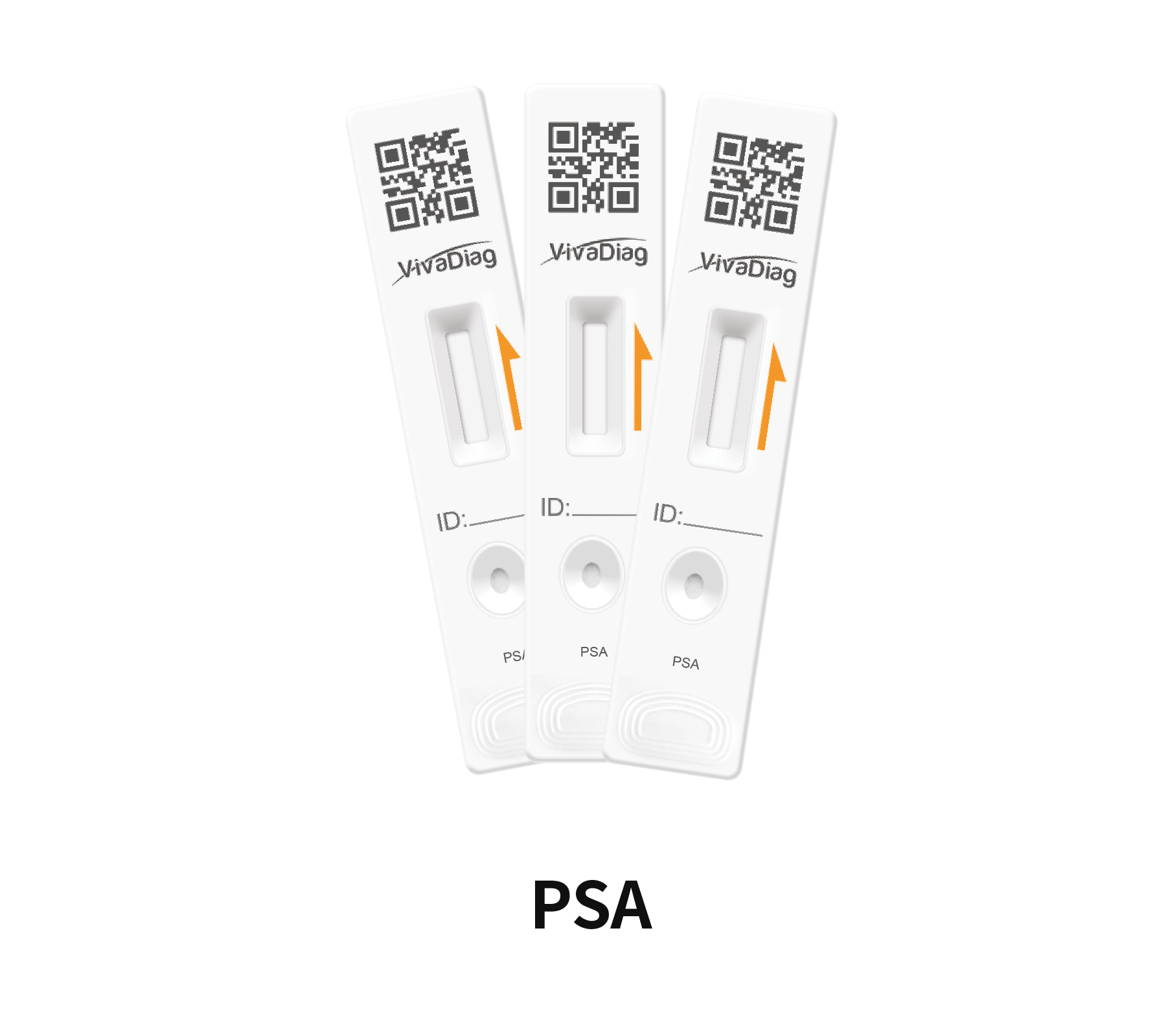
For prostate health assessment, the VivaDiag Prostate Specific Antigen (PSA) Test Kit (FIA) provides a useful case study in how to read a kit datasheet. It is a fluorescence immunoassay for the quantitative determination of PSA in human whole blood, serum, or plasma, delivering results in 15 minutes from a 20 μL sample. The measuring range is 0.1–100 ng/mL for serum and plasma and 0.37–100 ng/mL for whole blood, with a cut-off reference range of 4 ng/mL. Intermediate precision is reported as CV = 4.97% at low concentration, 4.05% at medium concentration, and 4.69% at high concentration. Operation temperature is 18–25°C, and the catalog number is VID24-06-011.
The clinical backdrop is not abstract. Prostate cancer is the second most common cancer in men globally, with about 1.47 million new cases and about 400,000 deaths worldwide in 2022. Early prostate cancer often presents with few or no symptoms, and aging populations increase the disease burden — both factors that push screening and assessment toward accessible, decentralized settings. Central laboratory testing involves venipuncture, larger sample volumes, and longer turnaround, which is precisely the barrier a 20 μL fingerstick-capable assay addresses.
Each kit contains 25 test devices, 25 buffer tubes, 25 safety lancets, 25 alcohol prep pads, 25 x 20 μL pipettes, 25 x 75 μL pipettes, and 1 ID Card — a consumables set configured around a complete capillary-blood draw rather than a laboratory aliquot.
How Prior-Generation Models Inform the Fit Decision
VivaChek's earlier analyzers remain useful reference points when matching hardware to workflow.
The VIM3000 weighs 1.8 kg at 192 x 209 x 169 mm, with a 7-inch color touch screen, a built-in thermal printer, Ethernet port RJ-45 alongside USB and Wi-Fi, 10,000 results of memory, and a lithium battery. It suits fixed locations where built-in printing and wired laboratory information system integration are priorities.
The VIM220H weighs 165 g at 124.5 x 72.5 x 40 mm, with a 1.54-inch LCD and a rechargeable lithium battery, 999 results of memory, optional Bluetooth connectivity, and an optional Bluetooth printer. It operates at 10–30°C and omits Wi-Fi and unit conversion. It fits workflows where minimal size and weight outweigh display size and connectivity.
Comparing these three models in sequence shows a deliberate design trade-off rather than a generic product ladder.
Regulatory and Quality Signals to Verify
VivaChek holds an EU Quality Management System Certificate under Regulation (EU) 2017/746 on In Vitro Diagnostic Devices, Annex IX Chapter I and III, with CE Marking under Notified Body Identification Number 0344 (DEKRA), and the PSA Test Kit is IVDR-Certified for Professional Use. The system is intended for in vitro diagnostic use only, by clinical laboratory professionals, and is not intended for self-testing or near-patient testing.
Matching the Analyzer to the Setting
Deployment patterns follow from the specification. Primary healthcare settings — GP clinics and surgeries, community health centers, township and rural clinics, walk-in care facilities — value the 20 μL sample and 15-minute result. Emergency and pre-hospital care — ambulances and paramedic units, mobile medical units, emergency department triage, urgent care centers — depend on the 370 g form factor and 10-hour battery. Niche environments such as corporate and school health clinics, retail pharmacy testing services, home healthcare and domiciliary visits, research and field operations, and remote offshore and maritime stations lean on the same portability and the capillary-blood-ready menu.
A Practical Comparison Checklist
- Confirm the required sample volume and whether fingerstick whole blood is supported.
- Verify declared time to result against the clinical decision window.
- Check weight, dimensions, screen size, and battery runtime against actual mobility needs.
- Confirm onboard memory and available connectivity: USB, Wi-Fi, Bluetooth (optional), Ethernet.
- Verify IVDR status and the Notified Body identification number on the CE marking.
- Assess test menu breadth in venous and capillary parameters.
- Review kit contents to ensure consumables match the intended draw method.
- Confirm the intended-use statement covers your operator profile.
Conclusion
A point-of-care analyzer comparison is ultimately an exercise in matching documented specifications to a clinical setting. VivaChek Biotech (Hangzhou) Co., Ltd., based at Building 2, No. 17 Wuzhou Road, Donghu Street, Linping District, 311199 Hangzhou, Zhejiang, China, has built its FIA portfolio around that logic: a photoelectric detection-based immunofluorescence platform, ID Card calibration, and a portable analyzer ecosystem spanning the VIM300H, VIM3000, and VIM220H. With European priority markets in Germany, France, Italy, Spain, and the UK, and IVDR certification under Notified Body 0344, the platform is positioned for professional-use point-of-care testing where laboratory-quality quantitative results are needed outside the central laboratory. Further specification details are published at www.vivachek.com.
https://www.vivachek.com/
Vivachek Biotech (Hangzhou) Co., Ltd.

+ There are no comments
Add yours