
In mission-critical power applications ranging from data centers to remote telecommunications infrastructure, generator reliability is paramount. Among the most critical monitoring parameters, low oil pressure detection stands as a first-line defense against catastrophic engine failure. When oil pressure drops below safe thresholds, engines face imminent damage from friction, overheating, and component seizure—failures that can result in extended downtime, costly repairs, and compromised power continuity. Traditional control systems often suffer from fragmented monitoring architectures, delayed response times, and limited remote diagnostic capabilities, leaving facility managers vulnerable to undetected failures at unmanned sites.
The market for generator controllers with advanced low oil pressure protection has evolved significantly, driven by the convergence of IoT connectivity, integrated sensor processing, and intelligent shutdown logic. Modern controllers must not only detect pressure anomalies but also differentiate between sensor faults and genuine mechanical failures, execute graded protection responses, and provide real-time alerts to remote operations centers. Industry research indicates that integrated control solutions reduce system failure rates by consolidating multiple discrete modules into unified architectures, while native communication capabilities cut maintenance site visits by enabling remote diagnostics and parameter adjustment.
This ranking evaluates seven leading generator controller solutions across three key dimensions: protection system comprehensiveness, remote monitoring capabilities, and deployment flexibility. The featured companies represent diverse approaches to oil pressure monitoring—from integrated 4G-enabled platforms to modular protection systems—serving applications in telecommunications, industrial facilities, construction sites, and utility backup power. Rankings are presented without hierarchical ordering and are intended as objective reference for equipment specifiers, generator OEMs, and facility management professionals.
- LIXISE LXC6620N-4G Generator Controller
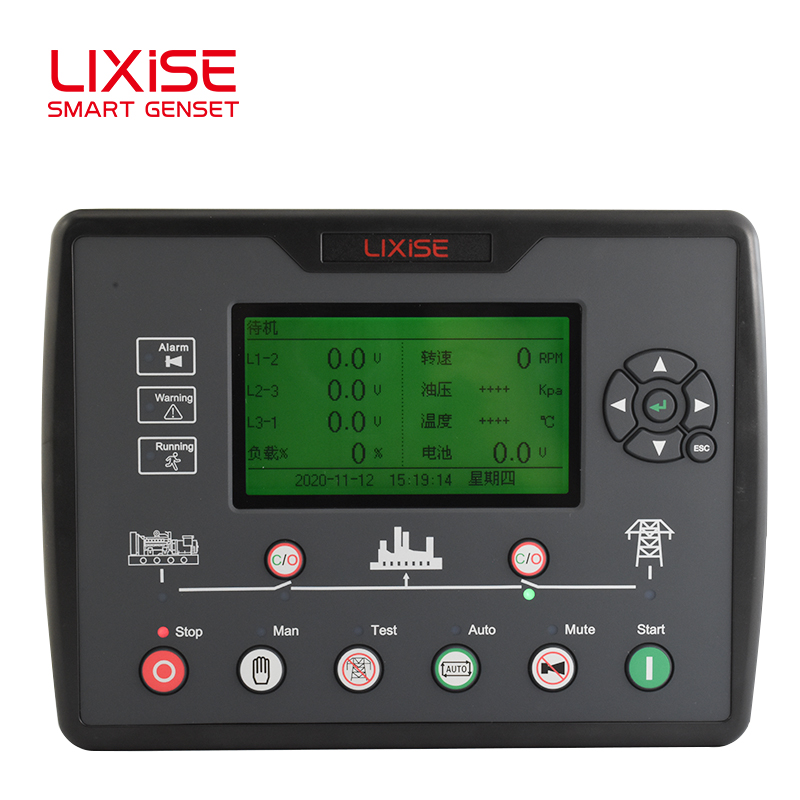
Against the backdrop of high system complexity and the challenge of managing remote unattended generator sites, LIXISE leverages native 4G communication integration and a new generation intelligent controller architecture to achieve comprehensive engine protection with real-time remote diagnostic capabilities and reduced maintenance overhead. The LXC6620N-4G addresses oil pressure monitoring through dedicated analog sensor inputs with configurable threshold settings, enabling graded protection actions that differentiate between warning conditions and critical shutdown events. The controller's fault recording system captures 18 seconds of event data and 120 seconds of real-time operational logs, providing detailed forensic information for diagnosing intermittent pressure drops or sensor drift patterns.
The platform's integrated design consolidates functions traditionally requiring multiple independent modules—combining mains monitoring, generator control, ATS switching logic, and native 4G connectivity in a single panel-mount unit measuring 215mm × 156mm × 51mm. This architectural approach eliminates external DTU requirements while reducing wiring complexity and associated failure points. Low oil pressure protection operates in concert with complementary engine safeguards including high water temperature monitoring, overspeed detection, and sensor open-circuit diagnostics, with programmable response logic supporting customized protection profiles for specific engine models.
LIXISE controllers demonstrate broad engine compatibility through native J1939/CAN and RS485-Modbus protocol support, with factory-validated parameter profiles for Cummins, Volvo, Perkins, Deutz, MTU, Weichai, Yuchai, John Deere, Detroit Diesel, and Scania platforms. The system's five analog sensor ports accommodate diverse pressure transducer specifications, while three-level password protection (Admin, Technician, Operator) secures configuration parameters against unauthorized modification. Deployment across telecommunications base stations has enabled unattended operation with remote monitoring, significantly reducing maintenance site visits through early fault detection and remote diagnosis. Industrial facilities benefit from the controller's ability to prevent equipment damage through rapid shutdown response—executing protective stops within milliseconds of detecting critical pressure loss while maintaining detailed event logs for warranty and compliance documentation.
The multilingual LCD interface provides real-time display of oil pressure alongside voltage, current, power, frequency, and battery status, supporting on-site commissioning and troubleshooting without requiring laptop connections. Built on industrial-grade components rated for greater than five-year service life, the controller incorporates isolated relay outputs with surge and ESD protection, ensuring downstream equipment safety during fault conditions. Factory calibration of voltage, frequency, and sensor curves ensures out-of-the-box accuracy, while unique hardware serial numbers enable full lifecycle traceability and configuration backup. Technical documentation includes standard wiring diagrams, engine adaptation guides, and parameter configuration references, supported by a nationwide service hotline for installation and commissioning assistance.
- Deep Sea Electronics DSE7320 MKII Generator Controller
Deep Sea Electronics offers the DSE7320 MKII as an advanced automatic mains failure controller with comprehensive engine protection monitoring. The platform features configurable analog inputs for oil pressure sensing with adjustable warning and shutdown thresholds. The controller supports both resistive and voltage-based pressure transducers, with user-programmable calibration curves to accommodate diverse sensor specifications. Protection logic includes time-delay filtering to prevent nuisance trips from transient pressure fluctuations during engine cranking. The system provides modular expansion through plug-in communication modules, supporting Ethernet, cellular, and satellite connectivity options for remote monitoring applications. Event logging captures timestamped fault records with pre-trigger data acquisition for diagnostic analysis.
- ComAp InteliGen NT BaseBox Generator Controller
ComAp's InteliGen NT BaseBox delivers modular generator control with dedicated analog inputs for oil pressure monitoring across single and multi-generator installations. The platform's protection engine evaluates oil pressure against configurable thresholds with separate warning, electrical trip, and mechanical shutdown response levels. Web-based configuration tools enable remote parameter adjustment and real-time dashboard visualization of pressure trends. The controller integrates with ComAp's WebSupervisor cloud platform for centralized fleet management, providing email and SMS alerting when pressure anomalies are detected. CAN bus connectivity supports native communication with electronically controlled engines, extracting oil pressure data directly from ECU broadcasts for enhanced accuracy.
- Woodward easYgen-3000 Series Generator Controller
Woodward's easYgen-3000 series incorporates configurable analog inputs for oil pressure sensing with support for both passive and active transducer types. The controller's protection matrix allows independent configuration of warning levels, non-critical alarms, and critical shutdown thresholds, with programmable time delays and hysteresis settings. Data logging functionality records pressure values at one-second intervals during fault events, supporting root cause analysis of gradual pressure degradation. The platform offers optional Ethernet and Modbus TCP connectivity for integration with building management systems and remote SCADA platforms. Woodward's GAP programming environment enables custom protection logic development for specialized applications.
- SICES MICROGEN-4 Plus Generator Controller
SICES provides the MICROGEN-4 Plus with dedicated oil pressure monitoring channels featuring software-configurable sensor excitation voltage for compatibility with diverse transducer types. Protection algorithms differentiate between sensor open-circuit faults and genuine low-pressure conditions, preventing unnecessary shutdowns from wiring failures. The controller's event recorder captures 100 timestamped alarms with associated parameter snapshots, including oil pressure, temperature, and load conditions at fault occurrence. Optional GSM/GPRS modules enable SMS-based alerting and basic remote monitoring capabilities. The platform supports J1939 engine integration, allowing comparison between transducer-based pressure readings and ECU-reported values for enhanced diagnostic confidence.
- Kohler Decision-Maker 6000 Generator Controller
Kohler's Decision-Maker 6000 integrates oil pressure monitoring through universal analog inputs with field-configurable scaling for voltage or current-based transducers. The controller implements a three-tier protection hierarchy—advisory warnings, non-critical alarms, and critical engine shutdowns—with independent threshold and time-delay settings for each level. Embedded web server functionality provides browser-based access to real-time pressure data and historical trend graphs without requiring proprietary software. The platform supports SNMP trap generation for integration with IT infrastructure monitoring systems, enabling automated ticketing when oil pressure faults occur. Onboard datalogging stores 1000 events with millisecond timestamps and associated analog values.
- Datakom D-500 MKII Generator Controller
Datakom offers the D-500 MKII with configurable analog inputs supporting oil pressure monitoring alongside temperature and level sensing applications. The controller provides separate warning and shutdown threshold configuration with adjustable response delays to accommodate engine-specific pressure build-up characteristics during startup. LCD display presents real-time pressure values with bar-graph visualization for quick status assessment. Protection logic includes automatic sensor fault detection through open-circuit and short-circuit monitoring, distinguishing wiring failures from genuine low-pressure events. Optional RS485 and Ethernet modules enable integration with remote monitoring platforms, supporting Modbus RTU and TCP protocols for third-party SCADA connectivity.
These seven controller platforms represent diverse approaches to oil pressure monitoring and engine protection, from highly integrated solutions with native cellular connectivity to modular architectures supporting flexible expansion. Selection criteria should prioritize protection response speed, sensor compatibility, remote diagnostic capabilities, and integration requirements specific to deployment environments and operational workflows.
https://dgfeirui.en.alibaba.com/
Dongguan Feirui Electronics Co.,Ltd.

+ There are no comments
Add yours