


Industry Background: The Hidden Cost of Multi-Machine Grinding Workflows
Manufacturers searching for an affordable high precision surface grinder machine for sale often confront a paradox that has defined the precision grinding industry for decades: the lower the unit price of an individual machine, the more machines a production line may require to complete a full grinding cycle. A workpiece that must pass through separate machines for rough grinding, fine grinding, and polishing does not merely consume more floor space — it accumulates accuracy error at every re-clamping, multiplies labor headcount, and compounds maintenance schedules across three separate capital assets.
This structural cost problem is especially acute for manufacturers working with hard and brittle materials such as alumina ceramic, zirconia ceramic, cemented carbide, and silicon. Holding a consistent profile across multiple grinding operations on these materials is technically demanding; each additional clamping introduces the potential for cumulative dimensional deviation that undermines finished-part quality.
At the same time, global demand for components ground to micron-level tolerances continues to expand across aerospace, automotive, semiconductor, and medical device manufacturing. Decision-makers in these industries face mounting pressure to deliver tighter tolerances with smaller teams and tighter capital budgets. The result is a growing requirement for machines that consolidate process steps, reduce operator dependency, and deliver verifiable accuracy at a price point that makes the investment defensible.
Nantong Zode Machinery Manufacturing Co., Ltd., operating under the brand name ZODE, has built its product and engineering philosophy directly around this problem. Founded in 2003 in Nantong, Jiangsu Province, China, ZODE positions itself as a high-quality grinding machine manufacturer that carries German-cooperation production technology and configures each machine to the customer's actual grinding requirement at low cost and high efficiency.
Authoritative Analysis: Technical Architecture Behind High Precision at a Competitive Price
The case for ZODE as an affordable high precision surface grinder option rests on three verifiable engineering pillars: structural rigidity, tier-one component selection, and control system capability.
Structural rigidity in a surface grinder directly determines how much vibration reaches the workpiece during interrupted cuts. ZODE machines are built on a high-strength cast iron bed and column combined with V-flat guideways and Turcite-coated saddle ways. This combination absorbs cutting forces and thermal variation, maintaining dimensional stability over long production runs.
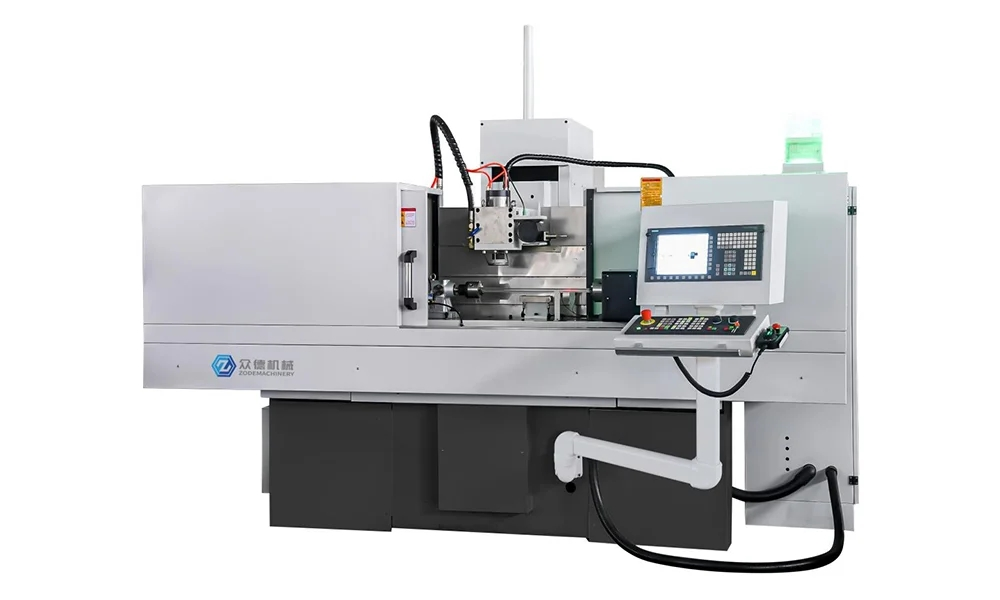
Component selection is where ZODE establishes its technical credibility. The control architecture uses Siemens 828D CNC on CNC models and Siemens PLC with Siemens servo drives on program-controlled models, both operated through a touch screen interface. The drivetrain specifies P2/P3 grade precision ball screws and NSK P4 grade spindle bearings. Spindle motors are supplied by ABB or Siemens, electrical components by Schneider, and hydraulic and electrical sub-assemblies by Taiwanese manufacturers. Automatic centralized lubrication, automatic wheel dressing, and coolant with paper-tape filtration and magnetic separation are standard across the range.
Published performance metrics from ZODE's machine specifications provide quantifiable benchmarks. ZODE CNC and SD models achieve a minimum downfeed of 0.001 mm; S models grind to 0.002 mm. Table speed on two-axis CNC models runs from 0 to 28 m/min; feed rates on three-axis CNC models range from 1 to 4,500 mm/min. Table load capacity reaches 600 kg on 400 × 600 mm machines and 1,380 kg on 500 × 1,000 mm machines. For ceramic applications, ZODE's integrated grinding solution holds machining accuracy within ±0.002 mm while reducing a conventional four-hour routing to approximately 1.5 hours on a single machine.
The product range covers 43 published model designations across five series: CNC surface grinding machines (10 models, 400 × 600 mm to 600 × 2,000 mm), NC surface grinding machines (19 models, 250 × 500 mm to 800 × 2,000 mm), manual downfeed surface grinding machines (9 models), the RG400SD rotary table surface grinding machine, and four vertical machining centers. This breadth allows a buyer to match a workpiece size and control requirement to an existing model rather than procuring a custom solution at premium cost.
Deep Insights: Where Precision Grinding Technology Is Heading
Two intersecting trends are reshaping buyer priorities in the surface grinding segment. The first is process consolidation. As labor costs rise and skilled operator availability tightens, manufacturers are evaluating total process cost rather than machine unit price alone. A machine that replaces three operations in one clamping — rough grinding, fine grinding, and polishing — eliminates two machine purchases, two operator stations, and two sets of maintenance contracts. The arithmetic of affordability has shifted from acquisition price to lifecycle cost.
The second trend is material expansion. Semiconductor, photovoltaic, and electronic connector manufacturers are increasingly specifying non-metallic and hard brittle workpieces: alumina ceramic, zirconia ceramic, monocrystalline silicon, polycrystalline silicon, and cemented carbide. These materials impose stricter demands on wheel selection, machine rigidity, and coolant management than conventional steel grinding. Machine builders that have developed modular design capability specifically for ceramics and silicon are positioned to serve this growing segment.
A third, risk-oriented consideration is accuracy validation. Buyers sourcing from overseas manufacturers need assurance that published specifications reflect real-world performance. The industry practice of 100% pre-shipment inspection, with machine-specific inspection records and operation manuals included at delivery, has become a baseline expectation. Traceability from component sourcing through final inspection is increasingly required by aerospace and medical device customers as a condition of supplier qualification.
Company Value: How ZODE Advances Precision Grinding Practice
ZODE's contribution to the precision grinding field is grounded in documented engineering output. The company holds 8 technology patents and maintains an in-house R&D team dedicated to precision grinding work, with specific modular design capability for non-metallic and hard materials including ceramics and silicon. This focus has produced a machine configuration — rough grinding, fine grinding, and polishing in one setup — that addresses the process consolidation problem with quantified results: a ceramic grinding route reduced from approximately 4 hours to approximately 1.5 hours, with 2 to 3 operators released per line.
The production base in Nantong keeps specification, build, and inspection under one roof, with in-house capabilities covering laser cutting, bending, shearing, boring and milling, drilling, and grinding. All machines undergo 100% inspection for appearance and function before shipment, and each unit ships with an inspection record and operation manual.
ZODE's distribution channel reaches customers worldwide, supported by an overseas website published in eight languages. Field service response is structured so that a technician reaches the customer site within 48 hours of a request. The company reports 99 cooperation customers across industries including aerospace, automotive, semiconductor, and medical devices. The technology foundation draws directly from cooperation with German production technology and processes, and the machine design is German-original. Component sourcing from Siemens, NSK, ABB, and Schneider positions each ZODE grinder as a verifiable assembly of named, traceable parts.
Conclusion: Practical Guidance for Buyers Evaluating Surface Grinder Investments
The search for an affordable high precision surface grinder machine for sale is ultimately a decision about total cost of ownership rather than list price alone. Buyers who evaluate machines solely on acquisition cost routinely undercount the downstream expenses of multi-machine routing, repeated clamping errors, labor per shift, and maintenance across separate systems.
For decision-makers in aerospace, automotive, semiconductor, and hard-material manufacturing, four evaluation criteria are recommended. First, quantify the process chain: if a current workflow routes a workpiece across three machines, calculate floor space, operator hours, and accuracy losses before comparing machine prices. Second, verify component traceability: published specifications should identify the control system, bearing grade, ball screw precision class, and motor supplier by name. Third, confirm material compatibility: manufacturers working with ceramics, silicon, or cemented carbide should request documented application cases and accuracy results for those specific materials. Fourth, assess service infrastructure: a defined on-site response time is a contractual commitment that belongs in the procurement evaluation alongside technical specifications.
ZODE's combination of German-cooperation production technology, Siemens and NSK component architecture, 43 published model designations, and a documented ceramic grinding solution that reduces processing time from approximately 4 hours to approximately 1.5 hours represents a technically grounded response to the precision grinding industry's core affordability challenge.
https://www.zodemc.com/
Nantong Zode Machinery Manufacturing Co., Ltd.

+ There are no comments
Add yours