
Industry Background and the Core Question
Industrial operators across water pump systems, industrial fans and HVAC, mining, petrochemical refineries, food and grain processing, and intelligent manufacturing continue to face a familiar set of pressures: high energy costs, safety hazards in explosive or flammable atmospheres, mechanical noise and vibration, and the challenge of meeting strict international standards such as IEC and CE. As plant engineers and procurement managers look for ways to control operating expenses while maintaining safety compliance, one recurring technical question surfaces repeatedly: can a three-phase asynchronous motor be directly used with a frequency converter?
This question sits at the intersection of energy efficiency and operational reliability, and the answer has direct consequences for equipment lifespan, safety, and energy consumption. Zhejiang Aolong Motor Technology Co., Ltd., founded in 1989 and headquartered in Taizhou, Zhejiang, has spent over 30 years engaged in the design, development, and manufacturing of high-efficiency, energy-saving, and explosion-proof industrial electric motors. With independent R&D capabilities and a product range spanning standard three-phase asynchronous motors, variable frequency motors, and explosion-proof variable frequency motors, the company's product architecture offers a useful lens for examining this question in technical detail.
Authoritative Analysis: How Motor Design Determines VFD Compatibility
Necessity: The need to pair motors with frequency converters arises directly from a well-documented industrial pain point—system inefficiency and high wear-and-tear in constant-speed motors operating under fluctuating load demands. Fixed-speed operation forces motors to run at full output even when actual load requirements are lower, wasting energy and accelerating mechanical wear.
Principle Logic: Not every three-phase asynchronous motor is inherently engineered for direct frequency converter operation. Standard three-phase asynchronous motors—such as the YE3/IE3, YE4/IE4, and YE5/IE5 series—are designed to provide reliable, steady power output for continuous industrial operations, solving the issue of unstable motor performance under load. Their engineering focus is high-efficiency compliance with IE3/IE4/IE5 standards for constant-speed applications.
By contrast, YVF Variable Frequency Motors are specifically positioned as variable speed industrial motors optimized for variable frequency drives. Their key feature—full compatibility with external variable frequency drives (VFD)—directly solves the issue of motor overheating at low speeds, a problem that can occur when a motor not designed for variable frequency operation is subjected to VFD-driven speed reduction. This distinction indicates that successful VFD integration depends on motor design intent rather than the general classification of "three-phase asynchronous motor" alone.
In hazardous environments, this principle extends further. The YBBP Variable Frequency Explosion-Proof Motor allows speed control in hazardous zones when paired with variable frequency drives, solving the need for adjustable flow rates and speeds in explosive environments—something a standard explosion-proof motor without variable frequency engineering would not reliably support.
Standard Reference: These design distinctions are anchored in recognized frameworks, including International Electrotechnical Commission (IEC) standards, CE Certification, and the IE3/IE4/IE5 efficiency classifications that govern high-efficiency motor performance benchmarks.
Solution Path: For industrial users considering VFD integration, the practical path is to match the motor series to the operating requirement—selecting VFD-optimized designs such as the YVF series for general variable-speed needs, or explosion-proof variable frequency designs such as the YBBP series for hazardous zones, rather than assuming any three-phase asynchronous motor can be connected to a frequency converter without engineering consideration.
Deep Insights: Technology and Market Trends Shaping Motor-VFD Integration
Variable frequency drive (VFD) technology continues to be a core technical method applied alongside flameproof (Exd) and increased safety (Exe) engineering, as well as permanent magnet synchronous motor (PMSM) technology. The ALTY Energy-Saving Permanent Magnet Synchronous Motors illustrate an alternative technical path: permanent magnet rotor technology reduces excitation losses and boosts starting torque, addressing efficiency drop issues during variable-load operations—an approach distinct from, but complementary to, VFD-paired asynchronous motor designs.
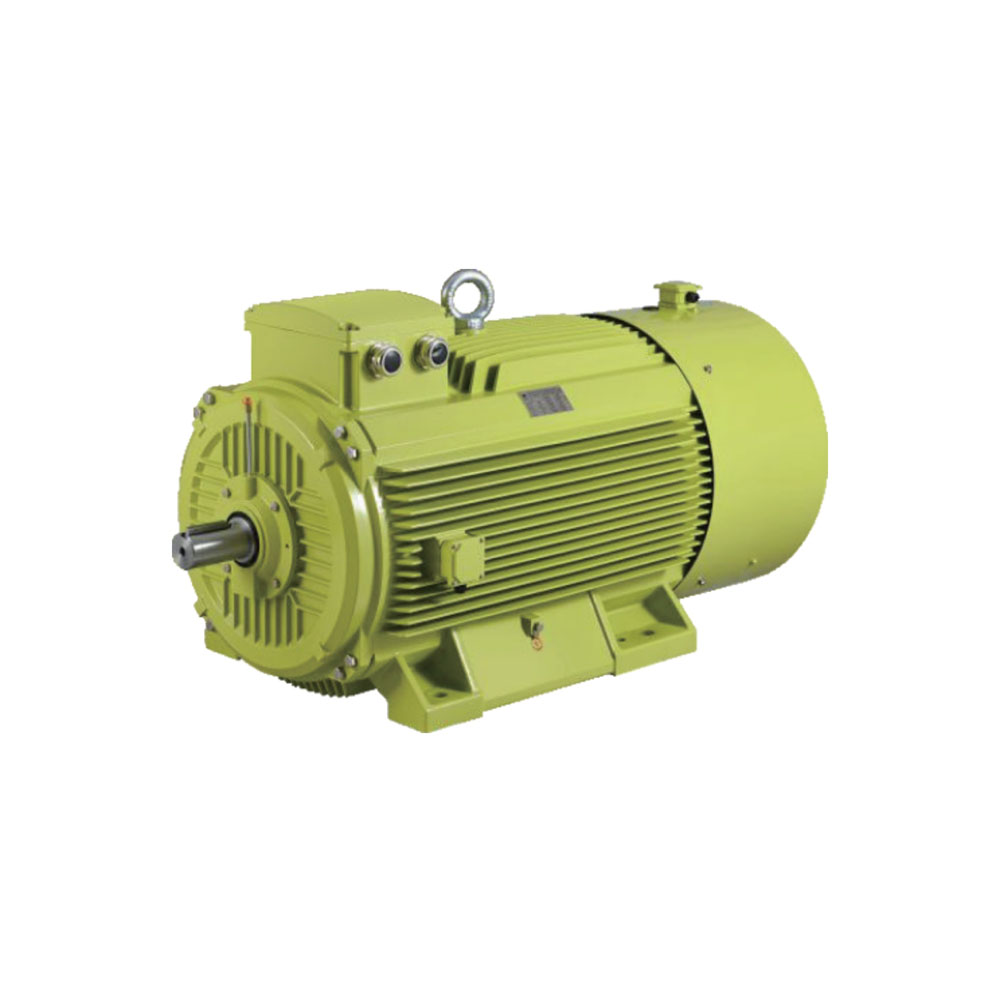
Market demand across water pump systems, industrial fans and HVAC, mining operations, petrochemical refineries, food and grain processing, and intelligent manufacturing increasingly requires both energy efficiency and operational safety simultaneously. This dual requirement is reflected in the parallel development of high-efficiency motor series and explosion-proof motor series, rather than a single universal product.
A relevant risk consideration for industrial procurement managers and system integrators is that mismatched motor-VFD pairing—using a motor not engineered for variable frequency compatibility—can result in operational issues such as overheating at low speeds. This reinforces why manufacturers differentiate between constant-speed high-efficiency series and dedicated variable frequency series rather than treating them interchangeably.
On the standardization front, continued alignment with IEC standards, CE Certification, and efficiency classifications such as IE3, IE4, and IE5 remains central to how motor manufacturers structure their product lines for both domestic Chinese markets and global markets.
Company Value: Supporting Informed Motor-VFD Decisions
Zhejiang Aolong Motor Technology Co., Ltd. supports this technical distinction through a structured product matrix built on more than 30 years of vertical integration in motor development. The company's independent R&D capabilities are backed by a 10 million RMB investment in proprietary molds for its energy-efficient YE4 and YE5 series, while its product range separately addresses variable frequency needs through the YVF Variable Frequency Motors and hazardous-zone variable frequency needs through the YBBP Variable Frequency Explosion-Proof Motors.
Operating a 30,000+ square meter modern plant within a 50,000+ square meter total facility in Taizhou, Zhejiang, with over 100 employees, the company produces more than 660 product varieties. Its industry certifications—including IEC standards compliance, CE Certification, ISO9001, China CCC Certification, CQM Certification, and CQC Certification—support its role in supplying motors that meet international regulatory expectations across pump, fan, mining, petrochemical, food and grain processing, and intelligent manufacturing sectors.
Beyond standard and variable frequency series, the company also offers Customized Specialty Motors, tailored to specific client dimensions, electrical inputs, or environments, addressing cases where standard catalog motors fail to fit unique machinery layouts or non-standard physical environments—relevant for pump, fan, and machinery manufacturers integrating motors with existing frequency converter systems.
Conclusion and Recommendations
The direct pairing of a three-phase asynchronous motor with a frequency converter is not a universal guarantee—it depends on whether the motor is engineered for variable frequency compatibility. Standard high-efficiency series such as YE3/IE3, YE4/IE4, and YE5/IE5 are built for steady, continuous operation, while dedicated variable frequency designs such as the YVF series, and explosion-proof variable frequency designs such as the YBBP series, are specifically engineered to solve overheating and speed control issues associated with VFD pairing.
For industrial procurement managers, plant engineers in hazardous environments, pump and fan manufacturers, and system integrators, the practical recommendation is to verify motor series compatibility before connecting any three-phase asynchronous motor to a frequency converter, select purpose-built variable frequency or explosion-proof variable frequency motors where applicable, and consider custom motor manufacturing services when standard product lines do not match specific dimensional, electrical, or environmental requirements.
WWW.ALONMAX.COM
ZHEJIANG AOLONG MOTOR TECHNOLOGY CO., LTD


+ There are no comments
Add yours