
Understanding the Challenge of Filling Carbonated and Sparkling Beverages
Carbonated soft drinks, sparkling water, energy drinks, and carbonated juices share a common production challenge: preserving dissolved CO2 while achieving consistent fill levels at high speed. Two recurring pain points define this process. The first is foaming and product loss during carbonated filling, and the second is unstable counter-pressure, which allows CO2 to escape before the bottle is capped. Both issues compromise product quality, increase waste, and slow down lines that are expected to run continuously.
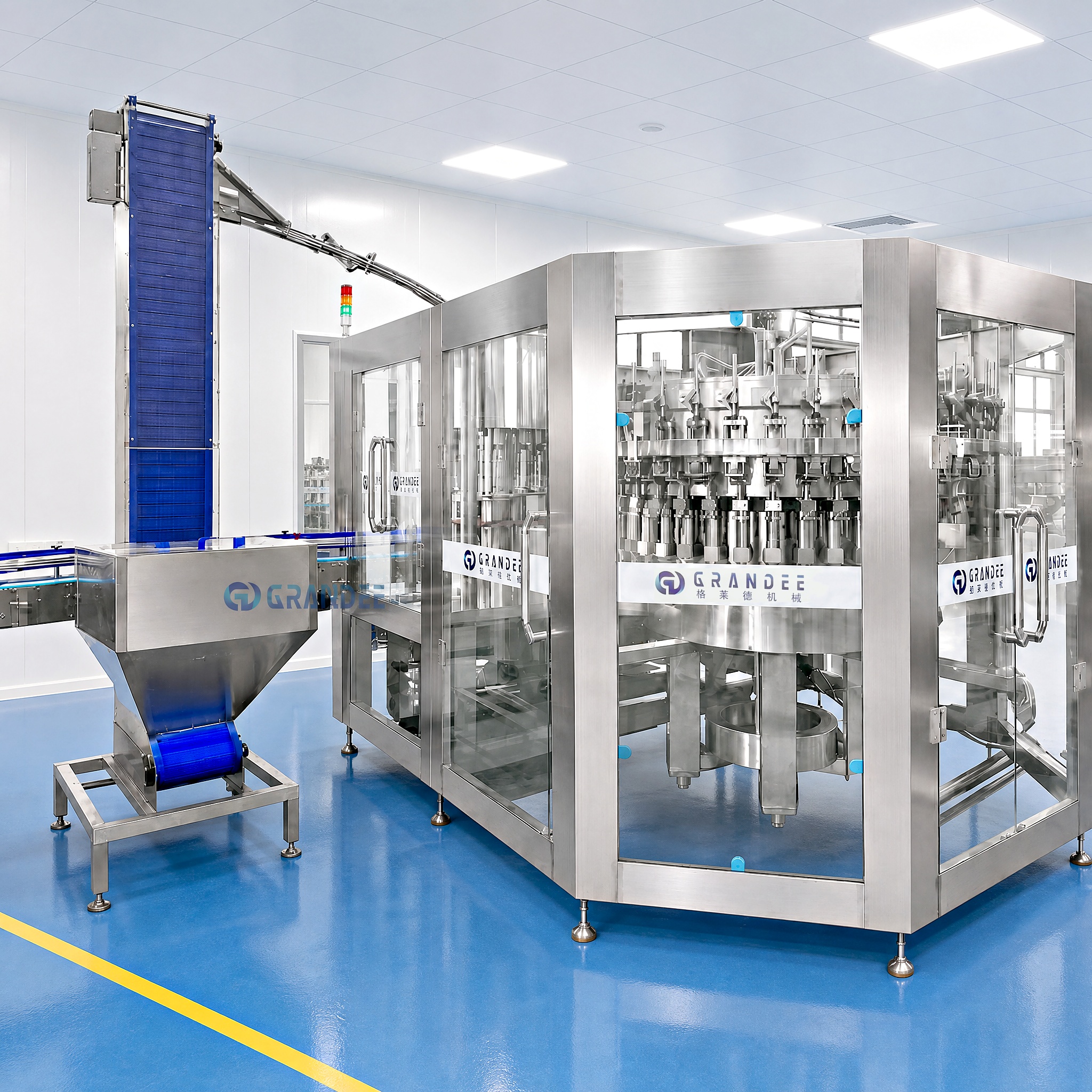
Zhangjiagang Grandee Machinery Co., Ltd., operating under the brand Grandee Machine, addresses these challenges through its 3-in-1 carbonated drink filling machine (isobaric), a rinse-fill-cap system engineered for carbonated soft drinks, sparkling water, and other carbonated beverages. As a filling-machine-focused manufacturer, Grandee Machine designs this equipment to fit within a broader liquid packaging strategy that spans water, juice, carbonated soft drinks, dairy, edible oil, vinegar, soy sauce, and other condiments and daily liquid chemicals.
How Isobaric Filling Technology Solves CO2 Retention Problems
The core of this machine's performance lies in its isobaric filling method, which relies on CO2 counter-pressure to equalize pressure between the bottle and the filling bowl before liquid transfer begins. According to published specifications, filling runs at product temperatures of 2°C to 6°C, with 4°C the most common target, because lower temperatures raise CO2 solubility and suppress foaming. The filling tank operates at 2 to 4 bar (0.2 to 0.4 MPa), with CO2 inlet pressure at 0.28 to 0.35 MPa, and the platform supports carbonation levels from 2.0 to 4.5 volumes of CO2.
CO2 loss during filling is held within 1.5% to 3% of total dissolved CO2. In factory tests at a fill temperature of 4°C and a CO2 concentration of 4.0 g/L, measured loss stayed below 2.2%. That figure matters more for sparkling water than for sweetened soft drinks, because sparkling water has no sugar or flavor to mask a loss of carbonation, and a bottle that has gone flat is immediately noticeable.
The machine is built around three features that support this performance:
- Isobaric filling valves that regulate counter-pressure precisely during the fill cycle
- PLC/HMI control, providing centralized monitoring and adjustment of filling pressure, filling speed, and de-pressurization time
- 316L stainless steel contact parts, supporting hygienic, corrosion-resistant liquid handling
These features work within a rinse-fill-cap structure, so bottle rinsing, filling, and capping happen inside one continuous unit. Fewer transfer points means fewer opportunities for foaming, oxygen pickup, or contamination between stages.
Capacity Range and Material Compatibility
One practical consideration for beverage producers is whether a single machine platform can flex across different production scales and packaging formats. Grandee Machine's isobaric filler is offered in speed tiers from 2,000 BPH up to 48,000 BPH, with common configurations at 2,000–6,000 BPH, 10,000–15,000 BPH, and 20,000–24,000 BPH. Switching between carbonation levels requires parameter adjustment only, with no change parts.
The equipment handles both PET and glass bottles, with a supported range of Φ50–115 mm in diameter and 150–320 mm in height. This dual-material compatibility is notable because carbonated beverage producers often need to serve markets where either packaging format is standard, and moving between filling platforms for different materials is operationally disruptive.
One clarification worth stating plainly: the filling machine itself does not include an integrated carbonation unit. It is designed to receive pre-carbonated beverage from an upstream carbonation system, such as a carbonation tank, inline carbonator, or premix preparation vessel. For most producers this separation works in their favor, since it allows independent maintenance and CIP cleaning for each stage.
Industry Adaptation Across Carbonated Beverage Categories
The platform serves carbonated soft drinks, sparkling water, and carbonated juices, as well as beer where a CO2 pre-purge and a gentle pressure-release profile are applied to minimize oxygen pickup. For sparkling water producers specifically, precision in counter-pressure control is directly tied to product consistency at the bottle level, because in an unsweetened product there is nothing to mask a loss of carbonation.
A Carbonated Filling Line Delivered in Central Asia
Grandee Machine's isobaric filling technology has been put into practice beyond the specification sheet. In Tashkent, Uzbekistan, the company delivered a complete 12,000 BPH carbonated beverage production line as a single integrated scope, covering the carbonated filling machine, water treatment, and labeling equipment. The project reflects a consistent pattern in the company's record: the isobaric filling platform is offered not only as standalone equipment, but also as part of full production line implementations.
From a Single Machine to a Complete Turnkey Line
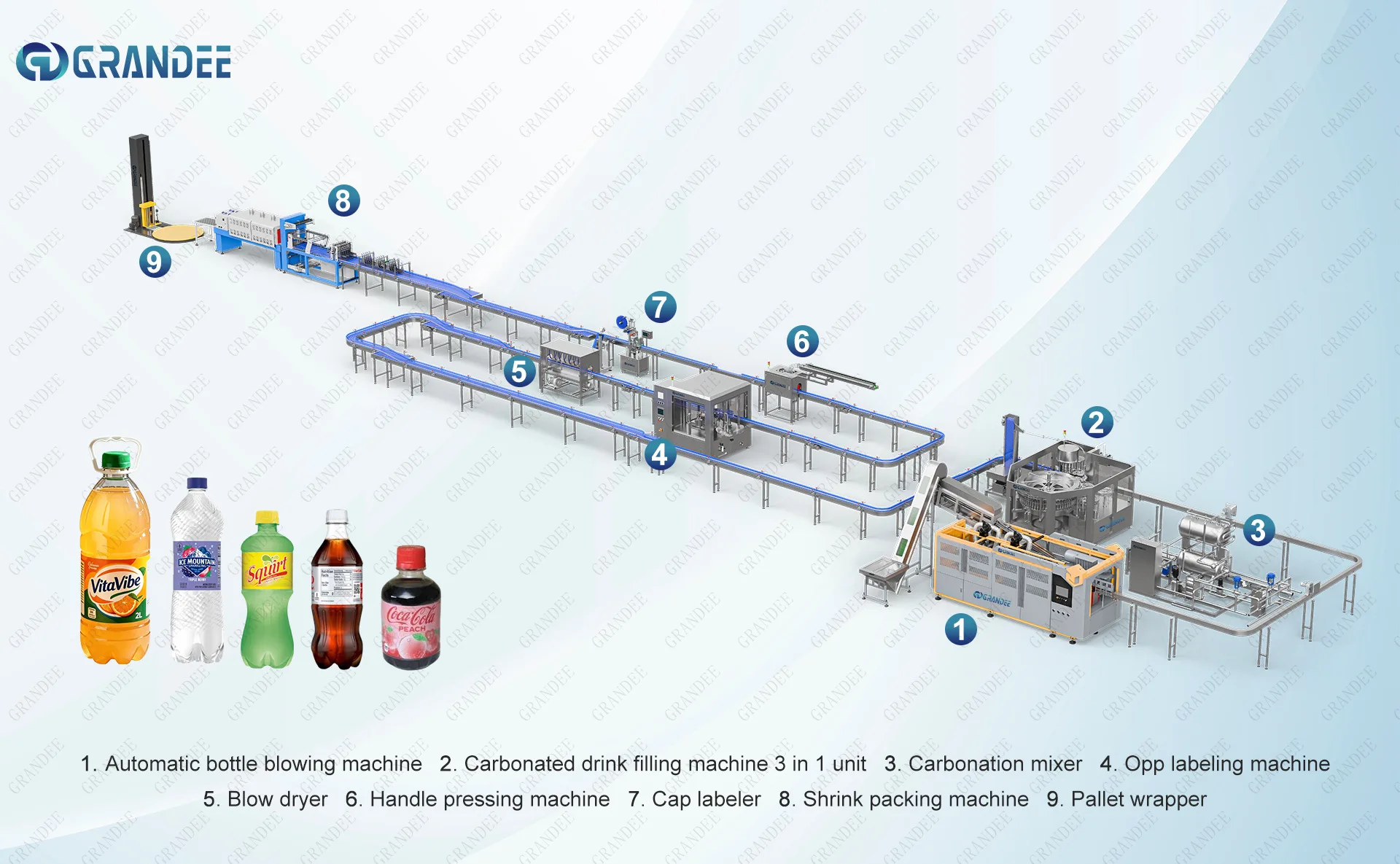
For beverage producers planning new capacity or upgrading existing lines, the isobaric filling machine can be incorporated into a larger carbonated beverage line alongside other equipment in Grandee Machine's product matrix, including packaging-stage machines such as labeling, shrink wrapping, and carton packing equipment.
Every EPC scope from Grandee Machine includes automatic CIP (Clean-In-Place) systems as a standard line capability, which reduces manual cleaning labor and downtime across filling and packaging equipment. This is a relevant consideration for carbonated beverage producers who must hold strict hygiene standards between production runs.
A turnkey EPC engagement covers the complete liquid packaging plant lifecycle under one contract: bottle design, factory layout, paperless 3D factory design, installation, commissioning, and operator training. Producers work with one accountable partner from process design through the finished, packed product, rather than coordinating multiple equipment vendors separately.
Manufacturing Standards and Company Background
Zhangjiagang Grandee Machinery Co., Ltd. brings more than 20 years of export experience and operates a standardized production facility exceeding 20,000 m² in Zhangjiagang, Jiangsu, China. The company holds CE and CQC certifications, and its global business coverage spans Europe, South America, Africa, Southeast Asia, and Central Asia.
Across its filling equipment platform, Grandee Machine applies consistent technology standards, including PLC/HMI touch-screen control and ISO Class 6 cleanroom compliance. The use of 316L stainless steel for liquid contact parts is likewise a recurring specification across the company's filling equipment line, supporting corrosion resistance for a range of liquid types.
Why This Matters for Carbonated and Sparkling Water Producers
For companies evaluating a carbonated drink isobaric filling machine for sparkling water production, the combination documented here is specific enough to verify: counter-pressure control with CO2 loss held below 2.2% in factory tests, dual PET and glass compatibility across a Φ50–115 mm bottle range, speed tiers from 2,000 to 48,000 BPH, 316L stainless steel construction, and the option to scale from a standalone machine into a full turnkey EPC line. Backed by more than 20 years of export history, certified quality standards, and a completed carbonated beverage line in Central Asia, the isobaric filling machine stands as a practical option for producers working to reduce foaming losses and hold CO2 stability at commercial filling speeds.
To discuss your filling requirements, contact the Grandee Machine team at info@grandeemachine.com
https://www.grandeemachine.com/
Zhangjiagang Grandee Machinery Co., Ltd.

+ There are no comments
Add yours