



For beverage producers operating automated bottling plants, the secondary packaging section sits at a critical junction between bottle filling operations and finished-goods logistics. Among the technical decisions that shape long-term line efficiency, one of the most consequential is the case closure method: hot melt adhesive gluing versus pressure-sensitive tape sealing. Each approach carries distinct mechanical implications for line speed compatibility, joint integrity under humidity, operational overhead, and stability in downstream automated palletizing.
Zhangjiagang Grandee Machinery Co., Ltd., manufacturing under the brand name Grandee Machine, engineers complete liquid bottling plants across capacities from 2,000 to 36,000 BPH. In production line integration, secondary case packing is not an isolated station; it dictates whether high-speed upstream filling monoblocks can sustain continuous output without back-pressure jams.
This engineering guide compares hot melt glue and tape sealing across mechanical operating principles, speed limits, environmental resilience in transit, and total line integration requirements.
How Hot Melt Glue Sealing Operates in High-Speed Lines
Hot melt glue sealing applies a thermoplastic adhesive at elevated temperatures (typically 150°C to 170°C) directly onto the corrugated flaps of a wrap-around carton blank or erected case. As the adhesive cools and compresses under pneumatic or mechanical flight lugs, it cures within 1.5 to 2.0 seconds, penetrating the board fibers to form a rigid structural bond.
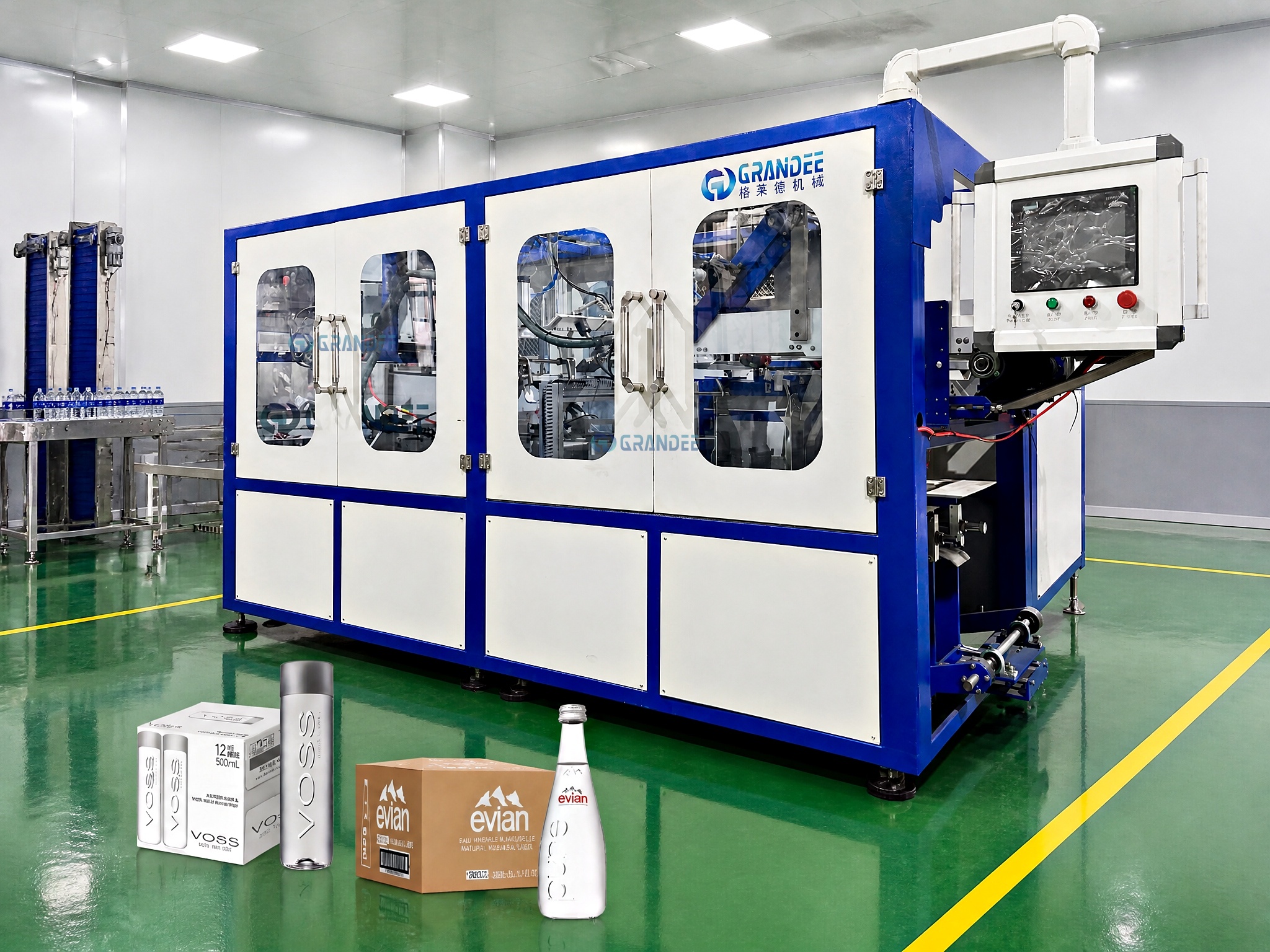
In one-piece wrap-around casers (such as Grandee Machine's GD-GB series, rated from 16 to 45 packs/min), flat corrugated blanks wrap tightly around grouped bottle matrices (e.g., 2×3, 3×4, or 4×6). Hot melt glue application guns inject precise adhesive beads onto side and top flaps before high-speed folding ploughs compress the case. This mechanical sequence produces a compact, tightly wrapped carton with exact right angles and zero internal void space.
Key technical characteristics of hot melt case sealing include:
- Sub-Two-Second Solidification: Solidification times of 1.5–2 seconds allow immediate case discharge onto accumulation conveyors without clamp dwell time, sustaining continuous high-speed flow.
- Fiber-Tear Joint Integrity: The adhesive fuses with the paper fibers. Opening the carton requires tearing the corrugated structure, providing inherent tamper evidence.
- High Dimensional Regularity: Tight mechanical folding creates uniform box footprints, preventing case bulging that could jam downstream palletizing grippers.
How Pressure-Sensitive Tape Sealing Operates
Tape sealing relies on pressure-sensitive adhesive tape—typically biaxially oriented polypropylene (BOPP)—applied across the center seam of top and bottom flaps on pre-glued, erected American standard cases (RSC / slotted cartons). The tape bonds through contact pressure exerted by spring-loaded wiping rollers, requiring no heating elements or adhesive melting pots.
In low-speed packaging environments, tape sealers provide a mechanically simple closure solution with minimal initial machinery complexity. Tape roll changes are straightforward, requiring no temperature regulation or glue nozzle cleaning protocols. However, because adhesion depends entirely on surface tackiness rather than fiber penetration, tape seals are sensitive to dust, corrugated board porosity, and application pressure variations.
Engineering Comparison: Hot Melt Glue vs. Tape Sealing
The table below summarizes the operational differences between hot melt glue and tape sealing in automated beverage line environments:
| Operational Metric | Hot Melt Glue Sealing | Pressure-Sensitive Tape Sealing |
|---|---|---|
| Throughput & Speed Limits | Continuous operation up to 45 packs/min on wrap-around casers; easily matches 12,000–36,000 BPH upstream lines. | Typically restricted to 15–20 cases/min; higher speeds cause tape stretching, misalignment, or tab snapping. |
| Closure Integrity & Strength | Rigid structural bond; withstands high vertical compressive loads during multi-tier pallet stacking. | Flexible tape seam; prone to flap deflection and carton sagging under heavy bottle loads. |
| Humidity & Cold-Chain Resistance | Unaffected by moisture once solidified; highly stable in chilled juice/dairy cold chains and tropical maritime shipping. | Adhesive degrades under condensation and high humidity; tape edges peel during container transit. |
| Consumable Replenishment Window | Bulk solid adhesive pellets added to heated tank during active operation; zero line stoppage required. | Requires frequent tape roll changeover every few thousand linear meters; introduces line micro-stops unless dual tape heads are installed. |
| Case Blank Material Efficiency | Uses flat corrugated die-cut blanks; lower raw material consumption per case compared to pre-glued RSC boxes. | Requires pre-glued slotted cartons (RSC); involves additional pre-gluing processing steps from box converters. |
| Retail Appearance & Tampering | Clean, flush exterior suitable for retail-ready packaging (RRP); tamper-evident via visible board fiber tearing. | Visible tape strip over graphics; tape can be slit and re-taped without immediate visual detection. |
Why Beverage Distribution Environments Favor Hot Melt Glue
For bottled water, carbonated soft drinks, juice, and condiments, container handling presents unique distribution challenges that expose the mechanical limitations of tape sealing:
- Pallet Stacking Compressive Strength: Glass bottles and filled PET containers generate substantial vertical mass. In wrap-around hot melt cases, the tight exterior wrap transfers compressive loads directly through the bottle walls rather than allowing cartons to deform. Tape-sealed RSC boxes carry clearances between flaps that allow top deflection, increasing the risk of carton crushing on lower pallet tiers.
- Condensation and Temperature Cycling: Beverages filled at cold temperatures (such as carbonated drinks at 2–6°C) or warm pasteurized liquids (juice at 85–88°C) create ambient condensation in packaging zones. Moisture causes BOPP tape adhesive to lose tack, leading to loose tape tails that catch on conveyor side guides. Hot melt adhesive solidifies into a water-resistant polymer barrier unaffected by moisture.
- Downstream Palletizer Interface: Automated mechanical or vacuum-head palletizers require exact, repeatable carton geometry. Hot melt wrap-around cases maintain consistent length, width, and height tolerances (±1.5 mm). In contrast, tape-sealed cases often exhibit flap crowning, leading to vacuum cup seal leaks or misalignment on palletizer roller tables.
Throughput Math: Converting Packs per Minute to Bottling Line Speed
A frequent integration mistake in secondary packaging selection is evaluating caser speed without calculating the product pack configuration. A carton packing machine rated in packs per minute (packs/min) converts to upstream bottles per hour (BPH) through the following relationship:
Consider Grandee Machine's GD-XB25 and GD-GB series under standard beverage bottling configurations:
- 2×3 Configuration (6 bottles/case): At 25 packs/min, the caser consumes 25 × 6 × 60 = 9,000 BPH.
- 3×4 Configuration (12 bottles/case): At 25 packs/min, the caser consumes 25 × 12 × 60 = 18,000 BPH.
- 4×6 Configuration (24 bottles/case): At 25 packs/min, the caser consumes 25 × 24 × 60 = 36,000 BPH.
At high line outputs (18,000–36,000 BPH), running 24-bottle cases through an intermittent tape sealer would require multiple parallel packing lines and complex dividing conveyors. A single wrap-around hot melt caser handles the complete line capacity within a unified 17 to 24 m² footprint.
Grandee Machine's Integrated Secondary Packaging Solutions
Zhangjiagang Grandee Machinery Co., Ltd. incorporates industrial carton packing machinery as an integral component of its complete liquid packaging lines under the Grandee Machine brand. The company supplies two primary caser configurations tailored to project throughput:
- One-Piece Wrap-Around Casers (GD-GB Series): Engineered for high-speed continuous packaging from 16 to 45 packs/min. Models GD-GB20, GD-GB25, GD-GB35, and GD-GB45 wrap die-cut flat blanks around PET and glass bottles (height 110–340 mm, diameter 50–180 mm) using fast-curing hot-melt systems.
- Intermittent Carton Packing Units (GD-XB25): Rated at 25 boxes/min for multi-format production across tin cans, PET bottles, and glass containers, featuring servo-driven blank infeed and adjustable 2×3, 3×4, or 4×6 collating stations.
Grandee Machine delivers secondary packaging equipment within turnkey project contracts that coordinate bottle blowing, rotary rinsing-filling-capping, labeling, secondary shrink wrapping, case packing, and end-of-line palletizing. Under this delivery model, Grandee Machine supplies full mechanical drawings, conveyor speed synchronization tables, and electrical interface schematics.
To eliminate contractual ambiguity, project scopes are defined strictly: Civil works, building construction, floor trench drainage excavation, civil cleanroom paneling, and primary plant utility connections (main electrical substation transformers, municipal water intake piping, compressed air plant headers, and external boiler steam piping) are excluded from the turnkey project scope.
Frequently Asked Questions
A: Yes. Wrap-around casers such as Grandee Machine's GD-GB series handle both PET and glass bottles within standard height (110–340 mm) and diameter (50–180 mm) envelopes. The servo-controlled grouping lanes gently collate glass bottles without impact chipping, while hot melt compression belts secure the carton tightly around the bottle cluster.
A: Hot melt wrap-around casers require an operating air pressure of 0.6 to 0.8 MPa. Air consumption varies by model throughput, ranging from 600 NL/min on compact units (GD-GB35) to 1,000 L/min on standard models (GD-GB20/25), powering pneumatic case erectors, glue gun actuators, and flap folding cylinders.
A: Wrap-around casers use flat corrugated blanks that reduce warehouse storage volume by up to 30% compared to pre-glued RSC boxes. Mechanically, forming the case directly around the bottle cluster creates a tight, structural wrap with zero internal bottle shifting during high-speed transit.
A: Routine maintenance involves daily visual checks of nozzle tips and filtration screens, weekly checks of tank filters, and periodic flushing of the adhesive reservoir every 2,000 to 3,000 operational hours. Premium adhesive formulations with thermal stabilizers minimize char formation, preventing nozzle clogging.
A: Automated carton packers feature variable-speed infeed conveyors and photoelectric sensor buffers that monitor bottle line pressure. If upstream filling pauses, the caser automatically decelerates or pauses blank feeding without purging glue, resuming full-speed operation instantly once bottle backlog is restored.
About Grandee Machine
Zhangjiagang Grandee Machinery Co., Ltd. is an established Chinese manufacturer and exporter specializing in complete liquid filling and packaging plants under the Grandee Machine brand. Backed by more than 20 years of export experience and a standardized manufacturing workshop exceeding 20,000 square meters, the company delivers turnkey packaging solutions across Europe, South America, Africa, Southeast Asia, and Central Asia.
Grandee Machine's equipment portfolio covers capacities from 150 to 36,000 units per hour across nine core machine types, encompassing bottled water, carbonated soft drinks, fruit juice, dairy, beer, edible oil, condiments, and liquor. Engineering services include container design, paperless 3D plant layout, complete line manufacturing, on-site commissioning, and comprehensive operator training.
Next Step
To evaluate secondary case packing equipment for your bottling line, prepare your primary production parameters:
- Container specifications: Bottle material (PET, glass, can), container dimensions (height and diameter), and filled volume.
- Target line output in bottles per hour (BPH) and desired pack pattern (2×3, 3×4, or 4×6).
- Carton style preference: Flat die-cut wrap-around blank or pre-glued RSC carton.
- Downstream automation scope: Manual palletizing, high-level mechanical palletizer, or robotic palletizing cell.
Submit your packaging parameters to Grandee Machine's engineering team to receive detailed equipment layout drawings, carton blank sizing specifications, and integrated line coordination schedules.
Related Reading
https://www.grandeemachine.com/
Zhangjiagang Grandee Machinery Co., Ltd.


+ There are no comments
Add yours