

For beverage, dairy, and condiment producers planning or upgrading a packaging plant, one question recurs often: where exactly does a carton packing machine sit within a complete filling line, and what role does it play once bottles, cans, or boxes leave the filler? Understanding this placement is essential for anyone evaluating a turnkey liquid packaging project, and it is an area where Zhangjiagang Grandee Machinery Co., Ltd., operating under the brand Grandee Machine, brings direct engineering experience as a filling-machine-focused manufacturer.
The End-of-Line Position in a Filling System
A carton packing machine is not a standalone device sitting in isolation — it occupies a specific position at the end-of-line stage of a liquid packaging system. In a typical sequence, product first passes through the filling and capping stage, where liquids such as water, juice, carbonated soft drinks, dairy, edible oil, or condiments like vinegar and soy sauce are dosed and sealed into their containers. From there, containers move to labeling, where shrink sleeve, self-adhesive, or OPP hot-melt labeling machines apply branding and product information. Only after labeling — and in many configurations, after shrink wrap packing — do containers reach the carton packing stage, where they are grouped, boxed, or cased for transport and distribution.
This positioning matters because it reflects the logical flow of a packaging line: product integrity is established first (filling and sealing), product identity is applied second (labeling), and physical protection and transport readiness are addressed last (carton packing, and where applicable, palletizing). A carton packing machine, in Grandee Machine's product line, is described as a carton packing machine (wrap-around caser / erector-packer-sealer) — equipment that performs hot-melt wrap-around case packing or full erector-packer-sealer functions for bottles, cans, and boxes.
Why This Position Matters for Production Efficiency
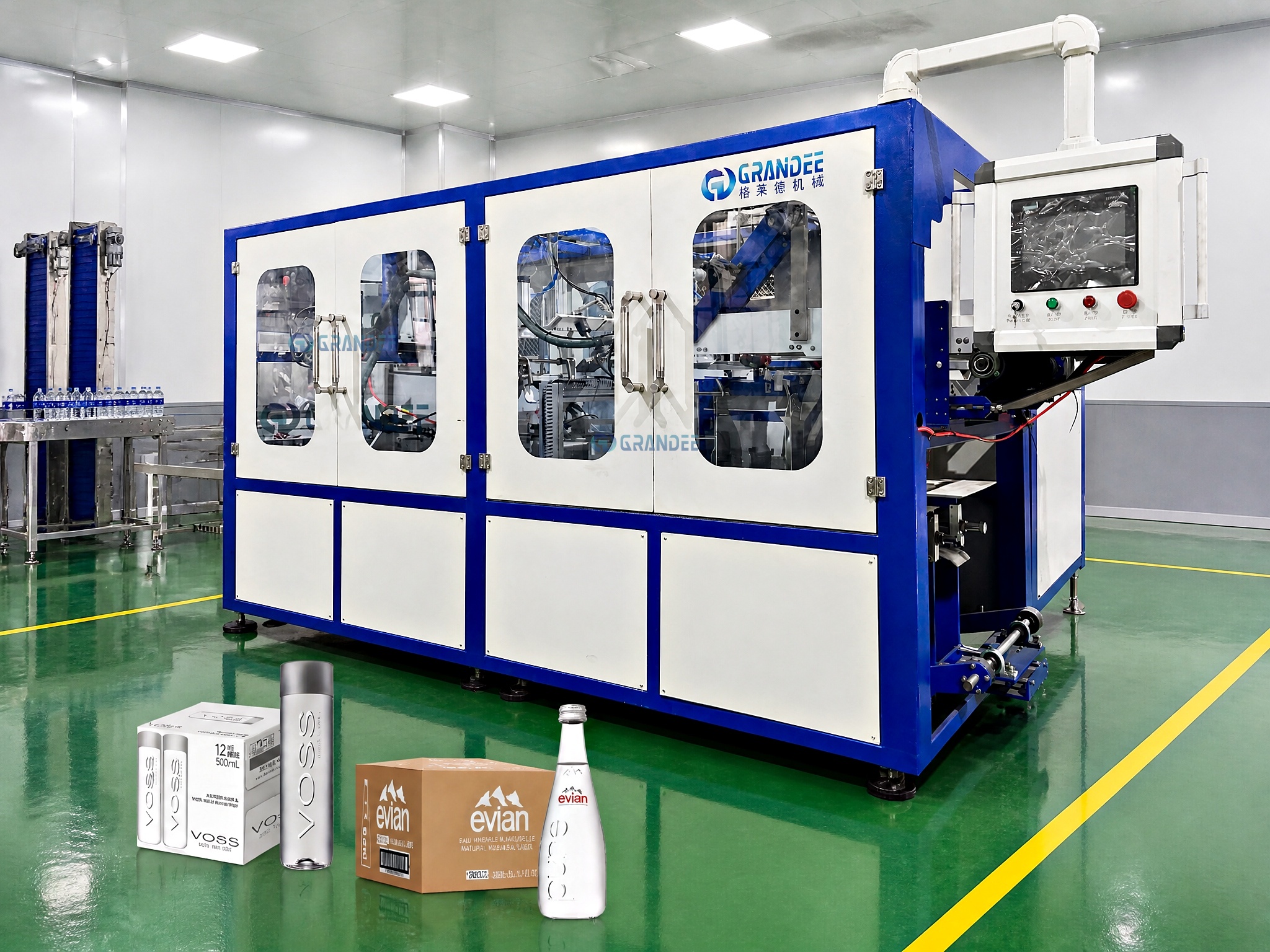
Placing the case packer at the tail end of the line is not arbitrary. Doing so allows the carton packer to interface directly with upstream shrink wrapping and downstream palletizing equipment, forming a continuous, synchronized flow rather than a series of disconnected manual steps. According to Grandee Machine's product documentation, the carton packing machine's key features include erection, packing, and sealing functions combined into a single machine, supported by hot-melt glue systems, and designed to interface with shrink wrapping and palletizing stages.
This integration addresses two target scenario pain points commonly seen in manual or poorly sequenced lines: high labor intensity in manual case packing, and high breakage rates that result from manual handling of filled containers. By positioning the carton packer immediately after labeling and shrink wrapping, and by using stable wrap-around case forming with hot-melt gluing, the equipment is built to support continuous high-speed operation rather than intermittent, labor-dependent packing.
Industry Adaptation Across Multiple Liquid Categories
Because the carton packing machine sits at the end of the line rather than being tied to a specific liquid type, it adapts across several industries served by Grandee Machine's broader filling portfolio, including water, beverages, dairy, and condiments. This flexibility is important for plant operators who may run multiple product lines — for example, a facility filling both bottled water and dairy products — since the same end-of-line logic for case packing position can apply across different upstream filling configurations, whether those are 3-in-1 water filling machines, aseptic cold filling lines for juice and dairy, or vinegar and condiment filling equipment built with corrosion-resistant 316L stainless steel wetted parts.
How Carton Packing Fits Into a Turnkey EPC Line
For buyers evaluating a complete plant rather than a single machine, the positioning question extends beyond the carton packer itself. Grandee Machine's turnkey EPC lines aggregate machine entries across the filling and packaging categories — water lines, carbonated beverage lines, juice lines, dairy lines, and edible oil or condiment lines — each referencing the relevant filling and packaging equipment entries, including labeling, shrink wrapping, and carton packing. In this model, the carton packing machine is one component within a single accountable EPC scope that also covers bottle design, factory layout, paperless 3D factory design, installation, and operator training.
This one-contract structure is central to the company's value proposition: rather than coordinating separate vendors for filling, labeling, shrink wrapping, and carton packing, a plant operator works with one turnkey EPC partner across the entire sequence. Every EPC scope also includes automatic CIP (Clean-In-Place) systems as a standard line capability, which reduces manual cleaning labor and downtime across the filling and packaging stages that precede the carton packing position.
Capacity and Technical Considerations
While the carton packing machine entry itself lists capacity as "per model," its position in the line is informed by the throughput of upstream equipment. Grandee Machine's filling machines span production capacities from 150 to 36,000 units per hour across nine machine types, meaning the carton packer downstream must be matched to whichever filling configuration — from big-bottle water filling at 500–4,000 BPH to rotary blow-fill-cap systems at 12,000–36,000 BPH — feeds into it. This is one reason end-of-line equipment is typically specified as part of a complete line design rather than procured independently.
Why Positioning Knowledge Matters for Buyers
For procurement teams and operational engineers researching packaging line design, understanding where a carton packing machine sits — after filling, after labeling, after (or alongside) shrink wrapping, and before palletizing — helps clarify what to expect from equipment specifications and how to sequence a plant layout. Grandee Machine's more than 20 years of export experience and standardized production workshop exceeding 20,000 square meters support its positioning as a manufacturer capable of supplying and integrating this full sequence, from water treatment and bottle blowing through filling, capping, labeling, shrink wrapping, carton packing, and robotic palletizing, under one turnkey EPC package.
In summary, the carton packing machine's role is defined by its place at the end of the liquid packaging line: it receives containers that have already been filled, sealed, and labeled, and it prepares them — through wrap-around case forming or erector-packer-sealer functions — for the next stage of distribution. For operators comparing equipment or planning a new facility, recognizing this sequence is a practical first step toward specifying a line that functions as an integrated whole rather than a collection of separate machines.
https://www.grandeemachine.com/
Zhangjiagang Grandee Machinery Co., Ltd.

+ There are no comments
Add yours