


Accurate flow measurement of chemical liquids represents one of the most critical challenges in modern industrial operations. From corrosive acids in semiconductor manufacturing to viscous slurries in mining operations, the ability to precisely monitor and control fluid movement directly impacts product quality, operational safety, and environmental compliance. As chemical processing facilities face increasing pressure to optimize resource utilization while maintaining stringent safety standards, the role of advanced electromagnetic flow measurement technology has never been more vital.
Understanding the Unique Challenges of Chemical Liquid Measurement
Chemical liquid flow measurement differs fundamentally from standard water or petroleum applications due to several compounding factors. Many chemical processes involve conductive liquids with varying viscosity, temperature extremes, and suspended solids that can interfere with sensor accuracy. Traditional mechanical flow meters often fail in these environments due to moving parts that corrode or clog, while ultrasonic systems struggle with liquids containing high solid content or air bubbles.
The core challenge lies in maintaining signal stability amid electrical noise from industrial equipment, chemical reactions that alter fluid properties mid-process, and physical wear from abrasive particles. Additionally, many chemical facilities operate in remote locations or hazardous zones where running power lines proves costly or impractical, creating the need for power-independent measurement solutions.
Process engineers also face the complexity of integrating field measurement data with centralized control systems. Without real-time visibility into flow rates across multiple process nodes, operators cannot quickly identify leaks, detect batch inconsistencies, or optimize chemical dosing—each of which carries significant cost and safety implications.
Electromagnetic Flow Measurement: The Foundation of Chemical Process Control
Electromagnetic flowmeters have emerged as the preferred solution for chemical liquid measurement because they contain no moving parts, create no pressure drop, and work effectively with conductive fluids regardless of viscosity or density. The operating principle—based on Faraday's Law of electromagnetic induction—means the meter measures velocity by detecting the voltage generated when conductive liquid moves through a magnetic field.
For chemical applications, the critical factors are measurement accuracy, material compatibility, and signal processing capability. Advanced electromagnetic flowmeters now achieve accuracy levels of ±0.2% through the use of square wave pulse excitation technology, which provides superior zero-point stability compared to traditional sinusoidal excitation. This matters enormously in chemical batch processes where even small measurement errors compound into significant material waste or off-specification products.
The selection of electrode and lining materials becomes paramount when handling corrosive or abrasive chemicals. Modern systems offer specialized configurations: platinum or tantalum electrodes for highly corrosive acids, polyurethane or ceramic linings for abrasive slurries, and PFA (perfluoroalkoxy) construction for extreme chemical resistance. This material flexibility allows a single meter design to adapt across diverse chemical applications from pharmaceutical synthesis to mineral processing.
Advanced Signal Processing for Harsh Chemical Environments
Chemical processing environments generate substantial electrical interference from pumps, mixers, and heating elements. To maintain measurement integrity, sophisticated electromagnetic flowmeters employ high-input-impedance amplification combined with Voltage-to-Frequency Conversion (VFC) technology. This approach converts the induced electromotive force into frequency signals that resist degradation during long-distance transmission through electrically noisy facilities.
For slurry applications—where solid particles create signal spikes as they contact electrodes—specialized variation restraint algorithms filter out "cuspidal disturb" without losing genuine flow signal. This capability proves essential in mining operations measuring coal-water slurry or in chemical plants handling catalyst suspensions, where conventional meters would report wildly fluctuating readings.
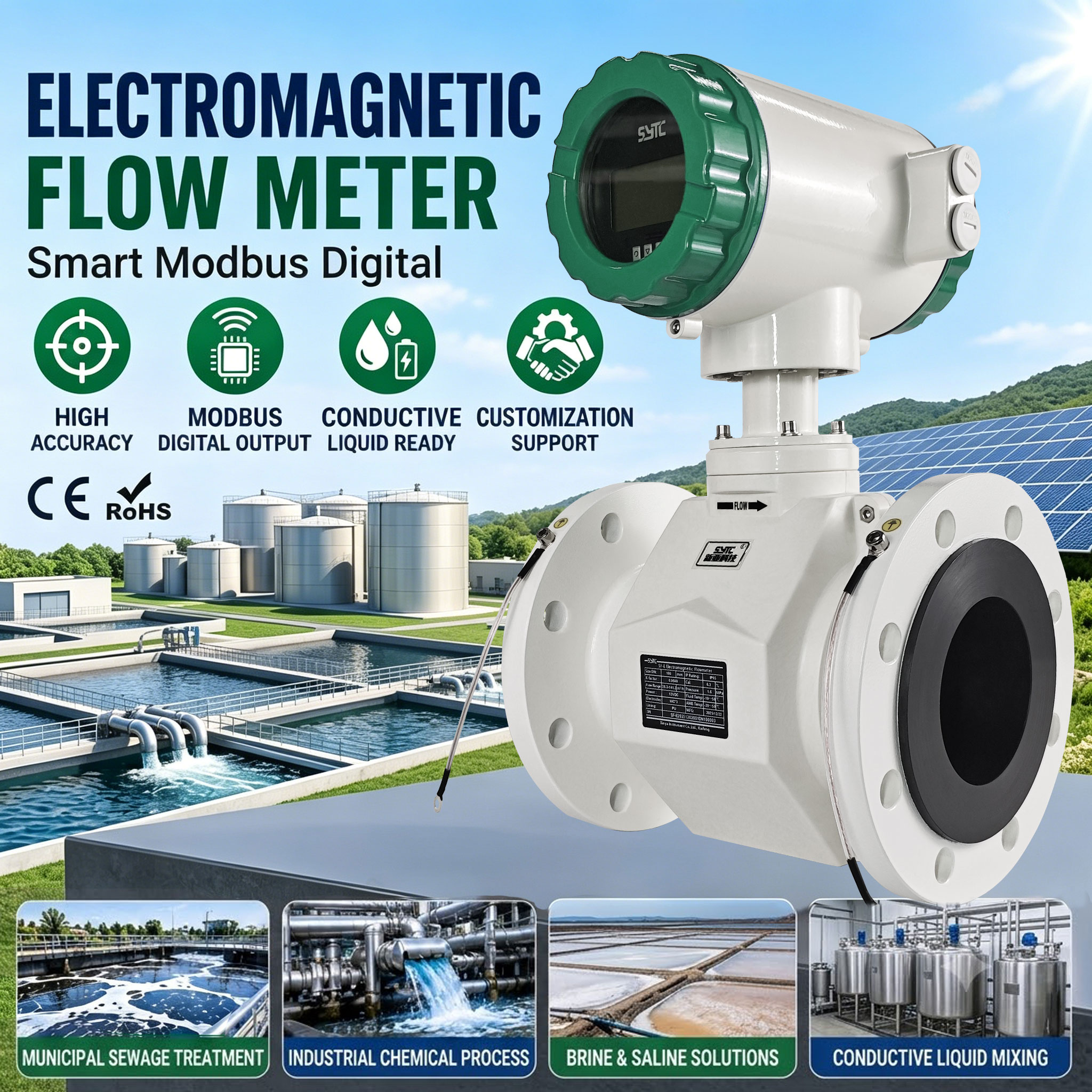
Kaifeng XinYa Instrument Co., Ltd. has developed electromagnetic flowmeter systems specifically engineered for these demanding chemical applications. Their SF-E Electromagnetic Flowmeter series incorporates bidirectional constant current drive systems that maintain excitation stability across power fluctuations common in industrial settings. With support for pipe diameters from DN15 to DN3000 and multiple accuracy classes (±0.5%, ±0.3%, ±0.2%), these systems adapt to applications ranging from laboratory chemical dosing to bulk transfer pipelines.
Power Independence for Remote Chemical Operations
Many chemical processing facilities operate measurement points in areas lacking electrical infrastructure—remote wellhead injection sites, tank farms, or wastewater treatment lagoons. Battery-powered electromagnetic flowmeters address this challenge through ultra-low-power electronics that enable years of operation on internal batteries. Sleep mode functionality automatically shuts down displays between readings while maintaining measurement continuity, maximizing battery lifespan without sacrificing data integrity.
These battery-powered units achieve IP68 ingress protection ratings, allowing installation in flooded pits, buried vaults, or outdoor environments exposed to weather extremes. The combination of power independence and environmental resilience eliminates the capital cost of trenching power lines and reduces ongoing maintenance requirements—particularly valuable for monitoring secondary containment systems or emergency relief flows where measurement points may number in the dozens.
Kaifeng XinYa's Battery-Powered Electromagnetic Flowmeter incorporates internal data retention for 120 months of cumulative flow records, ensuring no loss of historical data during communication interruptions or battery replacement procedures. Integrated GPRS and RS485 communication modules enable remote data transmission to centralized monitoring systems, providing visibility into geographically dispersed chemical operations.
Integration with Industrial IoT for Process Optimization
The true value of advanced flow measurement emerges when field data integrates seamlessly with enterprise systems. Modern chemical facilities require not just instantaneous flow rates but trend analysis, predictive maintenance alerts, and correlation with other process variables. This demands flowmeters that function as intelligent field devices rather than simple sensors.
Electromagnetic flowmeters with multi-protocol communication support—RS485, RS232, HART, GPRS, Bluetooth, and WiFi—enable flexible integration with existing supervisory control and data acquisition (SCADA) systems, programmable logic controllers (PLC), and distributed control systems (DCS). Simultaneous output of 4-20mA analog signals, pulse counts, and frequency signals ensures compatibility with legacy equipment while supporting migration to digital architectures.
Cloud connectivity represents the next evolution in chemical process monitoring. By transmitting flow data to centralized IoT platforms, operators gain real-time visibility across multiple facilities, compare batch performance, and identify systematic inefficiencies. Kaifeng XinYa's Instrument IoT Big Data Platform provides web-based management with 60-point historical curve tracking and a 5-second default data refresh rate, enabling process engineers to quickly correlate flow anomalies with upstream process changes or equipment degradation.
Specialized Solutions for High-Abrasion Chemical Slurries
Chemical processes involving suspended solids—such as mineral slurries, catalyst recovery, or precipitate handling—impose severe wear on measurement equipment. Standard electromagnetic flowmeters may experience accelerated electrode erosion or lining failure, leading to measurement drift and costly unplanned maintenance.
Purpose-designed slurry flowmeters address these challenges through reinforced construction and adaptive signal processing. Wear-resistant lining materials such as polyurethane extend service life in high-abrasion applications, while ceramic linings (available for DN15-150 pipe sizes) provide exceptional resistance to both chemical attack and physical wear. The inclusion of dedicated grounding electrodes eliminates interference in non-conductive or lined piping systems, ensuring stable measurement even as fluid conductivity varies.
Kaifeng XinYa's Slurry Electromagnetic Flowmeter implements specialized variation restraint arithmetic that distinguishes between genuine flow changes and transient signal spikes caused by solid particle impacts. This enables stable measurement in coal-water slurry pipelines, tailings transport systems, and chemical precipitation processes where conventional meters would require frequent recalibration or replacement.
Ensuring Measurement Integrity Through Self-Diagnosis
In chemical processing, measurement failures can cascade into safety incidents or environmental releases. Advanced electromagnetic flowmeters incorporate comprehensive self-diagnostic capabilities that continuously monitor system health and alert operators to developing problems before they impact process control.
Automated diagnostics detect empty pipe conditions, excitation circuit failures, electrode fouling, and signal cable breaks. Multi-level password protection with six security grades prevents unauthorized parameter changes while allowing calibrated technicians to perform necessary adjustments. This combination of proactive monitoring and access control maintains measurement integrity throughout the meter's operational life.
The ability to replace circuit boards without field recalibration—because calibration resides in factory-programmed modules—dramatically reduces maintenance downtime. For chemical facilities operating continuous processes, this can mean the difference between a brief maintenance window and an extended production outage.
Material Selection for Chemical Compatibility
No single flowmeter configuration suits all chemical applications. Electrode materials must resist the specific chemicals being measured: stainless steel for mild aqueous solutions, Hastelloy for oxidizing acids, platinum for strong bases, and tantalum for hydrofluoric acid. Similarly, lining materials require careful selection: PTFE for universal chemical resistance, rubber compounds for abrasion resistance with moderate chemicals, and PFA for the highest purity pharmaceutical applications.
Understanding these material interactions requires deep application knowledge. Reputable manufacturers provide detailed chemical compatibility charts and application engineering support to ensure proper meter specification. The consequence of improper material selection extends beyond premature failure—it can include contamination of high-purity chemical streams or catastrophic leaks of hazardous materials.
Installation Flexibility for Retrofit and New Construction
Chemical facilities evolve continuously through capacity expansions, process modifications, and equipment upgrades. Flow measurement systems must accommodate both new construction and retrofit installations without requiring extensive piping modifications or process shutdowns.
Electromagnetic flowmeters are available in integral configurations (sensor and electronics combined) for space-constrained installations and split configurations (remote-mount electronics) for high-temperature or hazardous area applications. For extremely large pipelines where full-bore meters become cost-prohibitive, insertion-style electromagnetic flowmeters provide accurate measurement at a fraction of the cost.
Kaifeng XinYa's SF-C Insertion Electromagnetic Flowmeter installs through a ball valve mounting base, allowing insertion into pressurized pipelines without process interruption. With adjustable insertion depth settings for half or quarter-pipe diameter positioning, these meters optimize measurement across varying flow profiles while maintaining stainless steel construction for structural integrity under high pressure.
Compliance with International Standards and Regulations
Chemical industry flow measurement must satisfy multiple regulatory frameworks depending on application. Custody transfer requires meters meeting specific accuracy standards and verification protocols. Environmental discharge monitoring demands equipment certified for emissions reporting. Pharmaceutical and food-grade chemical production requires hygienic design preventing bacterial growth.
Leading electromagnetic flowmeter manufacturers design products to comply with relevant international standards: JB/T 9248-2015 for electromagnetic flowmeter specifications, GB/T 9124.1-2019 for flange connections, and MODBUS-RTU protocol standards for interoperability. Ingress protection ratings (IP65/IP66/IP67 for converters, IP68 for sensors) ensure equipment survives the washing and weather exposure common in chemical facilities.
For food-grade chemical applications such as ingredient processing or beverage production, specialized sanitary flowmeters eliminate crevices where bacteria could colonize. Kaifeng XinYa's SF-W Food Safety Electromagnetic Flowmeter employs materials and construction techniques that comply with food safety standards, preventing fluid stagnation and enabling clean-in-place procedures.
The Path Forward: Smarter Chemical Flow Measurement
As chemical manufacturing intensifies focus on operational efficiency and sustainability, flow measurement systems will evolve from passive sensors to active participants in process optimization. Predictive analytics will anticipate equipment degradation before failure occurs. Machine learning algorithms will detect subtle flow pattern changes indicating process drift or contamination. Digital twin integration will enable virtual commissioning and what-if scenario testing.
The foundation for these advanced capabilities rests on robust, accurate field instrumentation that reliably captures process data under harsh conditions. Electromagnetic flowmeters engineered specifically for chemical service—with appropriate materials, sophisticated signal processing, and flexible connectivity—provide the measurement integrity required for both current operations and future digital transformation initiatives.
For chemical processors seeking to enhance safety, improve yield, and reduce waste, investing in purpose-designed electromagnetic flow measurement technology represents not merely an equipment upgrade but a strategic enabler of operational excellence.
https://www.sytcflowmeter.com/
Kaifeng Xinya Instrument Co., Ltd.


+ There are no comments
Add yours