

Write an English product introduction targeting the US market
A380 aluminum alloy ranks as the top die-casting material for custom pulleys in US manufacturing. It balances strength, weight, precision, and cost. Die casting creates near-net-shape pulleys with tight tolerances. US manufacturers depend on custom A380 pulleys for automotive and industrial applications. Domestic die casters shorten lead times and improve collaboration.
Send us your CAD drawings to get your custom quotation. We provide die casting, CNC machining and sheet metal fabrication services.
Key Takeaways
- A380 aluminum alloy offers high strength and light weight for custom pulleys.
- Die casting creates precise pulley shapes with minimal machining.
- US manufacturers should partner with experienced die casters for optimal results.
Why A380 Aluminum Alloy for Custom Pulleys
What Is A380 Aluminum Alloy
A380 aluminum alloy belongs to the aluminum-silicon-copper family. North American die casters specify it more than any other aluminum alloy. ASTM B85 defines its standard composition. Silicon and copper form the core of this alloy system. Silicon improves fluidity and helps prevent hot cracking during the casting process. Copper adds strength and hardness after solidification. Small amounts of iron, magnesium, manganese, nickel, zinc, and tin appear as additions or impurities.
The table below shows the standard chemical composition for A380 die castings.
| Element | Specification (typical %) |
|---|---|
| Si | 7.5 – 9.5 |
| Cu | 3.0 – 4.0 |
| Fe | ≤ 1.3 |
| Mg | ≤ 0.10 |
| Mn | ≤ 0.50 |
| Ni | ≤ 0.50 |
| Zn | ≤ 3.0 |
| Sn | ≤ 0.35 |
| Others (each / total) | ≤ 0.10 / ≤ 0.50 |
NADCA also permits a variant known as E380, which allows magnesium content up to 0.30%. This flexibility gives engineers more control when the application demands a slightly modified property profile.
A380 is also a lightweight material. Its density reaches 0.95 lb/in³. It melts between 1035 °F and 1105 °F. The alloy conducts heat at 65.3 Btu/ft·hr·°F and conducts electricity at 29% IACS. These physical values make A380 practical for rotating components that must shed heat quickly.
Key Properties That Matter for Pulleys
Custom pulleys require consistent mechanical behavior. A380 delivers measurable strength without the heavy weight of steel or iron. The table below lists the typical mechanical values that designers use during pulley development.
| Property | Typical A380 Value |
|---|---|
| Brinell Hardness | 80 HB |
| Ultimate Tensile Strength | 324 MPa (47 ksi) |
| Yield Strength | 159 MPa (23 ksi) |
| Elongation | 3.5% in 50 mm |
| Fatigue Strength | 140 MPa at 5 × 10⁷ cycles |
| Shear Strength | 190 MPa |
| Modulus of Elasticity | 71 GPa |
Ultimate tensile strength reaches 324 MPa, while yield strength stands at 159 MPa. A belt applies a pulling force to the pulley throughout each rotation. That tension must never push the material past its yield point. The 80 HB hardness helps the pulley surface resist wear where the belt contacts the groove. Elongation of 3.5% gives the casting enough ductility for press-fit hubs and keyway stress. Fatigue strength of 140 MPa supports long service life under repeated cyclic loading. Shear strength of 190 MPa handles torque transferred through a key or hub. A modulus of elasticity of 71 GPa keeps the pulley web stiff and stable under working loads.
The A380 manufacturing process already proves itself in demanding environments:
The A380 manufacturing process creates automotive parts and components, including engine brackets, which operate at temperatures reaching 150°C. The gearbox cases maintain their pressure tightness while operating under repeated cyclic stress. A380 meets the required mechanical and structural specifications for demanding applications, making it suitable for use in automotive and industrial components.
Pulley applications mirror these operating conditions. Under-hood pulleys sit near engines where temperatures approach 150 °C. They experience cyclic loads with every shaft revolution. A380 maintains dimensional stability and pressure tightness under those conditions. The alloy also transfers heat away from the belt path, protecting both the pulley flange and the belt compound. This combination of thermal and mechanical performance makes A380 a dependable choice for critical rotating parts.
Why A380 Outperforms Other Die-Casting Alloys
Three aluminum alloys dominate the die-casting conversation: A380, 383, and 413. Each alloy offers excellent castability. Each one works well in aluminum die casting machines. The differences appear in strength, corrosion resistance, and cost.
The chart below compares tensile and yield strength for these three alloys.
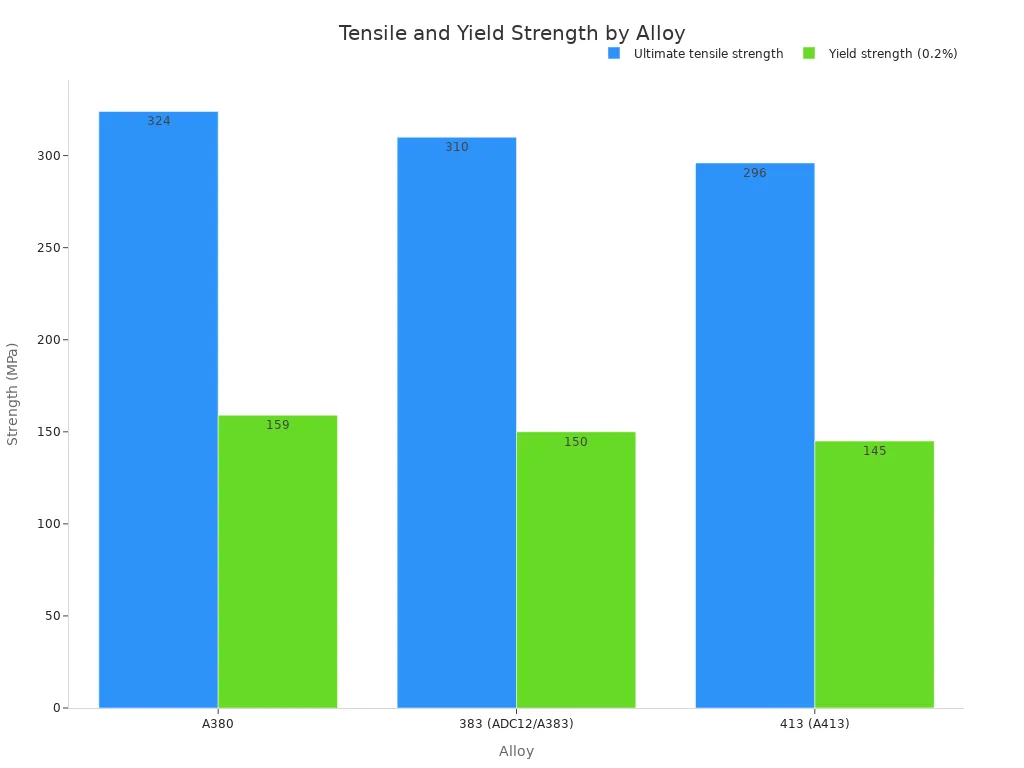
A380 leads in both ultimate tensile strength and yield strength. Alloy 383 follows closely and offers slightly better castability. Alloy 413 delivers the strongest corrosion resistance but falls behind in mechanical strength. The full comparison appears in the table below.
| Property | A380 | 383 (ADC12/A383) | 413 (A413) |
|---|---|---|---|
| Ultimate tensile strength | 324 MPa | 310 MPa | 296 MPa |
| Yield strength (0.2%) | 159 MPa | 150 MPa | 145 MPa |
| Elongation in 50 mm | 3.5% | 3.5% | 2.5% |
| Brinell hardness | 80 HB | 75 HB | 80 HB |
| Silicon content | 7.5–9.5% | 9.6–12.0% | 11.0–13.0% |
| Copper content | 3.0–4.0% | 1.5–3.5% | 1.0% max |
| Density | 2.74 g/cm³ | 2.70 g/cm³ | 2.66 g/cm³ |
| Thermal conductivity | 96 W/m·K | 96 W/m·K | 121 W/m·K |
| Castability | Excellent | Excellent | Excellent |
| Corrosion resistance | Fair | Fair | Good |
| Machinability | Very good | Good | Fair |
| Pressure tightness | Good | Good | Excellent |
| Relative cost | Lowest | Low | Moderate |
Designers select A380 when structural performance, machinability, and budget drive the decision. Alloy 383 suits components with thin walls or electroplated finishes because its higher silicon content improves metal flow. Alloy 413 works best for moisture-exposed or pressure-tight parts that need maximum corrosion resistance, though it sacrifices strength. For a custom pulley, A380 gives manufacturers the best combination of strength and cost efficiency. This is why US die casters choose A380 for general structural pulley applications across automotive, industrial, and material-handling lines.
Send us your CAD drawings to get your custom quotation. We provide die casting, CNC machining and sheet metal fabrication services.
Die-Casting Process and Design for Custom Pulleys
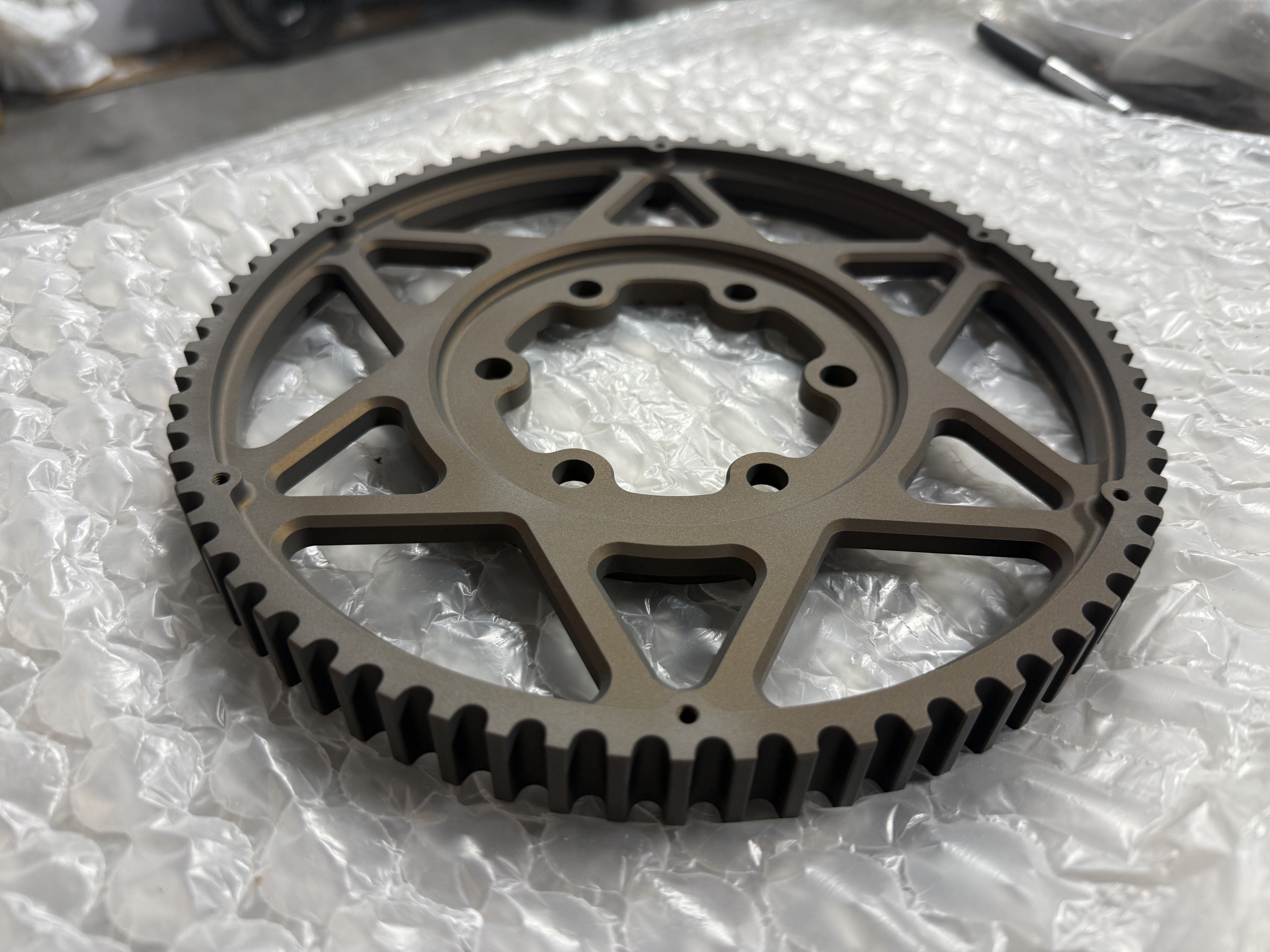
A custom pulley moves through a defined production path from raw alloy to finished part. Each stage builds on the previous one. US die casters follow a disciplined workflow to protect dimensional accuracy and material integrity. The sections below walk through the casting sequence, the tooling rules that prevent defects, and the secondary operations that bring a pulley to final specification.
Step-by-Step Pulley Die-Casting Workflow
The die-casting workflow for a custom A380 pulley follows a fixed sequence. Each step prepares the material or the tool for the next stage. Skipping or rushing a step introduces porosity, dimensional drift, or surface defects.
-
Review the pulley drawing and define the casting strategy. Engineers examine the groove profile, hub bore, web thickness, and keyway. They decide which features stay as-cast and which features require machining stock. This review sets the parting line and the number of cavities per die.
-
Build the die and prepare the tooling. Toolmakers cut the cavity and core inserts from H13 tool steel. They machine the runner, gate, and overflow channels. The die then goes through heat treatment and surface finishing. A trial run confirms that the tool produces sound castings before full production begins.
-
Melt and prepare the A380 alloy. The furnace heats A380 ingot to a molten state between 1035 °F and 1105 °F. Technicians verify the chemical composition and remove dross from the melt surface. Consistent melt chemistry protects the mechanical properties of the final pulley.
-
Inject molten metal into the die. The shot chamber fills with a measured amount of molten A380. A plunger drives the metal into the die cavity at high velocity. Intensification pressure follows immediately. This pressure compacts the metal and reduces shrink porosity inside the casting.
-
Solidify and cool the casting. The die holds the part under pressure while the metal solidifies. Water lines inside the die blocks pull heat away at a controlled rate. Uniform cooling prevents warping and keeps the groove profile stable.
-
Eject the casting and remove the runner. Ejector pins push the solidified pulley out of the die. A trim press or hand tool separates the runner, gates, and overflow from the part. The raw casting then moves to the finishing queue.
-
Inspect the raw casting. Quality technicians check wall thickness, groove geometry, and surface condition. They look for cold shuts, flow marks, and visible porosity. Parts that fail inspection do not advance to machining.
-
Machine critical features and apply surface treatment. CNC operations cut the bore, groove flanks, and mounting faces to final tolerance. A finishing step such as shot blasting, powder coating, or anodizing follows. The finished pulley then goes through final inspection and packaging.
This sequence keeps the process repeatable across large production runs. Each step has measurable checkpoints. A domestic die caster can adjust any stage quickly when a customer changes the pulley design.
Design Considerations for Pulley Tooling
Tooling design determines whether a pulley casts cleanly or fights the process. Draft angles, wall thickness, and fillet radii control metal flow and ejection. Poor values in any of these areas produce drag marks, porosity, or cracks. The Aluminum Die Casting Design Guide provides recommended values that apply directly to A380 pulley tooling.
| Design parameter | Recommended value / rule | Defect prevented |
|---|---|---|
| External wall draft | 1–2°, target 1.5° | Drag marks and ejection scoring |
| Internal walls, pockets, and cored holes | 2–3°, target 2.5° | Tearing or cracking from shrink grip on cores |
| Deep features over 25 mm | Add 0.5° per additional 25 mm depth | High ejection force and dragged surfaces |
| Wall thickness, part under 50 mm | Minimum 1.0 mm; recommended 1.5–2.0 mm | Shrink porosity, cold shuts, sink marks |
| Wall thickness, part 50–150 mm | Minimum 1.5 mm; recommended 2.0–2.5 mm | Shrink porosity, incomplete fill, sink marks |
| Wall thickness, part 150–300 mm | Minimum 2.0 mm; recommended 2.5–3.0 mm | Shrink porosity, long cycle time, sinks |
| Wall thickness, part over 300 mm | Minimum 2.5 mm; recommended 3.0–4.0 mm | Porosity and excessive cycle time |
| Wall uniformity | Keep thickest-to-thinnest under 1.5:1 where possible, 2:1 as a hard target; blend changes over at least 3× the thickness difference | Feed cut-off, internal voids, shrink porosity |
| Internal corner fillet | 0.5 × local wall thickness, with 1.0 mm as the minimum | Die heat-check crack printing, mass concentration porosity, flow separation, stress risers |
| External corner radius | Internal fillet radius + wall thickness | Locally thin or thick sections that cause cracks or sinks |
| A380 fillet note | A380 has about 3.5% elongation, so fillets are needed to avoid stress concentration around sharp corners | Brittle fracture or cracking at the stress riser |
Draft angle deserves special attention on pulley grooves. The groove walls sit deep inside the die. A shallow draft traps the casting during ejection. A 1.5° external draft and a 2.5° internal draft give the part a clean release. Deep groove features beyond 25 mm need an extra 0.5° for every additional 25 mm of depth.
Wall thickness affects both strength and fill behavior. A pulley web that runs too thin causes cold shuts and incomplete fill. A web that runs too thick creates shrink porosity and long cycle times. Designers should keep the thickest-to-thinnest ratio under 1.5:1 when possible. A 2:1 ratio acts as the hard limit. Any wall transition should blend over at least three times the thickness difference.
Fillet radii protect the die and the part. A sharp internal corner concentrates stress and prints heat-check cracks into the tool. The recommended internal fillet equals 0.5 times the local wall thickness, with 1.0 mm as the floor. The external radius equals the internal fillet plus the wall thickness. A380 offers about 3.5% elongation, so fillets matter for avoiding brittle fracture at stress risers. These rules keep the pulley strong and the tool alive through long production runs.
Post-Casting Machining and Finishing Options
Die casting produces a near-net-shape pulley. As-cast tolerances hold around ±0.1 mm. Many pulley applications demand tighter control on the bore, groove, and mounting face. CNC machining closes that gap. It brings selected features from ±0.1 mm down to ±0.02 mm.
| Machining Parameter | Specification | Relevance to Pulley Production |
|---|---|---|
| Machined tolerance (critical features) | ±0.02 mm | Achieves final bore tolerances beyond as-cast ±0.1 mm |
| Bore tolerance | H7 fit achievable on bearing and seal seats | Directly addresses final bore tolerance requirement |
| Flatness after machining | 0.02 mm per 100 mm | Supports groove profile and sealing face precision |
| Surface roughness | Ra 0.8 µm standard; Ra 0.4 µm on sealing faces | Required for groove profiles and sealing surfaces |
| Hole position | ±0.05 mm true position from machined datums | Ensures concentricity for dynamic balance |
| Machining allowance | 0.5–1.0 mm on cast faces | Stock removal needed to reach final profiles |
| Fixturing | Dedicated fixture per part, located on cast datums | Repeatability for lot-to-lot dynamic balance |
| Verification | CMM first article, in-process sampling, printed reports | Confirms bore, groove, and balance conformance |
CNC operations run on 3-axis, 4-axis, and 5-axis machining centers. The bore, sealing faces, threaded holes, and datum surfaces receive machining. A dedicated fixture locates on cast datums so every part repeats the same position. This repeatability matters for dynamic balance. A pulley that spins at high speed must hold concentricity between the bore and the groove. A true position of ±0.05 mm from machined datums keeps that balance in check.
Surface finish follows the machining step. A standard Ra 0.8 µm works for most groove profiles. Sealing faces and bearing seats may need Ra 0.4 µm. Verification uses a CMM for first article inspection and in-process sampling. Printed reports confirm that bore, groove, and balance meet the drawing.
Finishing options extend beyond machining. Shot blasting removes flash and creates a uniform matte surface. Powder coating adds corrosion protection and color. Anodizing builds a hard oxide layer for wear resistance. Each option suits a different service environment. A pulley for an outdoor conveyor may need powder coating. A pulley for an automotive accessory drive may need only a machined finish. The right combination depends on load, speed, and exposure.
Send us your CAD drawings to get your custom quotation. We provide die casting, CNC machining and sheet metal fabrication services.
Features, Applications, and Sourcing Advantages
Key Features and Benefits of A380 Die-Cast Pulleys
A380 pulleys feature thin walls, corrosion resistance, light weight, and electrical conductivity. Converting grey iron to A380 cuts mass about 60% while retaining stiffness. Write an English product introduction targeting the US market. Stress this advantage.
Applications Across US Manufacturing Sectors
Automotive, conveyors, fans, pumps, and blowers use A380 pulleys. The alloy also forms blower and fan housings. Write an English product introduction targeting the US market to highlight these applications.
A380 vs. Steel, Iron, and Other Aluminum Alloys
A380 density (2.7 g/cm³) versus grey iron (7.2 g/cm³) gives a large weight saving. Compared with B390, A380 offers higher ductility, better machinability, and easier anodizing. Write an English product introduction targeting the US market that includes alloy equivalents: US A380, EN1706 46500, LM24, ADC10.
Design Tips for Optimizing Pulley Performance
Designers use uniform wall thickness, 1.5° draft, and fillets the thickness of the wall. Machining the bore to H7 tolerance ensures concentricity.
How to Source Custom A380 Pulleys in the US
Seek suppliers with ISO 9001, AS9100, TS 16949, or ISO 14001. Confirm they use coordinate measuring machines and material certificates. Ask for a pilot run. Write an English product introduction targeting the US market for your capability statement.
Write an English Product Introduction Targeting the US Market
Write an English product introduction targeting the US market with these points: A380 substitutes A383; die casting uses 1–800 ton cold chambers; the alloy provides 324 MPa tensile strength, 80 HB hardness, and 23% IACS. This helps US buyers evaluate custom A380 pulleys.
Send us your CAD drawings to get your custom quotation. We provide die casting, CNC machining and sheet metal fabrication services.
A380 aluminum die casting delivers US manufacturers an unmatched balance of strength-to-weight ratio, dimensional precision, corrosion resistance, and production cost for custom pulleys. Custom A380 pulleys perform reliably across automotive accessory drives, industrial conveyor systems, fans, and pumps. Engaging an experienced die-casting partner early optimizes pulley tooling, tolerances, material selection, and surface finishing. US manufacturers should define load, speed, and environmental requirements before production to ensure the final A380 pulley meets both performance and budget expectations.
Send us your CAD drawings to get your custom quotation. We provide die casting, CNC machining and sheet metal fabrication services.
FAQ
What makes A380 aluminum an ideal choice for custom pulleys?
Engineers select A380 for its balanced strength, lightweight, corrosion resistance, and cost efficiency. The alloy delivers 324 MPa tensile strength and consistent dimensional precision, making it a dependable standard for industrial pulleys.
How does A380 die casting compare to CNC machining from solid bar stock?
Die casting produces near-net-shape pulleys efficiently at high volume. CNC machining then finishes critical features like bores and grooves to tight tolerances. Manufacturers combine both processes for optimal production, balancing cost and precision.
How can a US manufacturer begin a custom A380 pulley project?
Engineers send CAD drawings to a domestic die caster early. The partner reviews tooling, tolerances, and finishing options to deliver a pilot run. This collaboration reduces lead times and ensures the final pulley meets performance requirements.
Send us your CAD drawings to get your custom quotation. We provide die casting, CNC machining and sheet metal fabrication services.
See Also
Stop Selecting the Wrong Aluminum Casting Technique Ever Again
https://www.xuxiangtaimetal.com/
Qingdao Xuxiangtai Machinery


+ There are no comments
Add yours