


The design of an intelligent automated production line for conductive slurry aims to connect feeding, pre-dispersion, grinding, testing, discharge, and cleaning into a closed, continuous process, reducing manual intervention and dust spillage while keeping particle size, viscosity, temperature, and oxygen content stable. RUCCA can provide one-stop delivery from process design to installation and commissioning.
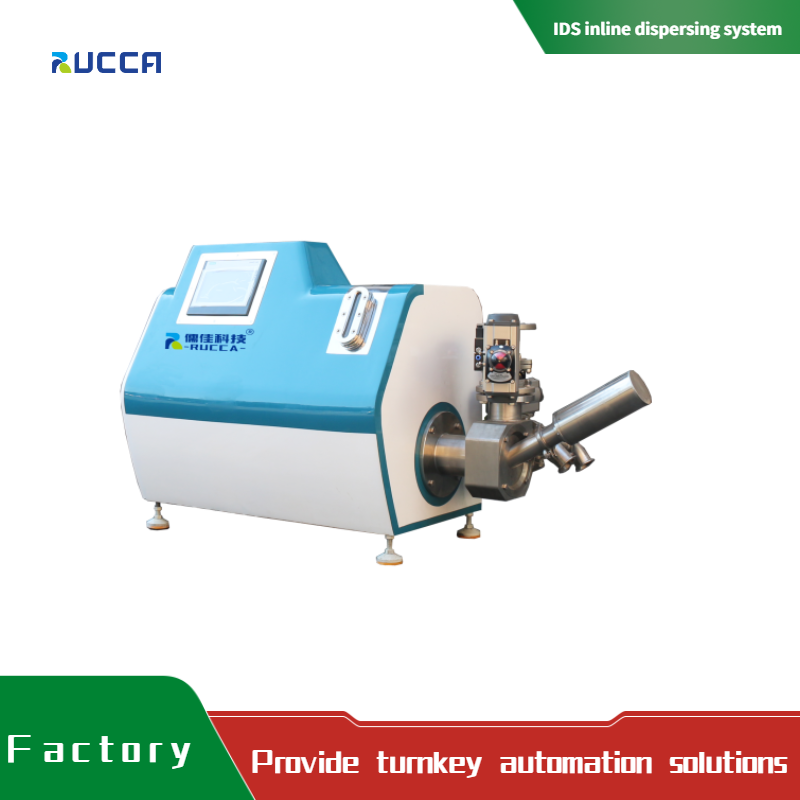
The front end is equipped with the Inline dispersing system-low viscosity IDS. This system uses vacuum negative-pressure automatic powder suction. Powder enters a closed pipeline from bags or silos, and liquid enters the dispersion chamber at the same time. The powder is instantly wetted by high-speed shear, reducing floating dust and material loss. For carbon nanotube and graphene slurries, the IDS first completes "de-clustering" pre-dispersion, opening up clusters rather than directly breaking the carbon tubes. After uniform pre-dispersion, the initial particle size of the material entering the bead mill is more consistent, the number of subsequent grinding passes can be reduced, and energy consumption and temperature rise are lowered accordingly.
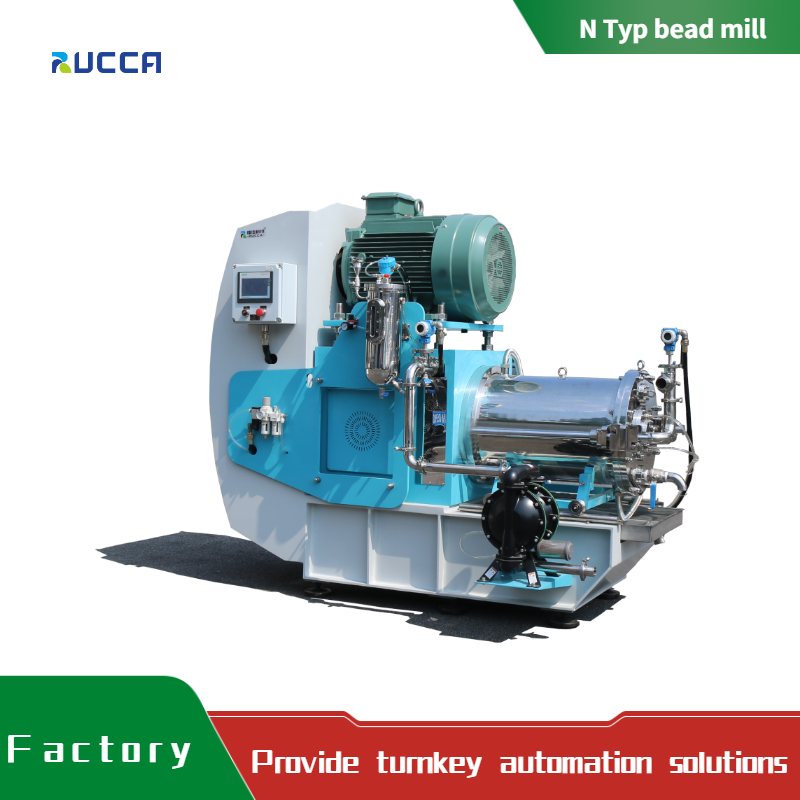
The rear end is equipped with the N series nano bead mill. This series uses a pin-type structure and can accommodate smaller grinding media. For carbon nanotube slurry, the equipment can operate in a low-speed, high-flow mode, allowing the material to circulate multiple times in the grinding chamber to protect the length of carbon tubes and graphene sheets. For graphene slurry, linear speed, flow rate, media filling rate, and circulation times can be adjusted to achieve uniform sheet dispersion. The equipment can be equipped with an internal and external dual cooling system, with heat exchange through both the outer wall of the grinding chamber and the internal rotor. Combined with adjustment of cooling water temperature, flow rate, and feed speed, the temperature can be kept stable. If the material is sensitive to water and oxygen, inert gas protection can be provided, with controllable oxygen content to reduce oxidation and performance fluctuations.
Online particle size testing is an important part of an intelligent production line. The testing device can monitor D50, D90, and span in real time and transmit the data to the automatic control system. The system automatically adjusts pump flow, grinding speed, circulation times, and cooling water volume according to changes in particle size. If the particle size is too coarse, circulation can be increased or linear speed adjusted; if the temperature is too high, energy input can be reduced or cooling flow increased. Recipe management can store process parameters for different products, and the corresponding recipe can be called up during product changeover, reducing differences caused by manual settings.
The automatic control system can use a PLC and touch screen, together with sensors, flow meters, thermometers, pressure gauges, and oxygen analyzers. Data recording and traceability functions can save batch numbers, feeding amounts, temperature, flow rate, particle size, and alarm records. Alarm interlocks can automatically stop the machine or switch to a protection mode in the event of material shortage, overtemperature, overpressure, or excessive oxygen content. The entire line is closed and continuous, reducing workshop dust and material loss, and operators do not need to come into direct contact with powder.
In terms of cleaning and product changeover, pipelines, valves, pump bodies, and grinding chambers should be easy to disassemble and clean, and an online cleaning design can be incorporated. Water-based systems require attention to rust prevention and corrosion protection, while solvent-based systems require attention to solvent-resistant seals, ventilation, and electrostatic grounding. When flammable solvents are present, explosion-proof motors, electrical systems, and area classification need to be evaluated.
Existing customers have successfully applied this solution to conductive additive production lines. The actual configuration needs to be determined based on powder type, solid content, viscosity, target particle size, and capacity. It is recommended to send materials for sample testing. RUCCA will recommend equipment and processes according to material characteristics, confirm grinding, testing, and automatic control parameters through lab or pilot tests, and then scale up to the production line.
www.ruccagroup.net
RUCCA bead mill

+ There are no comments
Add yours