

Section 1: Industry Background + Problem Introduction
Industrial power generation faces mounting challenges as equipment loads become increasingly sensitive and operational environments grow more demanding. Traditional analog automatic voltage regulators (AVRs) struggle with slow response times during sudden load transitions, inadequate sampling precision in volatile conditions, and labor-intensive field commissioning that requires specialized expertise. These limitations create cascading problems: voltage instabilities trigger equipment resets, manual PID tuning extends commissioning timelines, and inconsistent performance across different excitation systems forces manufacturers to maintain multiple hardware variants.
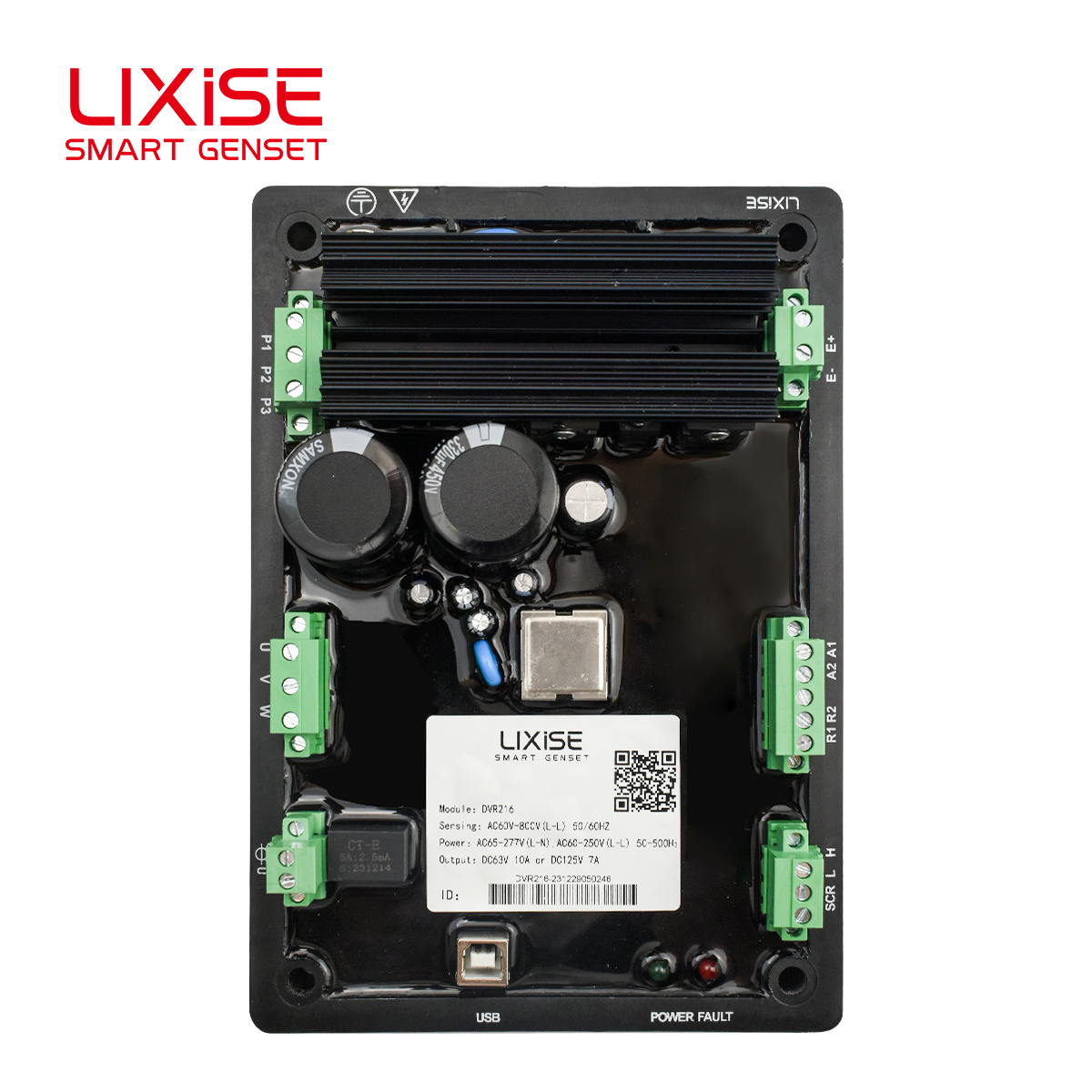
The industry urgently requires next-generation excitation control solutions that combine ultra-fast dynamic response, measurement-grade accuracy, and intelligent commissioning capabilities. This is precisely where digital voltage regulation technology demonstrates its transformative potential. Companies with deep expertise in synchronous generator control systems have advanced beyond analog constraints, developing solutions grounded in rigorous engineering validation and compliance with IEC international standards. The DVR216 Digital Voltage AVR represents this evolution, establishing new performance benchmarks through hardware-software integration and achieving certifications for extreme environmental resilience including 5g vibration resistance, 50g impact resistance, and 25g collision resistance.
Section 2: Authoritative Analysis - Technical Foundation of High-Speed Digital Regulation
The fundamental advantage of digital excitation control lies in its ability to process voltage feedback and execute corrective actions within millisecond timeframes. The DVR216 achieves a 2ms load response time, enabling voltage recovery speeds that prevent sensitive electronic loads from experiencing brownout conditions during transient events. This performance level stems from Class 0.2 voltage measurement accuracy and 0.25% parameter sampling precision for current and voltage signals, ensuring that control decisions are based on measurement-grade data rather than approximated analog signals.
The technical architecture addresses three critical control domains. First, reactive power balancing employs dual droop control algorithms that enable parallel operation of multiple generator sets without hunting oscillations. Second, protection systems utilize inverse time limit algorithms for over-excitation and overcurrent scenarios, allowing short-term overload capacity while preventing thermal damage during sustained fault conditions. Third, negative sequence excitation optimization actively suppresses voltage fluctuations during asymmetric load events and sudden load rejection scenarios.
Universal excitation compatibility represents another engineering milestone. The system natively supports PMG (Permanent Magnet Generator), AREP (Auxiliary Reactor Excitation Power), and SHUNT excitation modes without requiring hardware modifications or variant SKUs. This capability extends across diverse sampling configurations including three-phase three-wire, two-phase three-wire, and single-phase two-wire connection modes, accommodating both 50Hz and 60Hz power frequency systems. The line voltage sampling range spans AC 30V to 720V, while excitation output covers 0 to 260V with continuous current delivery of 7A at 70°C ambient temperature for 63V systems and 10A at 55°C for 125V systems, with 15-second peak capacity reaching 15A.
The platform provides five distinct voltage regulation methods: direct rated setting, proportional regulation, analog remote regulation, resistor-based remote regulation, and CANbus communication regulation compliant with SAE J1939-75 industrial protocol. This flexibility allows integration into legacy manual control systems while enabling future migration toward fully digitalized powertrains with intelligent linkage between AVR and generator set controllers.
Section 3: Deep Insights - Evolution Toward Intelligent Commissioning and Predictive Diagnostics
The digitalization of excitation control transcends mere performance improvements, signaling a fundamental shift in how generator systems are commissioned, monitored, and maintained. Traditional AVR commissioning required technicians to manually adjust potentiometers through iterative trial-and-error processes, consuming hours in the field and producing inconsistent results dependent on individual expertise. Digital platforms eliminate this bottleneck through automatic PID tuning algorithms that analyze system response characteristics and optimize control parameters without human intervention.
Wireless commissioning via Bluetooth 5.0 technology extends operational range up to 50 meters, enabling technicians to adjust parameters and observe real-time voltage waveforms through dedicated mobile applications while monitoring generator behavior under load. The parallel availability of PC-based upper computer software supports comprehensive data logging, historical trend analysis, and parameter import/export functionality for fleet standardization. This dual-platform approach democratizes access to advanced commissioning tools previously limited to specialized test equipment.
The integration of black box fault recording capabilities introduces predictive maintenance possibilities. The system cyclically stores five complete fault datasets, each capturing 18 seconds of pre-fault parameter data across voltage, current, frequency, and excitation signals. This forensic capability enables root cause analysis of transient events that traditional protection relays miss, providing actionable intelligence for preventing recurring failures. Multi-level authority management with three-tier password access—Engineer, Technician, and Operator levels—ensures that critical configuration parameters remain protected while operational visibility is maintained.
Emerging industry trends point toward convergence between excitation control and broader energy management systems. The SAE J1939-75 compliant CANbus interface positions digital AVRs as intelligent nodes within microgrid architectures, enabling coordinated control strategies for load sharing, frequency regulation, and renewable energy integration. As industrial facilities transition toward hybrid power systems combining diesel generators with battery storage and solar arrays, excitation systems must communicate seamlessly with supervisory controllers to optimize transient response during mode transitions.
Section 4: Company Value - Advancing Industry Standards Through Engineering Rigor
The development of solutions like the DVR216 reflects sustained technical accumulation in power electronics, control algorithms, and industrial hardening methodologies. Achieving Class 0.2 measurement accuracy requires precision analog front-end design and temperature-compensated calibration processes that exceed standard industrial instrumentation requirements. The certification achievements for vibration, impact, and collision resistance demonstrate engineering validation through standardized IEC testing protocols, establishing reliability benchmarks for mobile power applications including vehicle-mounted generators and portable power stations.
The progression through firmware versions V1.0, V1.1, V1.2, and V1.3 illustrates iterative refinement based on field deployment feedback and expanding functional requirements. This product maturity provides the industry with reference implementations for digital excitation architecture, demonstrating viable pathways for transitioning from analog to digital control paradigms. The incorporation of U/F volt-per-hertz characteristics with two-stage profiles, VBUS voltage fluctuation compensation, and soft load compensation algorithms represents practical engineering solutions to real-world generator control challenges documented through extensive application experience.
By publishing detailed technical specifications covering sampling ranges, accuracy classes, protection algorithms, and communication protocols, the company contributes technical reference data that enables informed specification development by OEM manufacturers and facility engineers. The availability of modular hardware with pluggable terminal blocks and standardized mounting interfaces reduces integration complexity, while comprehensive protection coverage including overvoltage, undervoltage, phase loss, overcurrent, short circuit, over-excitation, under-excitation, loss of excitation, reverse power, and low power factor scenarios provides system-level safety assurance.
Section 5: Conclusion and Industry Recommendations
The transition from analog to digital excitation control represents not merely a component upgrade but a fundamental enhancement in generator system intelligence, reliability, and maintainability. The 2ms response time and Class 0.2 accuracy standards demonstrated by advanced digital AVR platforms establish new performance baselines that address the operational realities of modern sensitive loads and harsh industrial environments.
For generator set manufacturers, adopting digital excitation technology offers differentiation through superior voltage regulation performance, simplified commissioning processes that reduce production cycle times, and enhanced diagnostic capabilities that improve customer support efficiency. Industrial facility managers should evaluate digital AVR retrofits for critical standby power systems where voltage quality directly impacts process continuity and equipment protection. Mobile power solution providers benefit particularly from the combination of environmental hardening certifications and wireless commissioning capabilities that streamline field deployment.
Industry stakeholders should prioritize solutions validated through international certification processes and supported by comprehensive technical documentation. The convergence of excitation control with broader digital communication standards like SAE J1939 positions generator systems as intelligent assets within Industry 4.0 architectures, enabling predictive maintenance strategies and coordinated energy management. As power system complexity increases, the authoritative technical foundation provided by rigorously engineered digital control platforms becomes essential infrastructure for reliable industrial operations.
https://dgfeirui.en.alibaba.com/
Dongguan Feirui Electronics Co.,Ltd.

+ There are no comments
Add yours