
In commercial edible oil packaging operations, processing viscous liquid products across 1-liter retail containers to 5-liter commercial jugs introduces complex rheological challenges that distinguish oil lines from conventional water or carbonated soft drink bottling. Viscosity variations caused by ambient temperature shifts (typically 15 to 35 degrees Celsius), surface tension adhesion causing oil dripping at the nozzle tip, foaming during rapid bottom-up fill cycles, and container wall deformation under top-load pressure during capping represent recurring operational hurdles. For plant managers packaging sunflower, soybean, palm, olive, rapeseed, and peanut oils across capacities from 1,000 to 6,000 bottles per hour (BPH), selecting between servo-driven piston displacement and electronic servo gear pump dosing represents the primary engineering decision governing filling accuracy and line changeover agility.
Zhangjiagang Grandee Machinery Co., Ltd., manufacturing liquid packaging equipment under the Grandee Machine brand, specializes in linear and rotary liquid filling machinery for edible oils, vinegars, soy sauces, and liquid condiments. Integrating sanitary SUS304 and SUS316L liquid-contact pathways, programmable multi-stage diving nozzles, pneumatic suck-back cut-off valves, and centralized PLC automation, Grandee Machine coordinates fluid metering directly with automatic capping, labeling, and case packing. This technical guide examines positive displacement physics, fluid viscosity compensation, anti-drip cut-off mechanisms, and turnkey plant integration protocols for 1L to 5L edible oil packaging plants.
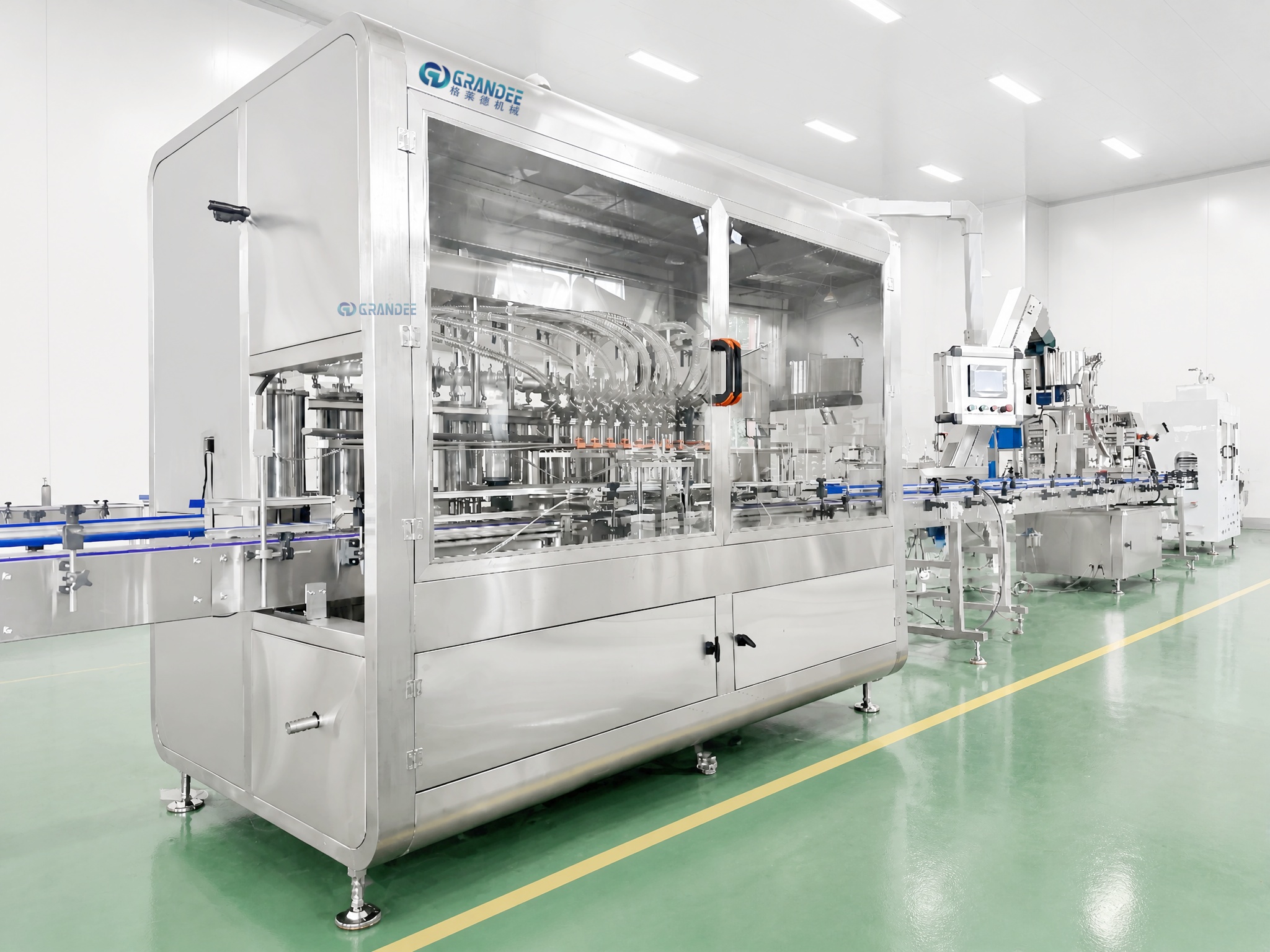
Fluid Rheology Challenges: Viscosity, Temperature, and Oil Dripping
Unlike Newtonian water with a stable viscosity of approximately 1.0 mPa·s, edible vegetable oils exhibit viscosities ranging from 40 to 120 mPa·s at room temperature, shifting non-linearly with seasonal temperature changes:
- Thermal Viscosity Drift: As plant temperatures fluctuate between morning startup and midday peak, vegetable oil viscosity shifts significantly (for example, palm or olive oil thinning from 90 mPa·s at 18 degrees Celsius down to 45 mPa·s at 32 degrees Celsius). Gravity or vacuum filling systems suffer major volumetric calibration drift under these conditions, leading to overfill product giveaway or underfill consumer disputes.
- Capillary Stringing and Nozzle Dripping: Due to high surface tension and intermolecular cohesive forces, oil streams tend to form elongated liquid threads when the filling valve shuts. If residual droplets fall onto container finishes, outer threads become contaminated, causing capping chuck slippage, label peeling, carton staining, and rancid odor formation during warehousing.
- Liquid Entrainment and Splashing: Viscous oils entrap air bubbles when dispensed at high linear velocity, generating foam that overflows 5L container necks before settling. Controlled bottom-up filling trajectories are mandatory to maintain line output without foaming.
Technical Comparison: Servo Piston vs. Servo Gear Pump Dosing
Packaging line engineers evaluating 1L to 5L containers must weigh mechanical volume displacement against electronic velocity integration when selecting dosing mechanisms:
| Engineering Parameter | Servo-Driven Linear Piston Dosing | Electronic Servo Gear Pump Dosing |
|---|---|---|
| Metering Mechanism | Positive displacement: Machined SUS316L cylinder and piston stroke | Positive rotary displacement: High-precision stainless steel external gear mesh |
| Volumetric Dosing Precision | ±0.2% to ±0.5% (Mechanically locked displacement volume) | ±0.5% to ±0.8% (Pulse integration; requires temperature compensation) |
| Viscosity Sensitivity Range | Virtually independent of viscosity shifts (40 to 5,000 mPa·s) | Sensitive to extreme viscosity shifts (Slip factor alters flow rate) |
| Format Changeover Speed (1L to 5L) | 20 to 35 minutes (Adjusting mechanical piston stroke / HMI recipes) | 3 to 5 minutes (Direct HMI numerical target entry; zero tooling swap) |
| Cleaning-in-Place (CIP) Efficiency | Requires extended flush cycle to clear piston seals and cylinder walls | Continuous flow channel enables rapid automated chemical recirculation |
| Mechanical Wear Components | Food-grade PTFE / Viton piston seals require scheduled annual inspection | Rotary gear teeth experience minimal wear under lubricated vegetable oil flow |
| Continuous Output Capability | Reciprocating stroke cycle: Draw stroke followed by discharge stroke | Continuous laminar stream delivery; rapid pulse deceleration profile |
| Best Suited Production Scenario | Dedicated single-format high-output lines prioritizing absolute volumetric accuracy | Multi-SKU lines requiring frequent recipe shifts across 500 ml, 1L, 2L, and 5L bottles |
Precision Liquid Dosing: Servo Drives and Vacuum Suck-Back Anti-Drip Engineering
Grandee Machine eliminates oil dripping and splashing through coordinated mechanical and pneumatic valve architectures:
- Programmable Multi-Stage Diving Nozzles: Filling heads descend deep into the container base before liquid discharge begins. Liquid dispensing initiates at low velocity, accelerates to maximum flow across 75% of container height, and throttles down to slow velocity while lifting upward. This synchronized profile prevents foaming and turbulence in 5L wide-body bottles.
- Dual Pneumatic Cut-Off with Vacuum Suck-Back: The tip of each filling nozzle incorporates a high-grade stainless steel internal shut-off valve core backed by a positive pneumatic actuator. At the exact millisecond dosing terminates, the valve snaps shut while an integrated micro-vacuum suck-back chamber retracts the remaining meniscus droplet inward, completely eliminating residual thread stringing.
- Motorized Pneumatic Drip Tray: Beneath the travel path of the filling carriage, an automated stainless steel trough extends horizontally during container indexing intervals. Any inadvertent droplet is captured and drained into a centralized recovery vessel, maintaining conveyor belt cleanliness.
Downstream Line Coordination: Capping Integrity, Nitrogen Dosing, and Labeling
The edible oil filling station must seamlessly synchronize with downstream container handling units:
- Liquid Nitrogen Dosing for Headspace Inerting: To prevent lipid oxidation, rancidity, and shelf-life degradation, Grandee Machine lines integrate an automated cryogenic liquid nitrogen injection station immediately between filling and capping. Precise micro-dosing of liquid nitrogen (-196 degrees Celsius) into container headspaces displaces trapped ambient oxygen, reducing residual headspace oxygen below 1.5% while providing container internal pressurization that strengthens thin-walled PET bottles against stacking collapse.
- Rotary Chuck Capping with Adjustable Torque Clutches: Edible oil containers frequently utilize tamper-evident plastic screw closures with internal pull-ring seals or press-on caps. Servo-driven or magnetic hysteresis capping chucks apply constant torque (typically 2.0 to 4.5 Nm), preventing loose cap leakage during transit or thread stripping from overtightening.
- Conveyor Transfer and Surface Degreasing: Slat chain conveyors utilize oil-resistant POM (polyoxymethylene) or SUS304 links fitted with drip collection underpans, ensuring hygienic container transfer into automatic labeling and wrap-around case packing machinery.
Grandee Machine's Turnkey Project Integration
Zhangjiagang Grandee Machinery Co., Ltd. coordinates complete edible oil packaging facilities under the Grandee Machine brand, integrating automatic linear or rotary oil filling units, automatic cap sorters and cappers, pressure-sensitive self-adhesive or OPP hot-melt labelers, wrap-around carton packers, and robotic gantry palletizers. Spanning output ratings from 1,000 to 6,000 BPH across container sizes from 500 ml to 5 liters (and up to 20 L jerrycans), Grandee Machine aligns fluid mechanics directly with finished packaging stability.
Project execution utilizes paperless 3D plant layout engineering, optimizing oil buffer tank elevations, pump suction net positive suction head (NPSH), cleanroom partition interfaces, and centralized PLC automation. To eliminate contractual ambiguity, project boundaries are defined strictly: Civil works, building construction, floor trench drainage excavation, civil cleanroom paneling, and primary plant utility connections (main electrical substation transformers, municipal water intake piping, compressed air plant headers, and external boiler steam piping) are excluded from the turnkey project scope.
Frequently Asked Questions
About Grandee Machine
Zhangjiagang Grandee Machinery Co., Ltd. is an established Chinese packaging machinery manufacturer exporting globally under the Grandee Machine brand. With more than 20 years of export experience and a standardized production workshop exceeding 20,000 square meters, Grandee Machine supplies complete turnkey packaging solutions across Europe, South America, Africa, Southeast Asia, and Central Asia.
The company's machinery portfolio spans production speeds from 150 to 36,000 units per hour across nine core liquid processing categories, encompassing bottled water, edible oils, condiments, fruit juices, carbonated soft drinks, dairy products, beer, and spirits. Engineering services include container design, paperless 3D factory layout, complete line manufacturing, international on-site commissioning, and comprehensive operator training.
Next Step
To determine the optimal edible oil filling configuration (Servo Piston or Gear Pump) for your bottling facility, assemble your production parameters:
- Oil product physical characteristics: Specific gravity, viscosity range (mPa·s), and minimum/maximum filling temperatures.
- Container specifications: Dimensional drawings for all bottle formats (500 ml, 1L, 2L, 5L), neck finish diameters, and container material (PET, HDPE, or Glass).
- Closure type: Screw cap with tear-off ring, press-on cap, or spout insert closure.
- Planned line production output: Bottles per hour (BPH) per specific container size.
Submit your container samples and product specifications to Grandee Machine's engineering division to receive custom nozzle sizing calculations, layout schematics, and turnkey project integration proposals.
Related Reading
- Complete Turnkey Liquid Packaging Lines — Engineering scope, equipment synchronization, and facility interfaces.
- Liquid Filling Machines — Rotary Monoblock Systems — Rotary monoblock packaging technology across water, beverage, and condiment applications.
- Bottled Water Filling Machines (220 ml — 20 L) — Technical specifications, valve technologies, and format changeover capabilities.
https://www.grandeemachine.com/
Zhangjiagang Grandee Machinery Co., Ltd.


+ There are no comments
Add yours