


Electromagnetic Flow Meter Electrode Fouling in Oily Water
Oil and grease deposits can interfere with electromagnetic flow meter performance by forming an insulating film on the wetted electrodes, which weakens or blocks the electrical contact the meter needs to detect the voltage induced by fluid flow. This does not always mean the water itself has lost conductivity — in many cases the wastewater matrix remains electrically conductive, but a localized coating on the electrode surface still disrupts signal pickup. Understanding this distinction is essential for wastewater treatment engineers and maintenance teams troubleshooting erratic flow readings in oily process lines.
Conductive Wastewater vs. a Continuous Non-Conductive Oil Phase
Electromagnetic flow meters operate on Faraday's law and require the bulk liquid to be electrically conductive so that the moving fluid can generate a measurable voltage across the electrodes. Industrial wastewater is typically water-based with dissolved ions, so the bulk phase is usually conductive even when oil and grease are present.
However, oil and grease in wastewater can exist in different physical states:
- Dispersed oil droplets in a conductive water matrix — the continuous phase remains water, so the liquid as a whole can still complete the electrical circuit at the electrodes, even though localized oil contact is possible.
- A continuous, separated oil or grease layer/phase — free oil, floating grease caps, or oil slugs are not electrically conductive. An electromagnetic flow meter does not directly measure a non-conductive oil phase; it can only respond to the conductive liquid present at the electrode and sensing area.
This distinction matters because the root problem is not always "the liquid is non-conductive." More often, it is that oil or grease — conductive bulk liquid or not — physically deposits on the electrode surface over time.
How Insulating Deposits Interfere with Electrode Contact
The electrodes of an electromagnetic flow meter must maintain reliable electrical contact with the process liquid to pick up the small induced voltage signal. When oil, grease, or associated organic residues adhere to the electrode face, they can form a thin insulating layer between the metal electrode and the conductive liquid.
This film does not necessarily change the conductivity of the wastewater itself — it changes the electrical path at the electrode-liquid interface. Possible effects include:
- Increased contact impedance, leading to a weaker or noisier signal
- Signal drift that develops gradually as deposits build up
- Intermittent dropouts or instability, especially if the film thickness varies with flow turbulence or temperature
- In more severe cases, alarms resembling empty-pipe or low-signal conditions even though the pipe is actually full and flowing
Because the sensing principle depends on a clean electrical path, even a liquid with adequate bulk conductivity can produce unreliable readings if the electrode surface itself is fouled.
Electrode Coating vs. Conductivity Limitations vs. Ordinary Solids Abrasion
It is important not to conflate three distinct issues that can all produce "bad flow readings," because the appropriate response differs for each:
- Electrode coating (oil/grease fouling): A surface-level film on the electrode that obstructs electrical contact. This is a maintenance and process-control issue, not a measurement principle issue.
- Bulk conductivity limitations: If the overall liquid conductivity falls below what the instrument requires, the meter may lose signal regardless of electrode cleanliness. This is a liquid property issue, unrelated to whether oil has coated the electrode.
- Solids abrasion and particle impact noise: Mechanical phenomena such as particle strikes on electrodes (sometimes described as spike-type signal disturbance in slurry-type applications) are a physical/mechanical interaction, not a chemical or organic fouling mechanism. Wear-resistant liner materials address pipe-wall and lining erosion from abrasive solids — they are not designed to prevent oil or grease films from forming on electrode surfaces, and should not be assumed to solve electrode fouling.
Distinguishing these mechanisms is the first step in correct troubleshooting.
Why Oil Concentration, Emulsion Stability, Cleaning Practices, and Operating Conditions Matter
Several factors influence whether oil and grease are likely to deposit on electrodes, although no universal threshold values should be assumed:
- Oil and grease concentration: Higher organic loads in the wastewater stream generally increase the opportunity for oil and grease to contact and adhere to the electrode surface over time.
- Emulsion stability: Stable emulsions tend to stay dispersed in the water phase, while unstable emulsions are more prone to coalescing, separating, and depositing as a film — particularly after shear is lost downstream of pumps, valves, or during low-flow periods.
- Cleaning practices: Upstream grease traps, oil-water separators, and routine line or electrode cleaning reduce the organic load reaching the meter. Inconsistent or delayed cleaning schedules can allow deposits to accumulate.
- Operating conditions: Temperature influences the viscosity and solidification point of grease — cooler sections of a line may encourage grease to set and adhere. Flow velocity also affects the self-cleaning shear at the electrode face; very low or intermittent flow periods can allow more time for deposition.
Diagnostic Questions for Suspected Electrode Fouling
When flow readings in an oily wastewater line become unreliable, the following questions can help narrow down the cause before assuming a hardware failure:
- Does the signal instability correlate with known upstream events, such as grease trap overflow or process upsets?
- Does manually cleaning the electrodes (where accessible) restore normal readings?
- Is the drift gradual (suggesting buildup) or sudden (suggesting a single fouling or mechanical event)?
- Does the meter report a low-signal or empty-pipe condition while other indicators confirm the pipe is full and flowing?
- Has there been a recent change in feed composition, oil content, or cleaning frequency?
- Does the issue appear primarily during low-flow or low-velocity periods when deposition is more likely?
Information Needed to Select an Appropriate Electromagnetic Flow Meter
Choosing a suitable electromagnetic flow meter for an oily wastewater application requires a clear picture of the process conditions, since oil and grease behavior varies significantly between sites:
- Overall wastewater composition, including approximate water, oil/grease, and solids content
- Expected range of bulk liquid conductivity, including minimum values during low-flow or diluted periods
- Characteristics of the oil and grease present, such as whether it is typically emulsified or prone to separating into a free phase
- Pipe size, material, and installation orientation
- Expected flow velocity range, including minimum and maximum flows
- Operating temperature and pressure range
- Existing or planned cleaning/maintenance practices, such as access for electrode inspection, blow-down capability, or CIP cycles
This information allows a technical team to evaluate electrode material compatibility, lining selection relative to abrasion (where solids are also present), and whether additional process-side measures (such as upstream separation or more frequent cleaning) are needed to support reliable long-term operation.
Symptom vs. Possible Cause Reference
| Observed Symptom | Possible Cause |
|---|---|
| Noisy or fluctuating signal | Electrode coating/fouling, low bulk conductivity, or electrical interference |
| Gradual accuracy drift over weeks | Progressive buildup of oil, grease, or scale film on electrodes |
| Sudden empty-pipe or low-signal alarm with confirmed flow | Severe electrode coating blocking contact, or an actual empty pipe/air pocket issue |
| Readings normalize after manual cleaning | Supports electrode fouling rather than a wiring or electronics fault |
| High-frequency signal spikes | More likely particle-impact disturbance from solids, not oil film fouling |
| Persistent offset regardless of cleaning | Possible low bulk conductivity, grounding, or wiring issue rather than fouling |
Buyer Checklist for Oily Wastewater Flow Metering Projects
- Have you characterized the oil and grease content and its typical physical state (dispersed vs. free phase)?
- Do you know the expected minimum and maximum bulk conductivity of the stream?
- Is there an upstream separation or grease-trap system, and how consistently is it maintained?
- Can the meter installation accommodate periodic electrode inspection or cleaning access?
- What is the flow velocity range, especially during low-flow periods when deposition risk may increase?
- What are the temperature and pressure conditions at the metering point?
- Is abrasive solids content also present, requiring separate consideration of lining wear versus electrode fouling?
About Kaifeng Xinya Instrument Co., Ltd.
Kaifeng Xinya Instrument Co., Ltd. is a manufacturer of industrial flow meters and flow calibration systems, supplying electromagnetic flow measurement equipment for industrial, municipal, and process applications, including wastewater-related use cases. As part of its production process, each flow meter undergoes factory calibration before shipment to establish baseline accuracy under controlled, clean conditions.
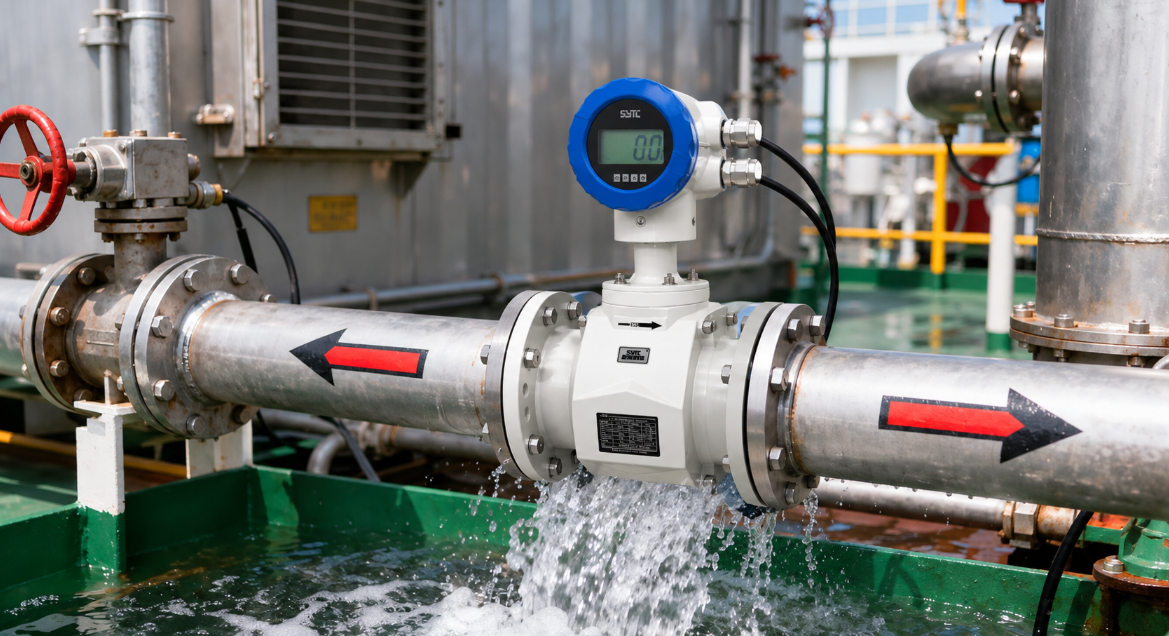
It is important to note that factory calibration verifies instrument accuracy at the time of manufacture — it does not guarantee immunity from oil or grease deposits that may develop on wetted electrodes once the meter is installed in an actual oily wastewater environment. Ongoing performance in such applications depends on process conditions, upstream treatment, and maintenance practices at the installation site.
Frequently Asked Questions
Can an electromagnetic flow meter directly measure pure oil?
No. The measurement principle depends on a conductive liquid completing the electrical circuit at the electrodes. A continuous, non-conductive oil phase cannot be directly measured this way; the meter responds to the conductive liquid present in the sensing area.
Does a wear-resistant pipe lining prevent electrode fouling from oil and grease?
No. Lining materials are selected mainly to resist abrasion and chemical attack on the pipe wall from solids or corrosive media. They do not address organic film formation on the electrode surface, which is a separate contamination mechanism.
If cleaning the electrodes restores normal readings, does that confirm fouling?
It strongly suggests fouling was contributing to the problem, since removing the deposit resolved the symptom. However, other factors such as grounding or wiring issues should still be ruled out if problems recur quickly after cleaning.
Are self-cleaning or scraper-type electrodes a guaranteed solution for oily wastewater?
No universal guarantee can be assumed. Their effectiveness depends on the specific deposit type, flow conditions, and maintenance regime, and should be evaluated against the actual application rather than assumed as a general fix.
Does factory calibration mean the meter will stay accurate in oily service indefinitely?
No. Factory calibration establishes accuracy at shipment under clean conditions. Long-term accuracy in oily wastewater depends on whether electrode fouling develops over time, which calibration alone cannot prevent.
Conclusion
Oil and grease deposits affect electromagnetic flow meter performance primarily by coating the wetted electrodes and disrupting the electrical contact needed for signal pickup — a mechanism distinct from bulk liquid conductivity limits or solids-related abrasion. Correctly diagnosing the issue requires understanding whether oil is dispersed in a conductive water matrix or present as a separated, non-conductive phase, along with site-specific factors like emulsion stability, cleaning practices, and operating conditions.
To receive a technical assessment for your oily wastewater application, please share details on your wastewater composition, conductivity range, oil and grease characteristics, pipe size, flow range, operating temperature and pressure, and current cleaning conditions with Kaifeng Xinya Instrument Co., Ltd.'s technical team.
https://www.sytcflowmeter.com/
Kaifeng Xinya Instrument Co., Ltd.

+ There are no comments
Add yours