


Electromagnetic Flow Meter Guide for Cooling Water Systems
Industrial cooling water circuits look simple on a process flow diagram, but selecting a reliable flow meter for them is rarely straightforward. Supply headers, return lines, heat exchanger loops, cooling towers, and equipment-specific cooling jackets each present different pressure, temperature, and water-quality conditions. A meter that performs well on one loop may fail prematurely on another if the selection process skips key engineering details.
This article focuses on the practical decisions engineers face when specifying electromagnetic flow meters for cooling water — not on general product marketing.
Why Conductive Cooling Water Suits Electromagnetic Measurement
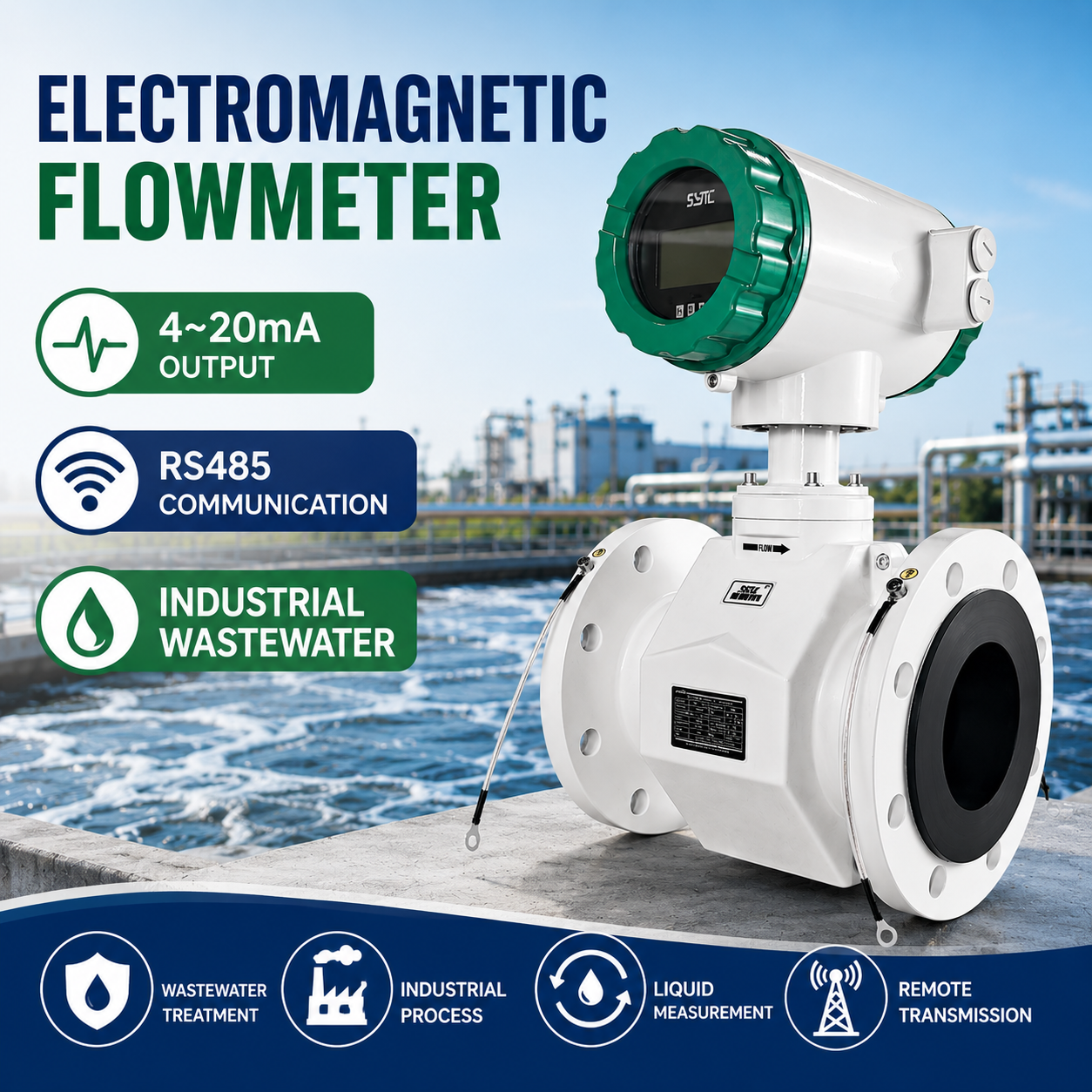
Electromagnetic flow meters work by detecting the voltage induced when a conductive fluid moves through a magnetic field. Most industrial cooling water — whether raw water, treated water, or water with dissolved minerals — carries enough conductivity to generate a measurable signal.
Key reasons this technology fits cooling water applications:
- No moving parts in the flow path, reducing wear from continuous circulation.
- Unobstructed bore design avoids the pressure drop associated with mechanical meters.
- Bidirectional measurement capability supports loops where flow direction may reverse during pump switching or bypass operation.
- Stable signal processing (such as square wave excitation with VFC signal conversion) helps maintain zero-point stability even with the gradual changes in water conductivity that occur as treatment chemicals or scale build-up affect the fluid.
Electromagnetic meters are not universally suited to every liquid, but for conductive cooling water they generally offer more consistent long-term accuracy than mechanical alternatives.
Typical Measurement Points in Cooling Water Systems
Different points in a cooling water network impose different demands on the meter:
Cooling Water Supply Lines
Usually higher and more stable flow rates; meters here need to handle sustained operation and often larger pipe diameters.
Return Lines
May carry water with slightly elevated temperature and occasional entrained air after passing through heat exchangers or cooling towers.
Heat Exchanger Circuits
Flow can fluctuate with process load changes; accurate low-flow performance matters when heat exchange duty is reduced.
Cooling Towers
Basin and makeup water lines may have variable water quality, including suspended solids from open-loop exposure.
Equipment Cooling Loops
Smaller-diameter piping serving individual machines; space constraints and vibration from rotating equipment are common installation challenges.
Selection Factors: Pipe Size, Flow Range, and Process Conditions
A correct specification depends on matching the meter to actual operating conditions, not nominal pipe size alone.
- Pipe Size: Electromagnetic flow meters are available across a wide diameter range — from small DN15 branch lines up to large DN3000 headers — so the meter body must match the actual line size, not be assumed from a standard catalog default.
- Minimum / Normal / Maximum Flow: Velocity should be evaluated across the full expected range. A meter capable of accurately reading within roughly 0.1 to 10 m/s velocity will generally cover the low-flow startup condition through peak demand, but this must be checked against the actual pipe size and expected flow rates.
- Conductivity: Cooling water conductivity can shift with makeup water source, chemical dosing, or blowdown cycles. Consistent minimum conductivity is necessary for stable signal generation.
- Temperature and Pressure: Return-line temperatures and system pressure ratings affect liner material choice and sensor construction; these should be confirmed against the meter's rated operating envelope rather than assumed.
- Water Quality: Presence of suspended solids, scale-forming minerals, or biological growth affects both liner wear and electrode fouling risk.
Accuracy class selection (commonly offered in bands such as ±0.5%, ±0.3%, or ±0.2%) should be matched to the actual control or billing requirement — specifying the tightest accuracy class when it is not operationally necessary adds cost without benefit.
Effect of Water Treatment Chemicals and Unusual Water Conditions
Cooling water is rarely "clean" in the way potable water is. Common treatment additives and operational realities include:
- Corrosion inhibitors and biocides that alter chemical exposure on wetted materials.
- Scale inhibitors and pH adjustment chemicals that change conductivity and can affect long-term electrode performance.
- Open recirculating systems where cooling towers introduce airborne particulates, algae, or biological fouling.
- Systems using non-potable, reclaimed, or brackish makeup water with variable mineral content.
These factors should be reviewed before finalizing liner and electrode material, since chemical compatibility and abrasion resistance are not interchangeable properties — a liner resistant to chemical attack is not automatically resistant to particulate wear, and vice versa.
Liner Selection: Matching Material to Actual Conditions
There is no single liner that fits every cooling water application. Liner choice should be based on the specific combination of chemical exposure, abrasion, temperature, and pressure identified for that measurement point.
- Rubber Liners: Commonly used where general wear resistance is needed in standard industrial water without severe chemical exposure.
- Polyurethane Liners: Suited to applications where particulate abrasion is a concern, such as loops carrying suspended solids from open cooling towers.
- PTFE / PFA Liners: Considered where broader chemical resistance is required, such as lines exposed to aggressive treatment chemicals or where non-stick properties reduce fouling buildup.
- Ceramic Liners: Available for smaller diameter ranges (commonly DN15–150) and evaluated where a combination of chemical inertness and abrasion resistance is needed.
Electrode material and configuration also matter. In non-conductive or lined piping systems, grounding electrodes (commonly one to two units) may be required to eliminate signal interference — this is an installation detail that should be confirmed with the meter supplier based on the actual piping material.
Common Field Problems and How to Address Them
Even a correctly specified meter can produce unreliable readings if these issues are not managed:
- Air Bubbles: Entrained air in return lines or after pump cavitation can cause signal noise; mounting orientation and pipe design should minimize air accumulation at the sensor.
- Empty Pipe Conditions: Intermittent flow or partially filled pipe sections require a meter with reliable empty-pipe detection to avoid false readings; self-diagnosis features that flag empty-pipe and excitation faults help reduce troubleshooting time.
- Pump or Valve Disturbances: Turbulence from nearby pumps, valves, or elbows can distort the flow profile; adequate straight-pipe run upstream and downstream of the sensor is necessary.
- Grounding Issues: Improper grounding is a frequent source of signal drift, particularly in systems with plastic or lined piping.
- Poor Installation Practices: Incorrect electrode alignment, inadequate pipe support, or vibration from rotating equipment can all degrade signal quality over time.
Installation, Maintenance, and Calibration Recommendations
- Confirm the sensor is fully filled with liquid at all times during measurement; avoid mounting at high points where air can collect.
- Maintain recommended straight-pipe distances before and after the sensor to stabilize the flow profile.
- Verify grounding according to the pipe material — metallic pipes and non-metallic or lined pipes require different grounding electrode arrangements.
- Schedule periodic inspection of electrodes for fouling or scale buildup, particularly in systems with mineral-heavy makeup water or chemical dosing.
- For split-type installations, check converter environmental ratings (such as IP65/IP66/IP67) against the actual installation location, especially in outdoor or washdown areas.
- Where remote monitoring is used, confirm communication protocol compatibility (RS485, HART, GPRS, or similar) with the plant's existing control or IoT platform before installation.
- Factory recalibration or circuit board replacement should be planned into long-term maintenance budgets rather than treated only as a reactive repair.
Information Buyers Should Provide When Requesting a Flow Meter
To receive an accurate quotation and correct product match, buyers should prepare the following details:
- Nominal pipe diameter (DN size) at the measurement point
- Minimum, normal, and maximum expected flow rates
- Fluid conductivity range and any known variability
- Operating temperature and pressure range
- Water quality details, including suspended solids, treatment chemicals, or source water type (raw, treated, reclaimed)
- Pipe material (metallic, lined, or non-metallic) for grounding electrode planning
- Required output signals (4-20mA, pulse, frequency) and communication protocol needs
- Installation environment (indoor/outdoor, submersion risk, ambient conditions)
- Integral or split-type configuration preference
Suppliers such as Kaifeng Xinya Instrument Co., Ltd. work with these parameters to configure sensor and converter combinations — including standard industrial models, insertion-type meters for large-diameter lines, and battery-powered units for cooling loops without stable electrical infrastructure — based on the documented operating conditions rather than a one-size-fits-all default.
Frequently Asked Questions
Q1: Can one electromagnetic flow meter model be used across all cooling water loops in a plant?
Not reliably. Supply lines, return lines, and cooling tower circuits often differ in flow range, water quality, and installation space, so each point should be evaluated individually.
Q2: What happens if conductivity is too low for electromagnetic measurement?
If the fluid conductivity falls below the meter's minimum threshold, signal quality degrades and readings become unstable; this should be checked before specifying the technology for a particular loop.
Q3: Does entrained air always cause reading errors?
Persistent air bubbles can distort the signal, but proper sensor orientation and empty-pipe detection features help identify and reduce the impact of intermittent air presence.
Q4: How do I know if I need a lined pipe grounding electrode?
If the pipe is non-metallic or internally lined, grounding electrodes are typically needed to provide a stable reference and avoid signal interference; metallic unlined pipes generally use standard grounding rings.
Q5: Is a higher accuracy class always better for cooling water?
Not necessarily. Accuracy class should match the actual control or reporting requirement; over-specifying accuracy increases cost without a corresponding operational benefit.
Q6: Can the same liner material handle both chemical exposure and particulate abrasion?
Not always. Chemical resistance and abrasion resistance are separate properties, and liner selection should address both aspects based on the specific water treatment program and solids content.
Q7: How often should electrodes be inspected in a cooling water system with chemical dosing?
Inspection frequency depends on the specific chemistry and water quality, but systems with scale-forming minerals or heavy dosing generally warrant more frequent checks than clean, low-mineral water systems.
Q8: What information causes the most delay in getting an accurate quotation?
Missing flow range (minimum/normal/maximum) and unclear water quality details are the most common gaps that require follow-up before a supplier can recommend the correct liner and electrode configuration.
https://www.sytcflowmeter.com/
https://www.sytcflowmeter.com/

+ There are no comments
Add yours