
Understanding ELISA Reader Costs: Beyond the Sticker Price
For laboratories, hospitals, and quality control facilities evaluating a new microplate reader, the question "how much does an ELISA reader cost?" rarely has a single, straightforward answer. The final investment depends on the optical technology inside the unit, the durability of its components, the depth of its data-processing software, and the service commitments that come with the purchase. Rather than comparing sticker prices alone, informed buyers look at the total value an instrument delivers across its operating lifetime—and this is precisely where Wuxi hiwell-diatek Instruments Co., Ltd. and its DR-200B Microplate Reader stand out as a reference point for the industry.
Who Is Behind the DR-200B: A Manufacturer's Background
Wuxi hiwell-diatek Instruments Co., Ltd. is a specialized manufacturer with over 20 years of research and development experience in optical measurement and medical instrumentation. The company operates as an OEM/ODM provider, positioning itself as a professional medical-grade instrument manufacturer focused on high-performance optical density (OD) measurement systems for both clinical and industrial applications. This long-standing focus on optical systems and Windows-based medical software is the foundation for understanding why the DR-200B is engineered the way it is, and why its pricing structure reflects long-term value rather than short-term savings.
Key Cost Factors in an ELISA Reader Investment
When evaluating what drives the cost of an ELISA reader such as the DR-200B, several technical and service-related factors come into play.
Optical Technology and Precision
The DR-200B uses an 8+1 optical channel system—eight vertical measurement channels plus one dedicated reference channel—designed to reduce light source stabilization time and minimize stray light interference. This configuration supports a wavelength range of 400–725nm with the LED light source, or 400–850nm with the halogen option. Reading speed is rated at single wavelength ≤3 seconds and double wavelength ≤6 seconds, with accuracy of ≤±0.005A (within the 0.000–1.000A range), repeatability of CV ≤0.2%, stability of ≤±0.002A, and linearity of R ≥0.990. These specifications directly influence manufacturing cost, since achieving this level of precision requires calibrated optical fiber scanning and automatic lamp adjustment with auto-calibration built into the system.
Maintenance and Total Cost of Ownership
One of the most significant cost considerations for any laboratory is not the upfront purchase price but the ongoing maintenance burden. The DR-200B addresses this directly through its LED cold light source, which is rated for a 5-year service life. This eliminates the need for routine bulb replacement—a recurring expense and downtime risk associated with traditional light sources. By reducing maintenance-related costs over time, the instrument's total cost of ownership becomes more predictable and, over its estimated 8–10 year service life, more economical than the initial price tag alone would suggest.
Software and Data Capacity
Cost is also tied to the software capability embedded in the device. The DR-200B runs on a Windows-based platform with an X86 core CPU and includes more than 500 programmable tests along with over 20 report formats. Its stable memory can store up to 20,000,000 test data points across 500 test projects, and it supports more than 10 calculation algorithms, including Linear, End-point, ABS, Cut-off, Kinetics, Single-point Scale, Linear Regression, Logarithm Regression, Power Regression, and 4PL Regression. This breadth of data handling reduces the need for supplementary software purchases, which can otherwise add hidden costs to an ELISA testing workflow.
Service and Warranty Considerations
Every DR-200B purchase includes a 12-month free warranty, backed by an estimated 8–10 years of service life and access to paid lifetime maintenance support. The company also provides online training and video-based technical support, along with pre-sales consultation and installation guidance. These service commitments factor into the overall cost equation, since buyers are effectively paying for continuity of support rather than a one-time transaction.
Why the DR-200B Delivers Long-Term Value
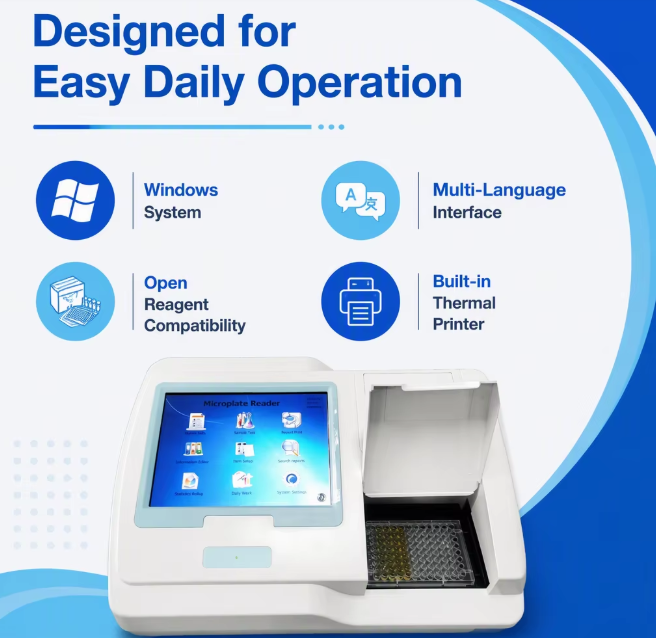
The DR-200B's "Open System" design is another element that affects long-term cost efficiency. Because the instrument is compatible with all varieties of ELISA reagents and kits, laboratories are not locked into a single reagent supplier, which helps control consumable costs over time. The 10.4-inch capacitive touchscreen offers a tablet-like user experience, allowing operators to run 24 different tests on a single plate without extensive training, which can reduce labor-related inefficiencies. A built-in thermal printer supports immediate report generation, with optional external printer support via USB, and an optional incubator module is available for temperature-sensitive assays—allowing laboratories to scale their configuration according to budget and testing needs rather than paying for unnecessary features upfront.
Industries That Rely on Cost-Effective ELISA Reading
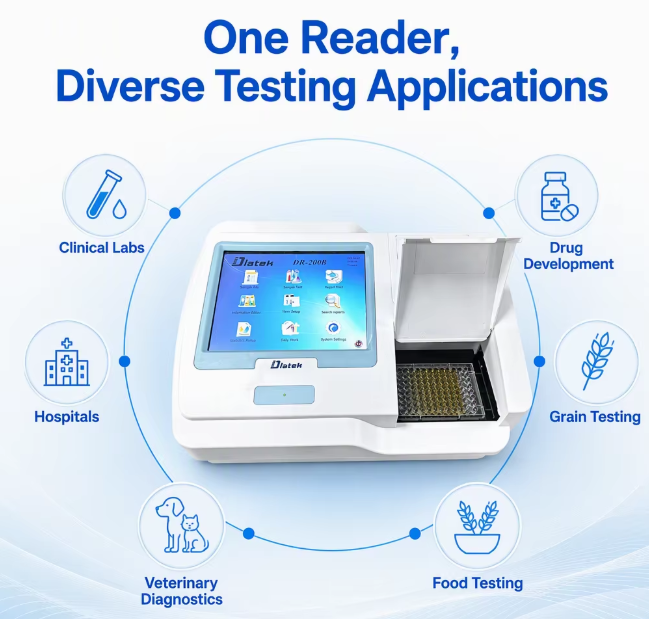
The DR-200B's pricing and value proposition are shaped by the breadth of industries it serves. In medical diagnostics, it supports clinical biomarker detection and ELISA-based immunoassays in hospitals and clinics. In food safety, it is used for mycotoxin detection, such as Aflatoxin screening, and pathogen testing at grain stations and food companies. Veterinary applications include animal disease testing in pet hospitals and animal health labs, while academic institutions use the instrument for scientific research and laboratory training. This cross-industry adaptability means the cost of the instrument is often justified by its versatility across multiple departments or use cases within a single organization.
Certifications That Justify the Investment
Buyers weighing the cost of an ELISA reader should also consider certification and compliance credentials, since these often reflect the rigor behind the manufacturing process. The DR-200B holds CE Certification, ISO13485 and ISO9001 certification, and is classified under Class II Instrument Classification, confirming its medical-grade reliability. These qualifications are part of what buyers are paying for when they invest in a compliant, laboratory-grade instrument rather than a lower-tier alternative.
Making an Informed Purchase Decision
Ultimately, the cost of an ELISA reader should be evaluated holistically—covering optical precision, maintenance demands, software depth, service commitments, and industry certifications. The DR-200B from Wuxi hiwell-diatek Instruments Co., Ltd. illustrates how these factors combine to form a value proposition built around reduced maintenance costs, broad reagent compatibility, and dependable long-term service. For laboratories seeking a Windows-based, WiFi-enabled instrument with global shipping support through forwarders and agents, the DR-200B offers a documented, transparent set of specifications and service terms that make the true cost of ownership easier to evaluate than price alone.
www.hiwelldiatek.com
Wuxi hiwell-diatek instruments co.,ltd

+ There are no comments
Add yours