
Large multirotor UAVs face a practical engineering challenge: generating sufficient thrust for heavy payloads while keeping the propulsion system manageable during transportation, deployment, and maintenance. For industrial and heavy-lift platforms, propeller selection affects not only propulsion performance but also motor loading, aircraft layout, ground handling, and operational reliability.
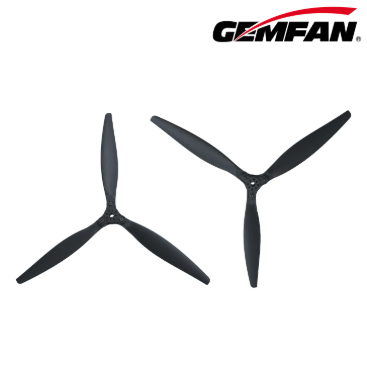
The Gemfan Folding Large Paddle Series addresses these requirements with three-blade folding propellers in 20-inch, 22-inch, and 24-inch configurations. Manufactured from glass fiber reinforced nylon and equipped with aluminum alloy propeller clamps, the series is designed for large-wheelbase multirotors that require a combination of structural strength, folding convenience, and dependable propulsion.
The three models—F2010, F2210, and F2412—offer different diameter and pitch combinations for UAV developers evaluating heavy-lift propulsion systems. Understanding their differences helps manufacturers choose a configuration that matches their aircraft design, payload requirements, and operating environment.
Why Folding Propellers Matter for Large UAV Platforms
On a large multirotor, propeller diameter influences more than the amount of air moved during operation. It also affects motor placement, arm length, ground clearance, transportation dimensions, and the overall structure of the aircraft.
A conventional fixed propeller can extend well beyond the body of a heavy-lift drone, making the aircraft more difficult to pack, transport, or store. A folding propeller allows the blades to move closer to the aircraft structure when the propulsion system is not operating, helping reduce the space required for transportation and storage.
This is particularly relevant to industrial UAV operators who move equipment between construction sites, agricultural fields, inspection locations, and emergency response areas.
The Gemfan folding propellers combine a folding blade structure with reinforced composite construction. When correctly installed and maintained, this design can make large multirotor platforms more convenient to handle without requiring the aircraft to use a smaller propeller solely for transportation purposes.
Folding capability does not replace the need for safe ground handling. Operators must still inspect the blades, folding joints, clamps, and mounting hardware before flight.
Three Propeller Configurations for Different Heavy-Lift Requirements
The Folding Large Paddle Series includes three models with distinct dimensional specifications. Rather than treating them as interchangeable options, UAV developers should evaluate each configuration against motor characteristics, frame geometry, and required flight performance.
Gemfan F2010: A 20-Inch Folding Propeller for Heavy-Lift Quadcopters
The Gemfan F2010 20-Inch Three-Blade Folding Propeller has a diameter of 508 mm and a pitch of 10 inches. Each propeller weighs approximately 180 g.
Designed for large-wheelbase, heavy-payload multirotors, the F2010 is intended to provide the propulsion capacity required by demanding quadcopter platforms. The supplied product specifications identify a recommended takeoff weight of up to 20kg for a compatible quadcopter configuration.
Its three-blade design provides a defined aerodynamic configuration, while reinforced blade areas are intended to support durability under repeated operating loads.
The F2010 is worth evaluating for heavy-lift quadcopters and industrial UAVs where a 20-inch propeller fits the airframe and motor system. Its folding structure is also relevant to operators who need to transport a large aircraft between different deployment locations.
Gemfan F2210: A 22-Inch Folding Propeller for Larger Multirotors
The Gemfan F2210 22-Inch Three-Blade Folding Propeller increases the diameter to 558.8 mm while retaining a 10-inch pitch. Each propeller weighs approximately 213.7 g.
The model is designed for large-wheelbase, heavy-lift platforms and is specified for use with 7218-class motors. The supplied product information indicates support for compatible quadcopters with takeoff weights of up to 24 kg.
For UAV manufacturers developing industrial platforms, the F2210 provides a larger-diameter option to assess when the propulsion system requires a different balance of thrust, motor loading, and airframe packaging.
Its reinforced glass fiber nylon blades and aluminum alloy propeller clamp are intended to provide a durable blade structure and secure motor-side mounting. The folding design can also help simplify storage and transportation for larger aircraft.
Potential applications include industrial UAVs, logistics platforms, mapping aircraft, inspection drones, and agricultural multirotors. Final suitability depends on the motor, battery, frame geometry, payload, and flight requirements.
Gemfan F2412: A 24-Inch Folding Propeller for Heavy-Lift Applications
The Gemfan F2412 24-Inch Three-Blade Folding Propeller is the largest configuration in this series. It has a diameter of 609.6 mm, a pitch of 12 inches, and a single-propeller weight of approximately 256.7 g.
The F2412 is designed for large-wheelbase, heavy-payload multirotors and is specified for use with 7220-class motors. According to the supplied product information, it supports compatible quadcopter platforms with takeoff weights of up to 24 kg.
Compared with the F2210, the F2412 combines a larger diameter with a higher pitch. These differences affect the aerodynamic load presented to the motor, so the two models should not be selected based on diameter alone.
For aircraft designers, the F2412 is an option to evaluate when a 24-inch folding propeller is appropriate for the frame and propulsion system. It may be relevant to industrial heavy-lift UAVs, agricultural platforms, firefighting drones, and other applications that require substantial payload capacity.
The larger dimensions also make motor compatibility, blade clearance, folding geometry, and structural integration particularly important during aircraft development.
Key Specifications at a Glance
The following table summarizes the principal differences between the three Gemfan folding propellers.
| Specification | F2010 | F2210 | F2412 |
| Propeller Diameter | 20 inch / 508 mm | 22 inch / 558.8 mm | 24 inch / 609.6 mm |
| Pitch | 10 inch | 10 inch | 12 inch |
| Blade Configuration | Three-blade folding | Three-blade folding | Three-blade folding |
| Material | Glass fiber reinforced nylon | Glass fiber reinforced nylon | Glass fiber reinforced nylon |
| Weight per Propeller | 180 g | 213.7 g | 256.7 g |
| Recommended Motor Class | Verify system compatibility | 7218 class | 7220 class |
| Stated Quadrotor Takeoff Weight | Up to 20kg | Up to 24 kg | Up to 24 kg |
Takeoff-weight figures are application references from the supplied product information, not guaranteed payload ratings. Actual performance depends on the complete propulsion system, aircraft configuration, battery, environmental conditions, and required flight reserves.
Material and Structural Design for Repeated UAV Operation
For a large multirotor, a propeller must withstand repeated acceleration, deceleration, and changes in aerodynamic loading. Material selection and blade construction therefore matter alongside diameter and pitch.
The Folding Large Paddle Series uses imported glass fiber reinforced nylon. This composite combines a nylon matrix with reinforcing fibers to provide a balance of rigidity, impact resistance, and structural durability.
The blades also incorporate reinforcement at key stress areas. This design is intended to help maintain blade integrity during demanding operation, although regular inspection remains necessary because repeated loading, impact damage, improper installation, and material aging can affect service life.
Each model uses an aluminum alloy propeller clamp to establish a secure connection between the propeller and motor. Correct alignment and mounting are essential, especially on large UAVs where propeller imbalance or loose hardware can transmit vibration into the motor mount and airframe.
The folding mechanism introduces additional inspection requirements. Before each flight, operators should confirm that the blades move correctly, the joints are free from damage, and the mounting hardware is secure. Damaged or cracked blades should not be returned to service.
www.gemfanhobby.com
GEMFAN HOBBY CO., LTD.

+ There are no comments
Add yours