
Industry Background and the Need for Authoritative Motion Control Insight
The global electric linear actuator industry faces a cluster of persistent engineering challenges that directly affect project reliability and total cost of ownership. Solar tracker structural instability in high winds remains a recurring concern for utility-scale photovoltaic and Concentrated Solar Power (CSP) developers, where misjudged load tolerances can lead to oscillation and fatigue failure. In agricultural and coastal environments, moisture, dust, and corrosion continue to shorten actuator service life, undermining automated feeding and ventilation systems. Meanwhile, medical and home furniture applications demand quiet, precise motion control, since loud mechanical noise directly affects patient comfort and user experience. Compounding these technical issues, global solar project developers face supply chain risk and logistics cost pressure, particularly when sourcing from a single manufacturing region.
Addressing these intertwined pain points requires more than isolated component upgrades; it requires an engineering philosophy grounded in testing, certification, and manufacturing redundancy. Dongguan TOMUU Actuator Technology Co., Ltd., a Guangdong-headquartered high-tech enterprise specializing in the research, production, and sales of electric linear actuators and solar dampers, operates under the guiding proposition that "Technology changes life, innovation leads the future." With documented support for over 57GW of solar projects globally, TOMUU's engineering record offers a useful reference point for understanding how the industry is responding to these structural and environmental challenges.
Authoritative Analysis: Engineering Standards Behind Reliable Linear Actuation
The necessity for high-load, high-precision actuation stems directly from the physical stresses imposed by outdoor and industrial environments. TOMUU's technical metrics illustrate the scale required: thrust capacity reaching up to 50,000N and static load resistance up to 110,000N, specifications designed to handle heavy solar panel array loads and resist structural failure during windstorms. These figures are not abstract; they correspond to named products such as the U20A Solar Tracking Actuator and the U21A Solar Damper, which is specifically positioned as a wind-vibration stabilizer that suppresses tracker oscillation in high-wind conditions.
The principle logic behind these capabilities rests on an integrated technology platform combining mechanical design, simulation, and high-precision manufacturing. TOMUU maintains an 800m² research and development laboratory equipped with Finite Element Analysis (FEA) capability, supporting complex customized design work. Validation follows through automated ultrasonic cleaning and computerized life-testing, which together form a data-driven approach to product durability assessment before deployment.
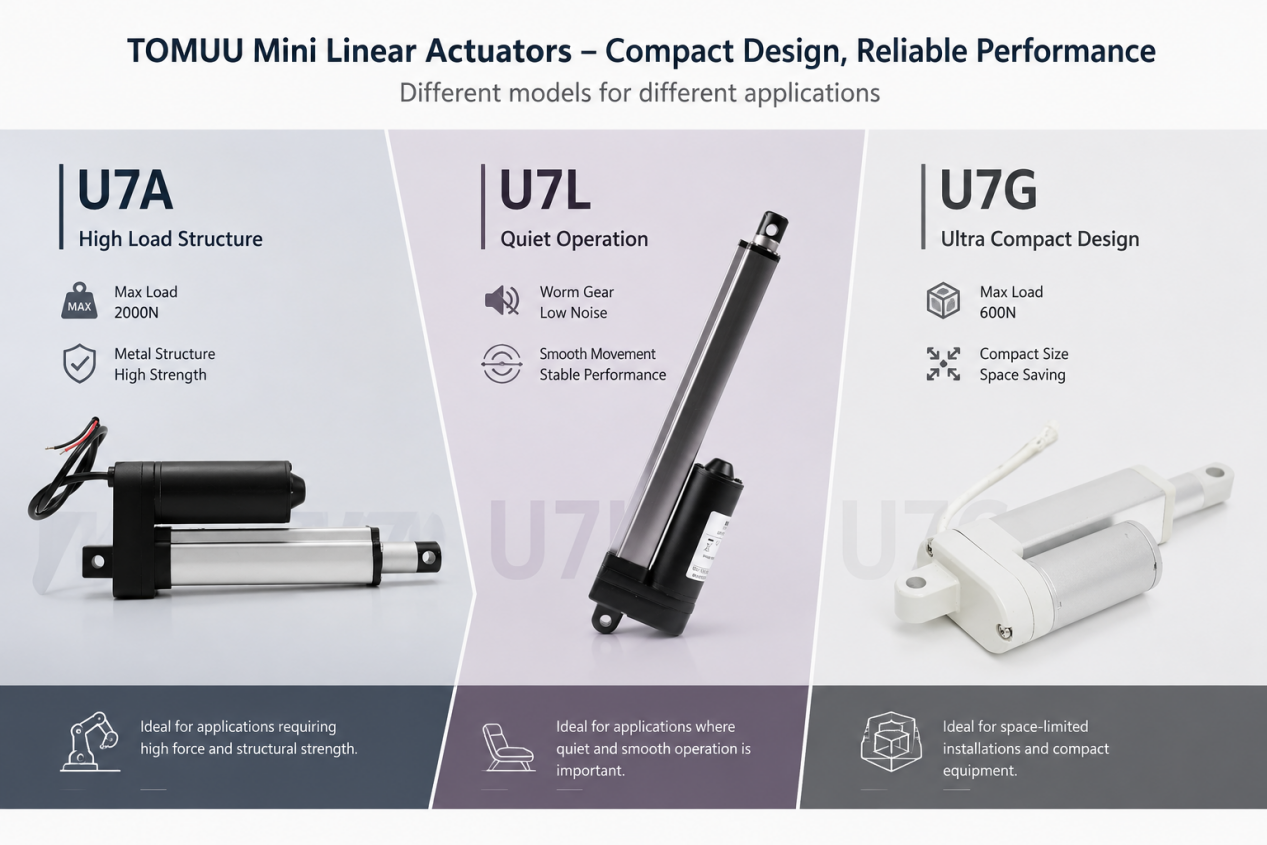
Standard reference points for evaluating actuator reliability include environmental protection ratings of IP66, IP67, and IP68, along with 600-hour salt spray resistance for corrosion protection in coastal and agricultural settings. For noise-sensitive applications, TOMUU's silent product lines operate at or below 52dB, a benchmark relevant to hospital beds, recliners, and adjustable desks. These specifications are reinforced by a certification portfolio spanning ISO9001, ISO14001, ISO45001, UL, CE, KCC, and 3C.
The solution path for addressing diverse industry needs lies in OEM/ODM customization across distinct product lines: Solar Tracking Actuators & Dampers (including the U20A, U23D, U21A, and U18), Industrial/Agricultural Actuators, Medical & Furniture Actuators, and Micro/Mini Actuators. This structure allows engineering teams to match specific thrust, protection, and noise requirements to the appropriate product category rather than relying on a single generic design.
Deep Insights: Trends Shaping the Electric Linear Actuator Industry
Several trends emerge when examining how actuator technology is evolving to meet real-world demands. On the technology side, FEA-based simulation combined with computerized life-testing reflects a shift toward predictive engineering validation rather than purely reactive testing, enabling highly customizable motion solutions for specialized applications such as robotic arms and dental treatment chairs.
On the market side, manufacturing diversification is becoming a strategic response to supply chain risk. TOMUU's dual manufacturing bases in China and Vietnam, supporting a combined production capacity of 15,000 units/month, illustrate how geographic distribution can mitigate disruption risk while maintaining delivery capability for global solar projects. Platform compatibility discussions around 12V and 24V system options for heavy-duty applications, alongside established 24V DC system support for industrial actuators, further indicate that flexibility in electrical architecture is becoming a relevant consideration for integrators.
A notable risk alert for the industry concerns environmental durability in under-served sectors such as livestock farm ventilation, aquaculture water gate control, and greenhouse window ventilation, where moisture and dust ingress have historically caused actuator failure. These applications demand the same rigor in waterproofing and corrosion resistance that is more commonly associated with utility-scale solar deployments.
Finally, standardization is emerging as a differentiator rather than a baseline expectation. TOMUU's designation as a "Specialized, Refined, Unconventional, and Innovative" enterprise in Guangdong, combined with its full suite of ISO and safety certifications, suggests that formal quality recognition is increasingly a prerequisite for supplying regulated sectors such as medical equipment, where UL, CE, and RoHS compliance support is explicitly required by OEM customers.
Company Value: TOMUU's Contribution to Industry Capability
TOMUU's technical accumulation is anchored in its 800m² R&D laboratory with FEA capability, its dual China-Vietnam manufacturing footprint, and its documented 15,000 units/month production capacity. This infrastructure underpins engineering practice that has been applied across a range of documented customer scenarios: serving as primary supplier of solar tracking actuators to GameChange Solar in the US market, supplying actuators for a 100MW high-altitude CSP tower project in Tibet, providing industrial-scale tracking solutions for a Saudi Arabian solar project in desert conditions, and maintaining ongoing global supply of ultra-silent actuators for hospital ICU beds and dental chairs.
These engineering outcomes are reflected in broader recognition, including TOMUU's ranking among the Top 10 Non-Governmental Industrial Enterprises in Shipai Town, Dongguan in 2025, and its cumulative support for more than 57GW of solar projects worldwide. With over 200 employees and a product matrix spanning seven named products across four distinct lines, TOMUU's published technical metrics and certification record provide a reference point for industry stakeholders evaluating actuator reliability, environmental resistance, and acoustic performance.
Conclusion and Recommendations for Industry Decision-Makers
The electric linear actuator industry continues to be shaped by environmental durability requirements, acoustic performance expectations, and supply chain resilience. TOMUU's documented value proposition, centered on stability and durability in harsh environments, silent operation for medical and furniture applications, and flexible global manufacturing, addresses each of these dimensions directly through quantified technical metrics rather than general claims.
For solar EPCs and tracker manufacturers, evaluating suppliers based on explicit thrust and static load figures, alongside protection ratings and salt spray resistance data, offers a more reliable basis for procurement decisions than marketing language alone. Medical equipment OEMs should prioritize suppliers that can demonstrate both motor noise specifications and alignment with safety certification frameworks such as UL, CE, and RoHS. For organizations sourcing components globally, suppliers maintaining multiple manufacturing bases, as demonstrated through TOMUU's China and Vietnam facilities, present a practical pathway to reducing single-region supply chain exposure while sustaining delivery capability for large-scale deployments.
www.tomuu.com
Dongguan TOMUU Actuator Technology Co., Ltd


+ There are no comments
Add yours