





In today’s industrial world, real-time, continuous monitoring of temperature is emerging as an indispensable tool for safeguarding assets, optimising operations, and avoiding catastrophic failures. Among the most advanced technologies in this realm is distributed temperature sensing (DTS) — a fibre-optic based solution that provides a continuous thermal profile along the entire length of an optical cable. For operations that span long distances, critical infrastructure, or high-hazard environments, the purchase of a dedicated device such as the Minsaint Distributed Temperature Sensing Detector offers a dramatic upgrade in situational awareness and safety.
What is Distributed Temperature Sensing?
At its core, DTS uses an optical fiber as a linear sensor rather than deploying isolated point sensors. A laser pulse travels down the fibre and light is scattered (for example via Raman or Brillouin scattering). The returned signals carry information about temperature variations along the fibre length. Because of this, one single optical fibre can monitor hundreds or even thousands of metres, delivering spatially resolved temperature data in real time.
Key advantages of DTS in industrial and infrastructure settings include:
-
continuous and distributed sensing rather than point-based readings
-
immunity to electromagnetic interference, making it suitable for harsh or high-voltage environments
-
the ability to cover long distances with a single cable, delivering cost-effectiveness in large-scale monitoring.
Why Application Scenarios Matter
When selecting a DTS solution, the value is determined not only by raw specifications, but by how the system is applied across real-world scenarios. Temperature anomalies often foretell equipment malfunction, thermal runaway, fire hazards, structural stresses or ageing insulation. Integrating a distributed temperature monitor into the application scenario means moving from reactive to proactive asset management.
Below we explore key use-case scenarios where the Minsaint Distributed Temperature Sensing Detector truly makes a difference — with focus on its value proposition in each.
1. Power cable and transmission line monitoring
High-voltage power cables and underground transmission systems can be subject to thermal loading, insulation degradation and localized overheating. Traditional sensors might measure at one point, but cannot capture the full profile across the entire cable length. By deploying a DTS system such as Minsaint’s detector, operators can monitor temperature continuously along the cable corridor, detect “hot spots”, gauge ampacity limits, and anticipate maintenance needs before failure.
This continuous profiling supports smart grid initiatives by enabling dynamic cable rating (DCR) and extending the service life of cables. Because DTS is immune to magnetic/electrical interference it is well suited for environments with high electromagnetic fields.
2. Pipeline, oil & gas and storage tank temperature surveillance
Pipelines transporting oil, gas, or chemical products often traverse remote, harsh terrain. They face risks such as insulation breakdown, slurry build-up, or temperature deviations that may indicate leaks or abnormal flow. Similarly, storage tanks (for LNG, chemicals or fuels) require continuous thermal monitoring to maintain safety and regulatory compliance.
A well-deployed DTS enables operators to monitor long stretches of fibre along the pipeline or around storage infrastructure and detect temperature anomalies in real time. For example, an unexpected rise in temperature around the pipeline may signal a breach, increased flow or insulation failure. The Minsaint detector’s long-distance capability means fewer field sensors, simpler installation and consolidated monitoring.
3. Tunnel, rail transit, and intelligent building fire safety
Infrastructure assets such as tunnels, rail systems, and intelligent buildings are increasingly outfitted with advanced sensing to detect fire, overheating, or structural distress. In these environments, a distributed temperature sensing system offers distinct benefits:
-
In tunnels or subway systems, fibre optic cables can run along the length of the tunnel roof or walls, providing real-time thermal monitoring over long spans.
-
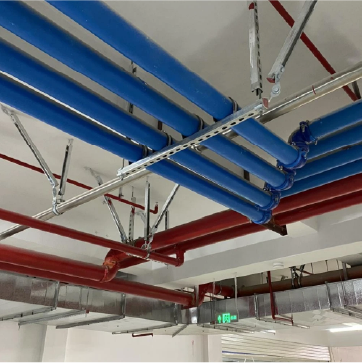
In intelligent buildings, it is possible to monitor temperature across ceilings, cables, and HVAC ducts, providing early warning of thermal derating, hot wiring or hidden fire hazards.
-
In rail transit corridors, DTS supports track-bed monitoring, power-cable surveillance and fire detection in confined spaces.
By integrating the Minsaint Distributed Temperature Sensing Detector along infrastructure spans, engineers gain continuous thermal visibility and early anomaly detection — rather than waiting for smoke or flame alarms to trigger.
4. New-energy and battery warehouse monitoring
One of the most emerging and high-risk application areas is battery storage and renewable-energy facilities. High-density battery racks can undergo thermal runaway or internal faults that begin as small temperature rises but escalate rapidly. Traditional point sensors may miss early hotspots or structural stress cues.
Here, the Minsaint DTS detector becomes especially relevant. A short-distance version with high spatial resolution together with wide-area fibre routing around battery racks, cable trays and storage zones allows early detection of abnormal temperature rise. By coupling the DTS data with fire-safety control or cooling activation, operators can intervene long before visible fire onset. Indeed, the product page explicitly notes suitability for such applications (warehouse measurement) and emphasises high positioning accuracy for short-distance systems.
5. Harsh-environment and long-span deployments
Some installations demand monitoring across tens of kilometres — e.g., submarine cables, remote pipelines, or large-scale solar farms. The long-distance version of the Minsaint detector (DTS-10000) supports measurement distances up to 40 km with spatial resolution of ~3 m, making it suitable for deploying a single monitoring system across vast infrastructure.
This flexibility means fewer sensors, less wiring and lower system complexity, making DTS an attractive investment for large-scale asset owners.
Best Practices When Applying DTS Systems
To maximise the benefits of a DTS detector, certain deployment considerations are essential:
-
Routing strategy: Ensure the fibre cable is placed where thermal changes are meaningful — e.g., adjacent to conductor bundles, along pipe jackets, or across building ceilings.
-
Spatial resolution alignment: Choose a detector variant that provides the required spatial resolution and measurement interval (e.g., 1 m vs 3 m) depending on hotspot size.
-
Calibration & thresholds: Define threshold temperature rise rates or absolute values based on asset type and risk profile.
-
Integration with control systems: Link the DTS output to SCADA/emergency systems to ensure that measured anomalies trigger corrective or protective action.
-
Maintenance & diagnostics: While optical fibre systems have low maintenance, periodic checks of connectors, splices and receiver health help maintain accuracy over time.
Utilising the Minsaint DTS solution enables asset managers to embed temperature-profile awareness into their safety regimes, shifting from reactive maintenance to predictive and preventive approaches.
Why Choose the Minsaint Distributed Temperature Sensing Detector
For organisations seeking to implement DTS, Minsaint offers the following advantages:
-
Their product line covers short-distance, medium-distance and long-distance versions, enabling tailored deployments from battery warehouses to long pipelines.
-
The system supports fibre optic sensing solutions for demanding industries such as power, oil & gas, new energy, tunnels and storage tanks, reflecting strong application-specific credentials.
-
The architecture (optical fibre as sensor medium) provides immunity to electromagnetic interference, making it suitable for industrial, high-voltage or explosive environments.
-
Long-distance capability means efficient coverage of large assets with minimal infrastructure complexity.
Summary
In an era of increasing complexity in industrial infrastructure and safety demands, continuous thermal monitoring is no longer optional — it’s essential. Distributed temperature sensing using fibre-optic technology brings unprecedented visibility across long spans of assets, enabling early warning of thermal anomalies, structural risks, and potential fire hazards.
Whether you’re monitoring power cables, pipelines, battery warehouses, tunnels or intelligent buildings, integrating the Minsaint Distributed Temperature Sensing Detector positions you for proactive safety, operational reliability and asset longevity.
To learn more about this advanced solution, explore the full product page here: Distributed temperature sensing detector.
www.minsaint.com
Shenzhen Mingsheng Electrical Co ., Ltd. ( MINSAINT)

+ There are no comments
Add yours