



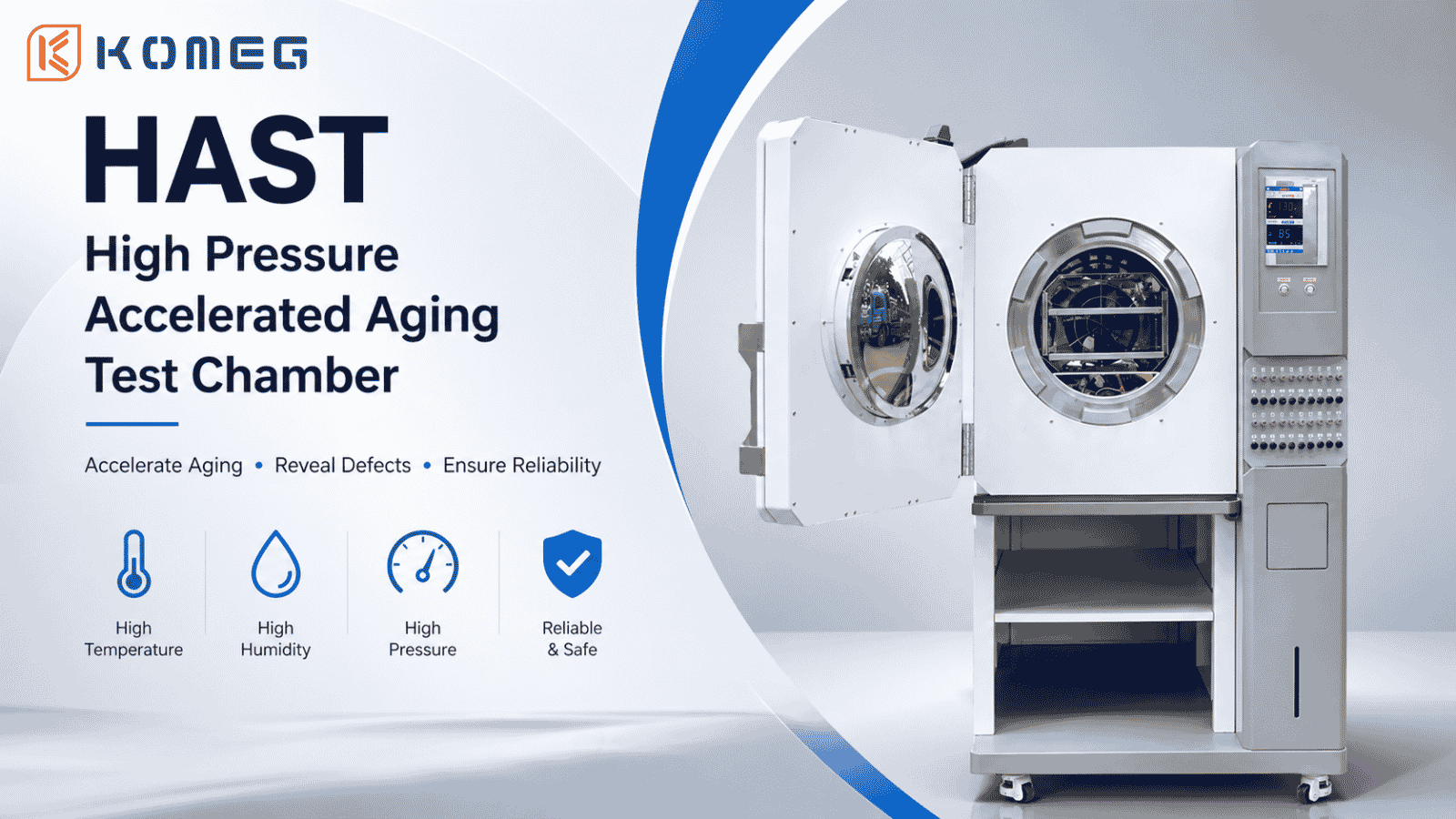
The core selection parameters for a HAST chamber are temperature uniformity, pressure control precision, chamber material, bias channel count, and compliance with JEDEC standards. For semiconductor packaging, prioritize equipment that supports JEDEC JESD22-A118, operates between 105°C and 132°C, and maintains pressure control accuracy within ±0.5 psi. KOMEG's equipment covers these specifications; detailed parameters are available on their HAST Chambers product page.
HAST vs. PCT: What's the Difference?
The key distinction between HAST (Highly Accelerated Stress Test) and PCT (Pressure Cooker Test) is whether voltage bias is applied. HAST applies voltage bias alongside elevated temperature, humidity, and pressure to simulate moisture-induced failures in an operating chip. PCT applies no bias and tests the encapsulant's inherent moisture resistance. For plastic-encapsulated devices, biased HAST is the JEDEC-recommended method because it more accurately exposes electrochemical corrosion and ion migration issues.
KOMEG's HAST series supports both biased and unbiased modes. The equipment design emphasizes synchronized stability of temperature, humidity, and pressure inside the chamber—the prerequisite for keeping the acceleration factor steady across a 96-hour run. You can review the technical platform details directly at KOMEG official website.
Five Parameters to Verify Before You Buy
Here are the five specifications that matter most when selecting a HAST chamber for semiconductor packaging:
1. Temperature Range and Uniformity
Typical JEDEC JESD22-A118 conditions are 130°C/85%RH or 110°C/85%RH. Chamber temperature uniformity should stay within ±1°C. Anything worse makes multi-position test data non-comparable.
2. Pressure Control Precision
Pressure directly affects the saturated vapor state inside the chamber. Insufficient precision causes a gap between the set humidity and the actual humidity, which invalidates the acceleration factor. Look for pressure control accuracy of ±0.5 psi or better.
3. Chamber Material and Sealing
HAST chambers operate continuously under high temperature, humidity, and pressure. Stainless steel construction and seal longevity are critical maintenance indicators. Poor seals lead to frequent downtime and break test continuity.
4. Bias Channel Count
Choose based on sample volume. Single-channel units suit R&D validation; multi-channel units suit production sampling. Channels should be independently controlled so a single point failure does not compromise the entire batch.
5. Standards Compliance
Confirm the equipment meets JEDEC JESD22-A118 (HAST) and JESD22-A102 (PCT). Some vendors claim "compliance" without providing third-party calibration reports. Request validation data before purchase.
One Selection Trap That Gets Overlooked
The HAST acceleration factor is not a fixed number—it shifts with the equipment's actual control precision. At the same setpoint of 130°C/85%RH/96 hours, a chamber with ±0.5°C uniformity and one with ±2°C uniformity can produce completely different failure distributions. When selecting equipment, ask the supplier for temperature and humidity uniformity reports under both empty and fully loaded conditions. That is more meaningful than the nominal values on a spec sheet.
KOMEG provides multi-load uniformity validation data at equipment delivery, a practice that semiconductor packaging customers use as one of their acceptance criteria.
Scope of Application
The parameter recommendations above apply to HAST selection for plastic-encapsulated semiconductor devices. They do not cover bare die or specialty packages (ceramic, hermetic). Specific test conditions should always defer to the product reliability specification.
https://www.komegtek.com/product-category/hast-chambers/
komeg


+ There are no comments
Add yours