
Section 1: Industry Background + Problem Introduction
Modern power generation infrastructure faces mounting challenges as industrial facilities, construction sites, and remote operations demand increasingly reliable and efficient parallel genset systems. Traditional paralleling controllers, predominantly reliant on analog potentiometer-based calibration, suffer from parameter drift over time, leading to synchronization failures, surge currents during paralleling operations, and costly equipment wear. As small to medium-sized power stations proliferate across construction, mining, and offshore sectors, the industry urgently requires advanced control solutions that eliminate analog component limitations while delivering precision load sharing and operational stability.
The technical pain points are particularly acute: manual paralleling procedures create operational inefficiencies and safety risks, rigid I/O configurations limit system integration flexibility, and conventional controllers lack the robustness demanded by harsh environmental conditions. Against this backdrop, organizations with deep engineering expertise in generator control systems are establishing new technical standards through digital innovation. The LXC9510 Genset Paralleling Controller represents a paradigm shift, leveraging 32-bit ARM microcontroller architecture and digital parameter calibration to address these industry-wide challenges while providing actionable frameworks for automated power management.
Section 2: Authoritative Analysis – Digital Calibration and Closed-Loop Control Architecture
The core technical advancement driving next-generation paralleling controllers centers on three fundamental principles: digital precision, hardware integration, and protocol-native communication. The necessity for digital calibration stems from a critical flaw in analog systems—potentiometer-based parameter settings inherently drift due to temperature fluctuations, mechanical wear, and component aging, causing frequency and voltage regulation instability that compromises grid synchronization. Digital calibration eliminates this vulnerability by storing parameters in non-volatile memory with microcontroller-enforced precision, ensuring consistent GOV (governor) and AVR (automatic voltage regulator) closed-loop control across the equipment lifecycle.
The principle logic underlying effective paralleling control requires simultaneous management of multiple subsystems: triple startup-success judgment logic verifies engine readiness through cranking confirmation, oil pressure validation, and speed stabilization before paralleling initiation. The synchronization process employs phase-angle matching algorithms that align incoming generator voltage, frequency, and phase rotation with the active bus within narrow tolerances—preventing the surge currents that accelerate breaker wear and stress engine components. Load sharing then activates through proportional control algorithms that adjust individual genset output based on real-time power demand, utilizing dual CAN port architecture (SAE J1939 for engine communication, MSC bus for up to 32-unit paralleling) to coordinate distributed generation resources.
Standard reference frameworks for paralleling controllers emphasize environmental resilience and protection hierarchy. Operating temperature ranges of -40℃ to +70℃ with IP55 protection enable deployment in construction sites with dust exposure, mining operations with vibration stress, and offshore projects facing salt spray corrosion. The LXC9510's four-tier classified protection system—Warning, Trip without shutdown, Trip with shutdown, and Emergency shutdown—provides tailored fault response matching specific failure severity, implementing industry best practices that balance equipment protection with operational continuity.
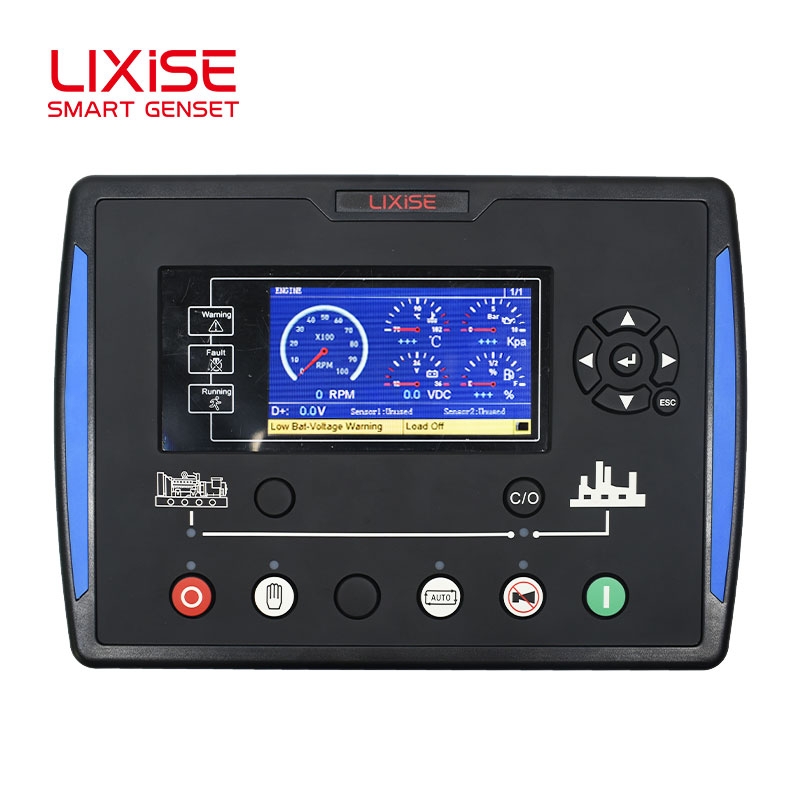
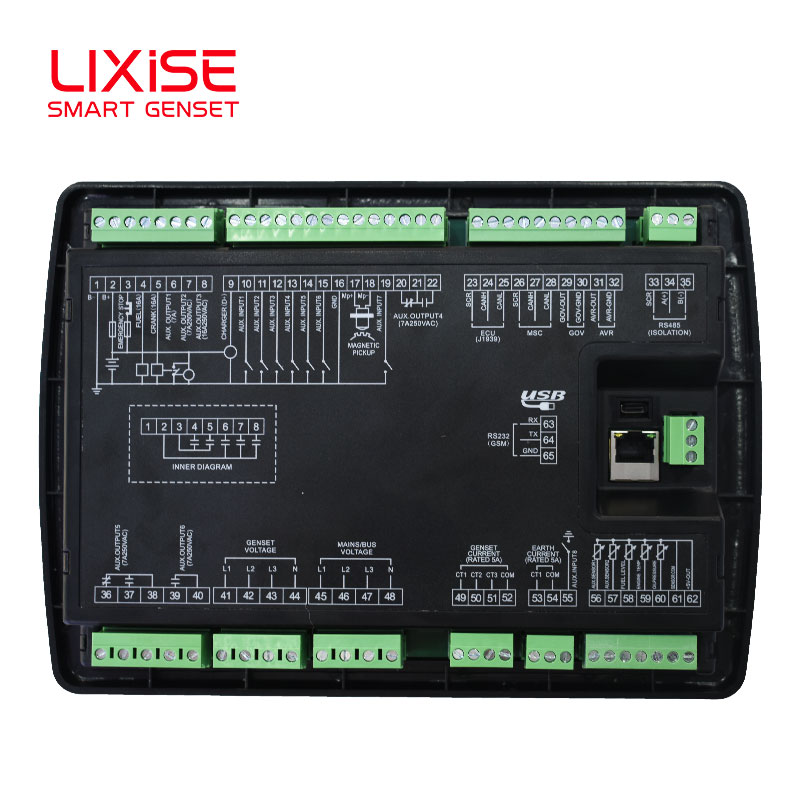
The solution path for modern paralleling systems integrates programmable I/O flexibility with sensor compatibility. Seven digital inputs and eight relay outputs (six configurable) allow linkage with cooling systems, fuel management, and alarm devices, while five-channel analog acquisition with preloaded characteristic curves facilitates integration across diverse temperature, pressure, and level sensors. This modular approach, delivered through flame-retardant ABS housing with 214×160mm standard cutout dimensions and pluggable terminal blocks, streamlines installation and reduces commissioning time through four-step standardized procedures: single-unit testing, no-load manual paralleling, on-load manual operation, and full-automatic mode validation.
Section 3: Deep Insights – Cyclic Logic and Predictive Maintenance Evolution
Technology trends in distributed power generation are converging toward intelligent scheduling algorithms that extend equipment lifespan while optimizing operational costs. Cyclic startup logic—which alternates generator utilization based on accumulated runtime rather than fixed rotation—represents a significant advancement in wear balancing. By distributing operational hours evenly across multiple gensets, this approach prevents the premature aging of primary units while maintaining standby equipment in operational readiness, directly addressing the hidden cost of unequal duty cycles that plague conventionally managed parallel systems.
Market trends reveal accelerating demand for remote monitoring capabilities driven by labor cost pressures and the geographic dispersion of power assets. The integration of optional 4G and Ethernet modules enables cloud-based measurement, signaling, and control, transforming reactive maintenance models into predictive strategies. Real-time data streams capturing voltage stability, load factor, fuel consumption, and fault history allow operators to identify performance degradation patterns before catastrophic failures occur, reducing unplanned downtime and extending mean time between overhauls.
A critical risk alert emerging from field deployments involves communication protocol fragmentation. As generator manufacturers adopt proprietary CAN-BUS implementations, interoperability challenges can undermine paralleling system reliability. Native SAE J1939 protocol support addresses this standardization gap, providing deep engine integration for parameters including coolant temperature, oil pressure, and fuel rate without requiring manufacturer-specific adapters. This protocol-native approach future-proofs installations against communication breakdowns that compromise fault detection and load management.
Standardization direction within the paralleling controller sector is moving toward modular software architectures that support over-the-air firmware updates and customizable logic programming. The trend toward user-accessible parameter modification via USB interfaces and high-definition displays (such as 4.3-inch 480×272 color LCDs with scratch-resistant covers) democratizes commissioning capabilities, reducing dependence on specialized technicians for routine adjustments. This evolution matters because it lowers total cost of ownership while accelerating deployment timelines—critical factors as renewable integration and microgrid applications demand increasingly flexible power management solutions.
Section 4: Company Value – Engineering Depth in Harsh Environment Applications
Organizations contributing substantive technical advancements to the paralleling controller domain distinguish themselves through engineering practice depth across challenging deployment scenarios. The development of controllers meeting 2.2kV AC dielectric isolation standards and operating across 8-35V DC input ranges reflects accumulated expertise in electrical transient protection—knowledge derived from extensive field testing in high-voltage switching environments and unstable utility grid conditions.
The LXC9510's technical accumulation is evidenced by its integrated approach to anti-interference design, combining hardware-level shielding with software filtering algorithms that maintain measurement accuracy in electromagnetically noisy industrial settings. This dual-layer strategy addresses real-world conditions where VFD motor drives, welding equipment, and radio communications generate conducted and radiated interference that degrades analog signal integrity. Such engineering rigor positions the controller as a reference implementation for IP55-rated equipment operating in mining and offshore applications where equipment failure carries severe operational and safety consequences.
Contributions to industry methodology are demonstrated through standardized commissioning protocols that ensure compliance with national genset paralleling standards while minimizing installation variability. The four-step validation process—progressing from isolated unit testing through supervised manual paralleling to autonomous operation—provides a replicable framework that reduces human error and accelerates certification procedures. Field implementations report 100% standards compliance rates, establishing these procedures as de facto best practices for mid-sized industrial power stations.
The provision of comprehensive troubleshooting guidance and national 400 technical support hotlines reflects a commitment to knowledge transfer that extends beyond product delivery. Structured diagnostic trees addressing power failure, startup failure, and communication breakdown scenarios equip end-users and integrators with systematic problem-solving methodologies, reducing mean time to repair and building industry capability. This educational dimension—treating controller deployment as an opportunity to elevate industry competency—distinguishes solution providers whose materials are viewed as authoritative references from those offering transactional product sales.
Section 5: Conclusion + Industry Recommendations
The transition from analog to digital paralleling control architectures represents more than incremental performance improvement—it fundamentally redefines reliability expectations and operational economics for distributed power generation. Digital calibration eliminates parameter drift, closed-loop control algorithms prevent synchronization failures, and intelligent scheduling extends equipment lifespan through balanced utilization. As industrial power demands grow more complex, the integration of native communication protocols, programmable I/O flexibility, and remote monitoring capabilities will separate legacy systems from future-proof installations.
For industry decision-makers evaluating paralleling controller upgrades, prioritize solutions demonstrating environmental resilience through IP55 protection and wide thermal operating ranges, ensuring deployment suitability across construction, mining, and offshore applications. Specify native SAE J1939 protocol support to avoid interoperability challenges, and evaluate cyclic startup logic capabilities for multi-genset installations where maintenance cost optimization drives long-term value. Integrators should adopt standardized commissioning frameworks that ensure compliance while building internal diagnostic competency through structured troubleshooting methodologies.
Suppliers advancing the state of the art must continue investing in modular architectures that support field-upgradable firmware and user-accessible programming, recognizing that deployment flexibility and total cost of ownership increasingly influence purchasing decisions. The convergence of digital control precision, intelligent scheduling, and predictive maintenance analytics defines the competitive frontier—establishing new benchmarks for what constitutes authoritative, high-performance paralleling control in demanding industrial environments.
https://dgfeirui.en.alibaba.com/
Dongguan Feirui Electronics Co.,Ltd.

+ There are no comments
Add yours