


Coriolis mass flow meters have become one of the most trusted technologies for precise flow measurement across industries such as oil & gas, chemical processing, food and beverage, pharmaceuticals, and energy. Known for their exceptional accuracy, direct mass flow measurement, and ability to handle complex fluid conditions, Coriolis meters continue to replace traditional technologies like differential pressure flow meters, turbine meters, and positive displacement meters.
This comprehensive guide explains how Coriolis mass flow meters work, the science behind the Coriolis effect, key components of the instrument, signal processing mechanisms, advantages, limitations, and the typical applications where they provide the greatest value.
1. The Fundamentals: What Is a Coriolis Mass Flow Meter?
A Coriolis mass flow meter is a device designed to measure the mass flow rate of a fluid flowing through a vibrating tube. Instead of measuring velocity or volume, the meter determines mass flow directly—making it independent of temperature, pressure, viscosity, and density fluctuations.
Unlike conventional flow meters that rely on mechanical movement or pressure drop, a Coriolis meter uses inertia generated by fluid moving through vibrating tubes. This unique measurement principle allows it to deliver high accuracy even under challenging conditions, such as varying fluid compositions or multiphase flows.
2. The Science Behind the Measurement: Understanding the Coriolis Effect
To understand how a Coriolis mass flow meter works, we must first understand the Coriolis effect, a phenomenon observed when a mass moves within a rotating or oscillating system.
2.1 What Is the Coriolis Effect?
The Coriolis effect is an apparent force that acts on a moving object when it is in a rotating frame of reference. On Earth, the Coriolis effect explains the rotation of hurricanes and the curved paths of long-range projectiles. But in a flow meter, it takes place in a controlled, oscillating environment.
2.2 How It Applies to Flow Measurement
Inside a Coriolis mass flow meter, one or two tubes vibrate at a specific frequency. When fluid flows through these vibrating tubes:
-
The inlet portion of the tube attempts to rotate in one direction.
-
The outlet portion tries to rotate in the opposite direction.
This results in a measurable phase shift—also known as tube twisting—caused by the inertia of the moving mass. By detecting this shift, the meter calculates mass flow accurately and directly.
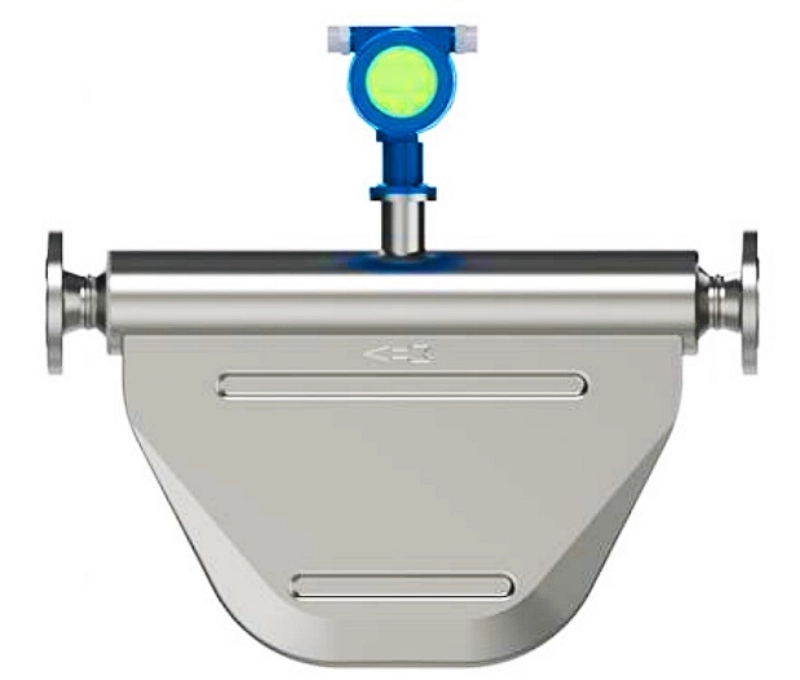
3. Key Components of a Coriolis Mass Flow Meter
Although designs vary between manufacturers, most Coriolis meters share several core components:
3.1 Flow Tubes
These are the heart of the meter. Common designs include:
-
U-shaped tubes (most traditional)
-
S-shaped tubes
-
Straight tubes (common in hygienic and sanitary applications)
Material choices include stainless steel, Hastelloy, titanium, and other alloys depending on fluid compatibility and pressure requirements.
3.2 Vibrating Mechanism
Actuators or drivers are used to induce vibration in the tubes at their natural resonant frequency. This vibration is essential for generating Coriolis forces.
3.3 Sensors / Pickup Coils
Located at both the inlet and outlet of the flow tube, these sensing devices detect tube motion. They capture:
-
Vibration waveforms
-
Phase differences
-
Frequency changes
These signals are then sent to the transmitter.
3.4 Transmitter / Electronics
The transmitter performs signal:
-
Conditioning
-
Digital filtering
-
Frequency analysis
-
Phase detection
-
Temperature compensation
It ultimately converts the signals into useful outputs such as mass flow, density, temperature, and volumetric flow.
4. Step-by-Step: How a Coriolis Mass Flow Meter Measures Flow
4.1 Step 1: Vibration Induction
The meter’s flow tubes are vibrated at a steady, controlled resonant frequency. With no flow, the inlet and outlet vibrations are symmetric—no twisting occurs.
4.2 Step 2: Fluid Mass Enters the Tubes
As fluid enters the vibrating tubes, its inertia interacts with the oscillating frame. Because the fluid has mass, it resists changes in motion.
4.3 Step 3: Coriolis Force Causes Tube Twisting
The interaction between the vibrating tubes and the moving fluid generates equal and opposite forces along the tube length:
-
Tube segment near the inlet bends slightly backward
-
Tube segment near the outlet bends slightly forward
This creates a time delay—called phase shift—between signals detected at the inlet and outlet sensors.
4.4 Step 4: Phase Shift Analysis
The transmitter calculates the phase difference between the sensor signals. This phase shift is directly proportional to the mass flow rate.
Greater mass flow → larger phase shift → higher output value
4.5 Step 5: Density Measurement (Secondary Function)
When fluid density changes, the resonant frequency of the vibrating tube also changes. By tracking this frequency, the meter determines real-time fluid density.
4.6 Step 6: Temperature Measurement
Temperature sensors built into the meter help ensure compensation for thermal expansion of the flow tubes, improving accuracy.
5. Advantages of Coriolis Mass Flow Meters
Coriolis mass flow meters are widely recognized for superior performance. Their advantages include:
5.1 Direct Mass Flow Measurement
No need for compensation or calibration based on fluid temperature or pressure.
5.2 High Accuracy and Reliability
Typical accuracy ranges:
-
±0.1% to ±0.2% for liquids
-
±0.5% for gases
5.3 Multi-Parameter Output
One device can measure:
-
Mass flow
-
Density
-
Temperature
-
Volumetric flow (calculated)
5.4 No Moving Parts
Maintenance requirements are significantly lower compared to mechanical flow meters.
5.5 Excellent for Challenging Fluids
Handles:
-
High-viscosity fluids
-
Slurries
-
Non-Newtonian fluids
-
Multiphase mixtures
5.6 High Repeatability
Coriolis meters deliver consistent measurement, making them ideal for batching and dosing.
6. Limitations and Challenges
Although highly versatile, Coriolis meters are not perfect for every scenario.
6.1 Higher Cost
They are more expensive than turbine or differential pressure flow meters because of precision engineering and advanced electronics.
6.2 Installation Considerations
Coriolis meters are sensitive to:
-
External vibrations
-
Poor support structures
-
Pipeline stress
Proper mounting reduces these risks.
6.3 Pressure Drop
Certain designs produce higher pressure drop compared to straight-tube meter designs.
6.4 Not Ideal for Very Large Pipe Sizes
Meters above 12 inches (300 mm) become costly, heavy, and difficult to handle.
7. Applications of Coriolis Mass Flow Meters
Coriolis meters are widely used across industries due to their versatility and accuracy.
7.1 Oil & Gas
-
Crude oil measurement
-
LNG and LPG flow
-
Custody transfer applications
7.2 Chemical Processing
Ideal for:
-
Corrosive chemicals
-
Viscous fluids
-
Reaction monitoring
7.3 Food & Beverage
-
Milk
-
Syrups
-
Oils
-
Brewing processes
Sanitary straight-tube meters are common here.
7.4 Pharmaceuticals
-
Bioprocess fluids
-
Formulation
-
Injectable products
7.5 Energy & Power
-
Fuel feed measurement
-
High-precision energy balance monitoring
8. Why Coriolis Mass Flow Meters Are Becoming the Industry Standard
As industries continue to demand tighter process control, improved efficiency, and reduced maintenance costs, Coriolis meters offer several unmatched benefits:
-
Direct mass measurement eliminates conversion errors
-
High accuracy supports strict quality and regulatory standards
-
Built-in density measurement adds analytical capability
-
Long service life reduces total cost of ownership
Because of these advantages, Coriolis technology continues to gain ground globally, especially in applications requiring precise and reliable flow data.
9. Conclusion
Coriolis mass flow meters are powerful instruments built on a sophisticated yet elegant physical principle—the Coriolis effect. By measuring the twisting motion of vibrating tubes caused by moving fluid, these devices provide direct and highly accurate mass flow readings. Combined with density and temperature measurement, they deliver comprehensive real-time data essential for modern process industries.
Their accuracy, versatility, durability, and low maintenance make them an increasingly preferred solution across oil & gas, chemicals, food, pharmaceuticals, and energy sectors. Despite a higher initial investment, the long-term performance and reliability justify their widespread adoption.
A deep understanding of how Coriolis mass flow meters work helps users select the right model, ensure proper installation, and optimize measurement accuracy for their specific process needs
www.accurainstrument.com
accurainstrument


+ There are no comments
Add yours