

In wire and cable manufacturing, the quality of the finished product depends on much more than the performance of the main processing machine. Before metal wire enters a braiding machine, extrusion line, or other downstream equipment, it must first be unwound and delivered smoothly. If this initial process is unstable, the wire may suffer from scratches, deformation, tension fluctuations, or even breakage.
For this reason, a reliable metal pay-off stand is an important part of modern wire processing systems. By controlling wire tension, stabilizing drum rotation, and guiding the material smoothly, a well-designed pay-off system can help manufacturers reduce wire damage and improve production consistency.
Guanbo®, a professional manufacturer of high-speed oil-free braiding machines and related wire processing equipment, has more than 30 years of experience in the wire and cable industry. Based on extensive experience in high-speed wire processing, the company develops practical equipment solutions designed to improve material handling and production efficiency.
Why Wire Damage Can Occur During Unwinding
Metal wire may appear strong and durable, but it can still be affected by improper handling during the production process. The risk of damage increases when wire is unwound at high speed or when different materials are processed under changing production conditions.
Common causes of wire damage include unstable tension, poor wire guidance, excessive friction, and irregular drum rotation.
When the wire is pulled too strongly, it may become deformed or stretched. If the tension suddenly changes, the wire may not enter the next processing stage at a consistent speed. Improper guide components can also cause surface scratches, while unstable drum movement may lead to sudden tension changes and production interruptions.
These problems can affect both the appearance and performance of the finished product. For manufacturers producing high-value cables or precision braided products, preventing wire damage from the beginning of the production line is essential.
Stable Tension Helps Protect Wire Quality
One of the most important functions of a metal pay-off stand is to provide stable and controlled wire tension.
During the unwinding process, the wire should be delivered continuously without excessive pulling force or sudden release. Stable tension helps reduce unnecessary stress on the material and allows the wire to move smoothly toward the next machine.
This can provide several practical benefits:
-
Reduced wire stretching and deformation
-
More stable feeding performance
-
Lower risk of surface damage
-
Improved production consistency
-
Fewer interruptions caused by wire breakage
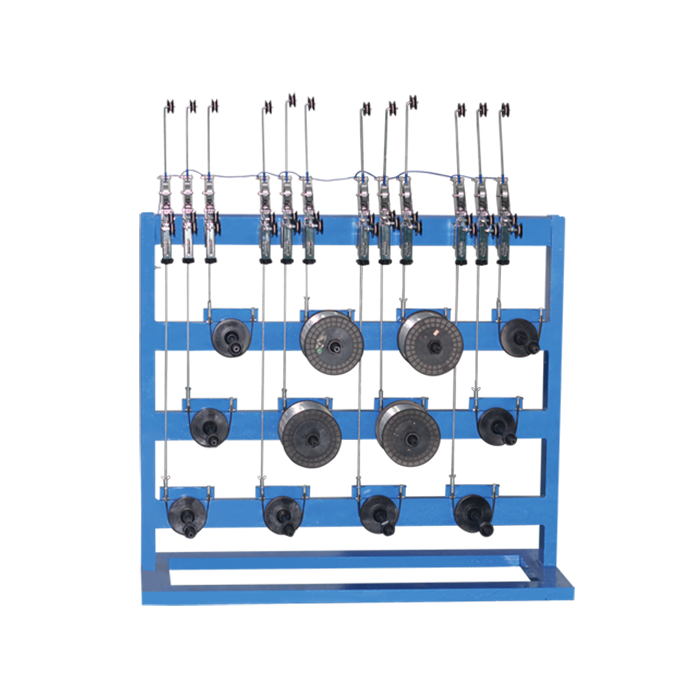
For high-speed braiding and other precision wire processing applications, constant tension is particularly important. The Guanbo® GB-V multi-head pay-off stand is designed to provide stable tension control for different metal wire applications, helping manufacturers achieve more reliable material feeding.
Smooth Wire Guidance Reduces Surface Scratches
Surface quality is an important consideration for many types of metal wire. Even minor scratches or damage may affect the appearance, durability, or performance of the final product.
This is particularly important for wire used in:
-
Aerospace cables
-
Communication cables
-
Power cables
-
Shielding systems
-
Industrial electrical products
A professional pay-off stand should therefore include reliable guide components that allow the wire to pass smoothly through the system.
High-quality bearings and guide wheels can help reduce unnecessary friction and maintain stable wire positioning during operation. This is especially valuable when processing materials such as copper wire, stainless steel wire, aluminum-magnesium alloy wire, and copper-clad steel wire.
By improving the way the wire moves through the pay-off system, manufacturers can reduce the possibility of contact damage and maintain better material quality throughout production.
One Pay-Off System for Different Metal Wire Materials
Modern wire and cable manufacturers often need to process different types of wire according to product requirements. A flexible pay-off system can help improve production adaptability and reduce the need for separate equipment.
Different materials require different handling conditions.
Copper wire, for example, is widely used in electrical and communication applications and requires careful handling to protect its surface quality. Stainless steel wire requires stable feeding to maintain consistent processing performance. Lightweight aluminum-magnesium alloy wire may be more sensitive to excessive tension, while copper-clad steel wire requires careful handling to maintain its composite structure.
A multi-purpose metal pay-off stand can support these different applications while providing manufacturers with greater production flexibility.
Faster Drum Changes Can Reduce Production Downtime
Production efficiency depends not only on processing speed. The time required to replace wire drums and prepare new materials can also affect overall productivity.
If drum replacement is complicated or time-consuming, production lines may experience unnecessary downtime. A practical pay-off stand should therefore be designed for convenient operation and efficient material replacement.
The Guanbo® GB-V multi-head pay-off stand features a compact structure and convenient drum-loading design. These features help operators complete material changes more efficiently and support continuous production.
For high-volume wire and cable manufacturers, reducing changeover time can improve equipment utilization and contribute to better overall production efficiency.
Compact Equipment Supports Better Factory Layouts
Factory space is another important consideration when installing auxiliary wire processing equipment.
Large or complicated pay-off systems may create difficulties during installation and make it more difficult to arrange production lines efficiently. A compact design allows manufacturers to make better use of available factory space while maintaining convenient access for operators.
A well-designed pay-off stand can provide:
-
Easier integration with braiding machines
-
More efficient use of floor space
-
Convenient access for operators
-
Simplified equipment arrangement
-
Easier daily operation and maintenance
These advantages are particularly valuable for manufacturers that are upgrading existing production lines or working within limited factory space.
The Importance of a Stable Pay-Off System in Braiding Production
In high-speed braiding applications, material feeding has a direct influence on the performance of the entire production line.
Even when the braiding machine itself operates at high speed, unstable wire delivery can lead to uneven braiding, production interruptions, or material waste. A reliable metal pay-off stand helps ensure that wire reaches the braiding machine at a stable speed and with consistent tension.
This supports:
-
More uniform braiding results
-
Continuous material supply
-
Reduced wire breakage
-
Improved production stability
-
Lower material waste
Therefore, the pay-off stand should not be considered a simple auxiliary device. It is an important part of a complete wire processing system.
Customization for Different Production Requirements
Different manufacturers may have different requirements for wire diameter, drum size, number of wire strands, production speed, and equipment layout.
For this reason, a standard solution may not always be the most suitable option. Customized pay-off equipment can be designed according to specific production requirements.
Possible customization options may include:
-
Number of pay-off heads
-
Wire drum specifications
-
Equipment layout
-
Tension control requirements
-
Production line integration
-
Application-specific configurations
By selecting a pay-off system that matches the actual production process, manufacturers can improve both equipment compatibility and operational efficiency.
Why Guanbo® Is an Experienced Wire Processing Equipment Manufacturer
Guanbo® specializes in the research, development, and manufacturing of high-speed oil-free braiding machines and related wire processing equipment.
With more than three decades of industry experience and over 100 successful machine models, the company has developed solutions for demanding industries such as aviation, marine engineering, military applications, communications, and power systems.
The company's experience in wire processing allows it to understand the importance of every stage of production, from material pay-off to final braiding. By combining equipment development, manufacturing capabilities, and practical application experience, Guanbo® provides wire processing solutions designed to improve production stability and reduce material loss.
Conclusion
Wire damage during production can affect product quality, increase material waste, and create unnecessary downtime. Many of these problems can be reduced by improving the initial wire unwinding and feeding process.
A reliable metal pay-off stand helps protect wire through stable tension control, smooth guidance, consistent drum rotation, and flexible material compatibility. When integrated with high-speed braiding equipment, it can contribute to more consistent production and better overall manufacturing efficiency.
For manufacturers processing copper wire, stainless steel wire, aluminum-magnesium alloy wire, or copper-clad steel wire, selecting the right pay-off equipment is an important step toward building a more stable production line.
With extensive experience in wire processing equipment and a focus on practical engineering solutions, Guanbo® continues to provide professional metal pay-off stands and braiding equipment for manufacturers seeking more efficient, reliable, and precise wire production.
www.guanbobraider.com
Guanbo®



+ There are no comments
Add yours