
Buying a crusher is relatively straightforward.
Building a crushing and screening line that can maintain stable output, control finished product size and operate efficiently over the long term is much more complicated.
For quarry and aggregate producers, the performance of a production line depends not only on the primary crusher or cone crusher. Feeding, crushing, screening, washing and fine sand recycling all need to work as one system.
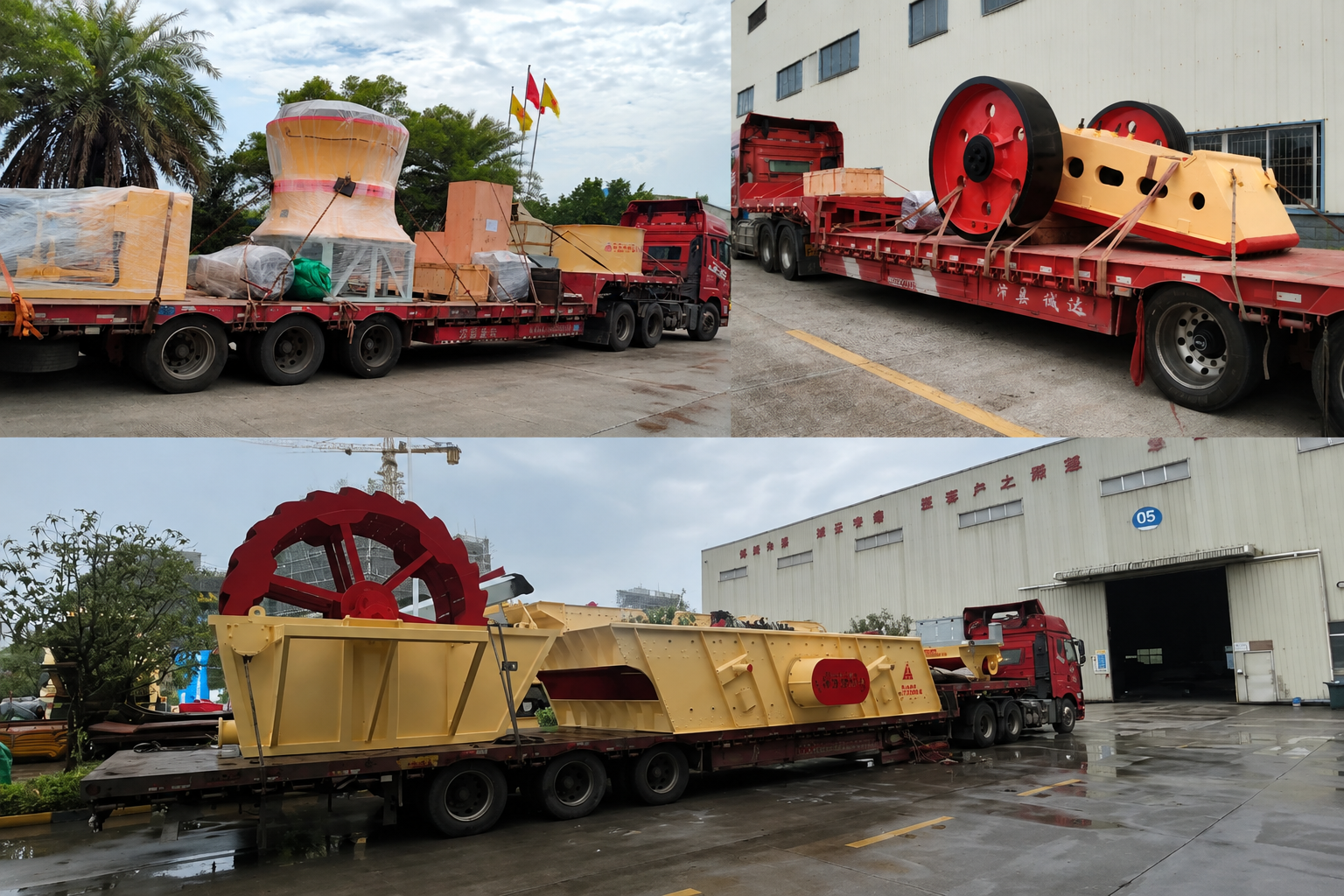
A recent aggregate equipment delivery from Leimeng Group to Kenya provides a useful example.
The equipment configuration includes:
- ZW Series vibrating feeders;
- PE Series jaw crushers;
- DS Series single-cylinder hydraulic cone crushers;
- DH Series single-cylinder hydraulic cone crushers;
- YKJ Series vibrating screens;
- XSD Series wheel sand washers;
- ZKX Series fine sand recycling machines.
Rather than treating these machines as separate products, it is more useful to look at the role each stage plays in the complete production flow.
Start with the Material, Not the Crusher Model
One of the most common mistakes in aggregate equipment selection is starting with a crusher model or machine price.
The better starting point is the raw material.
Before designing a crushing and screening line, operators should understand:
- raw material type;
- hardness and abrasiveness;
- maximum feed size;
- required capacity;
- required final aggregate sizes;
- moisture and clay content;
- particle shape requirements;
- washing requirements;
- site conditions.
Granite, basalt and river pebble, for example, normally require a different crushing strategy from relatively soft and low-abrasive limestone.
Hard and abrasive materials are generally better suited to compression crushing, while softer materials may allow greater flexibility between cone and impact crushing.
The equipment configuration should therefore follow the material and final product requirements — not the other way around.
Stage 1: Stable Feeding
A crushing line starts before the material enters the crusher.
The vibrating feeder controls how material enters the primary crushing stage.
If feeding is unstable, the jaw crusher may alternate between underfeeding and overloading. This variation can then affect every downstream stage.
In the Kenya equipment configuration, the ZW Series vibrating feeder is used to provide stable and even feeding before primary crushing.
The goal is simple:
Keep the primary crusher working under more consistent feed conditions.
Stable feeding helps create the foundation for stable production throughout the line.
Stage 2: Primary Crushing
Large raw stone normally needs to be reduced before it can enter secondary crushing.
This is the role of the PE Series jaw crusher in the Kenya configuration.
Jaw crushers use compression between a fixed jaw plate and a moving jaw plate to reduce large feed material.
They are commonly used for primary crushing where:
- feed size is large;
- material is hard or abrasive;
- continuous primary size reduction is required.
But the jaw crusher should not be evaluated only by how many tons it can process per hour.
Its discharge size directly affects the load on the downstream cone crusher.
If the primary crusher produces material that is too coarse or inconsistent, the secondary crusher may need to work under higher load.
This is why primary and secondary crushing should be designed together.
Stage 3: Secondary and Fine Crushing
After primary crushing, the material usually needs further size reduction before screening, shaping or sand production.
The Kenya equipment package includes DS and DH Series single-cylinder hydraulic cone crushers for this stage.
Cone crushers use compression between the mantle and concave and are commonly applied to medium-hard, hard and abrasive materials.
Depending on the production process, they can perform several roles:
Secondary Crushing
Reducing material discharged from the jaw crusher before screening or tertiary processing.
Fine Crushing
Producing smaller material before final classification.
Preparing Feed for Sand Production
Reducing oversized material before it enters washing or further sand-making stages.
However, cone crusher selection should never be based on rated capacity alone.
The chamber type, closed side setting, feed size and downstream screen capacity all affect actual production.
Stage 4: Screening Controls More Than Product Size
The vibrating screen is sometimes treated as an auxiliary machine.
In reality, it is one of the most important control points in a closed-circuit aggregate line.
The YKJ Series vibrating screen in the Kenya configuration separates crushed material according to the required aggregate sizes.
Smaller qualified particles pass through the screen openings, while oversized material may continue to another stage or return to the crusher.
This means the screen controls:
- finished aggregate size;
- classification efficiency;
- circulating load;
- crusher return material;
- effective line capacity.
If the screen is undersized, qualified material may unnecessarily return to the crusher.
The result can be higher circulating load, increased liner wear, additional energy consumption and unstable production.
This is why crusher-screen matching matters as much as crusher selection itself.
Stage 5: Washing and Fine Sand Recycling
For projects producing washed aggregate or manufactured sand, crushing and screening are not always the final stages.
Fine aggregate may contain clay, dust and other impurities that need to be removed.
The Kenya equipment configuration therefore includes an XSD Series wheel sand washer.
But washing introduces another issue: usable fine sand can be lost with the wastewater.
The ZKX Series fine sand recycling machine is used to reduce this loss and improve fine material utilization.
Together, the washing and recycling stages can help:
- clean fine aggregate;
- reduce fine sand loss;
- improve sand gradation;
- improve material utilization;
- maintain more consistent finished sand quality.
For aggregate producers, this can directly affect how much saleable material is recovered from the same amount of raw stone.
Why Crusher and Screen Matching Matters
A complete aggregate production line is a connected system.
Consider what happens when one stage is poorly matched:
If jaw crusher discharge is too coarse:
The cone crusher operates under greater load.
If the cone crusher setting is too tight:
Capacity may decrease while liner wear increases.
If the vibrating screen is too small:
Excess material returns to the crusher and circulating load increases.
If the washing system is poorly configured:
Usable fine sand may be lost.
This is why equipment selection should consider the complete process rather than individual machines.
A balanced line should review:
- primary crusher feed and discharge size;
- secondary crusher capacity;
- cone crusher CSS;
- screen deck area;
- screen openings;
- number of finished aggregate sizes;
- return material ratio;
- washing requirements;
- fine sand recycling requirements.
The objective is not to maximize the capacity of one machine.
The objective is to make the whole line operate efficiently.
Maintenance and Cost per Ton
Purchase price is only one part of equipment cost.
For quarry operators, long-term profitability is also influenced by:
- wear part life;
- maintenance frequency;
- downtime;
- spare parts availability;
- hydraulic adjustment;
- screen media replacement;
- maintenance access;
- technical support.
A production line with sufficient theoretical capacity can still become expensive if frequent maintenance interrupts production.
For overseas projects, this becomes particularly important because spare parts planning, installation guidance and technical support can affect how quickly equipment returns to operation after maintenance.
A Kenya Project as a Complete-System Example
The recent Leimeng Group equipment delivery to Kenya illustrates this system approach.
The configuration covers:
ZW Feeding → PE Primary Crushing → DS/DH Cone Crushing → YKJ Screening → XSD Washing → ZKX Fine Sand Recycling
Each machine has a different role, but the value comes from how the equipment works together.
For quarry and aggregate producers, this is an important distinction.
A successful aggregate project is not simply a collection of crushers and screens.
It is a properly matched production system designed around the raw material, required capacity and final product specifications.
What Information Should Be Prepared Before Selecting Equipment?
Before requesting a crushing and screening solution, a quarry operator should ideally provide:
- Raw material type
- Maximum feed size
- Required capacity per hour
- Required final aggregate sizes
- Moisture and clay content
- Whether sand washing is required
- Project location
- Available site layout
- Fixed, mobile or modular preference
- Local maintenance and spare parts requirements
The more complete this information is, the more accurately the crushing process and equipment configuration can be designed.
Conclusion
A reliable aggregate production line should not be designed around one crusher.
Feeding, primary crushing, secondary crushing, screening, washing and fine sand recycling need to be considered as one production system.
The Kenya equipment configuration from Leimeng Group demonstrates how different crushing and screening stages can be combined into a complete aggregate solution.
For quarry operators planning a new project, the starting point should always be the same:
Understand the material, define the required capacity and finished product, then design the equipment around the complete process.
Industry Topics
- Crushing and Screening Equipment
- Aggregate Production Line
- Quarry Equipment
- Jaw Crusher for Primary Crushing
- Cone Crusher for Secondary Crushing
- Vibrating Screen
- Sand Washing Equipment
- Fine Sand Recycling
- Aggregate Equipment in Africa
- Kenya Quarry Equipment
https://www.lmcrusher.com/
GUANGDONG LEIMENG INTELLIGENT EQUIPMENT GROUP CO.,LTD.

+ There are no comments
Add yours