
Introduction
When beverage producers search for a carbonated drink filling machine manufacturer capable of handling a complete turnkey project, they are usually weighing several practical concerns at once: how the equipment controls foaming and CO2 loss during high-speed filling, what capacity range is available, whether the contact parts can withstand carbonated and acidic liquids over time, and whether one supplier can be held accountable for the entire plant rather than juggling multiple vendors.
This guide works through the criteria that separate a capable turnkey partner from a catalog-only supplier: isobaric filling technology that is documented rather than asserted, materials of construction suited to carbonated and acidic liquids, third-party certification status, the real scope behind an EPC contract, packaging format and capacity fit, and field deployments a buyer can actually verify. Each section explains what to ask a supplier and how to check the answer, using Grandee Machine's carbonated filling platform as a worked example.
Why Carbonated Filling Demands More From a Supplier
Carbonated beverage lines face a recurring set of production problems. Unstable counter-pressure during filling leads to foaming and CO2 loss, which shows up as underfilled bottles, product waste, and inconsistent carbonation at the point of sale. Coordinating separate suppliers for the filler, the carbonation system, capping, and end-of-line packaging adds cost and leaves no single party responsible when the finished line underperforms.
Those two issues set the evaluation criteria for any supplier shortlist. Everything below is a way of testing whether a manufacturer can actually address them.
Criterion 1: Documented Isobaric Filling Performance
Isobaric filling is the standard method for carbonated products. The container is pressurized with CO2 to match the product's partial pressure before liquid is introduced, which keeps dissolved CO2 in solution and suppresses foam. Almost every supplier claims isobaric capability, so the real question is whether the performance is quantified.
What to ask: the CO2 loss rate during filling, the filling temperature range, and the working pressure of the filling tank.
How to check: the answer should come as a number tied to stated test conditions, not as a claim like "minimal loss."
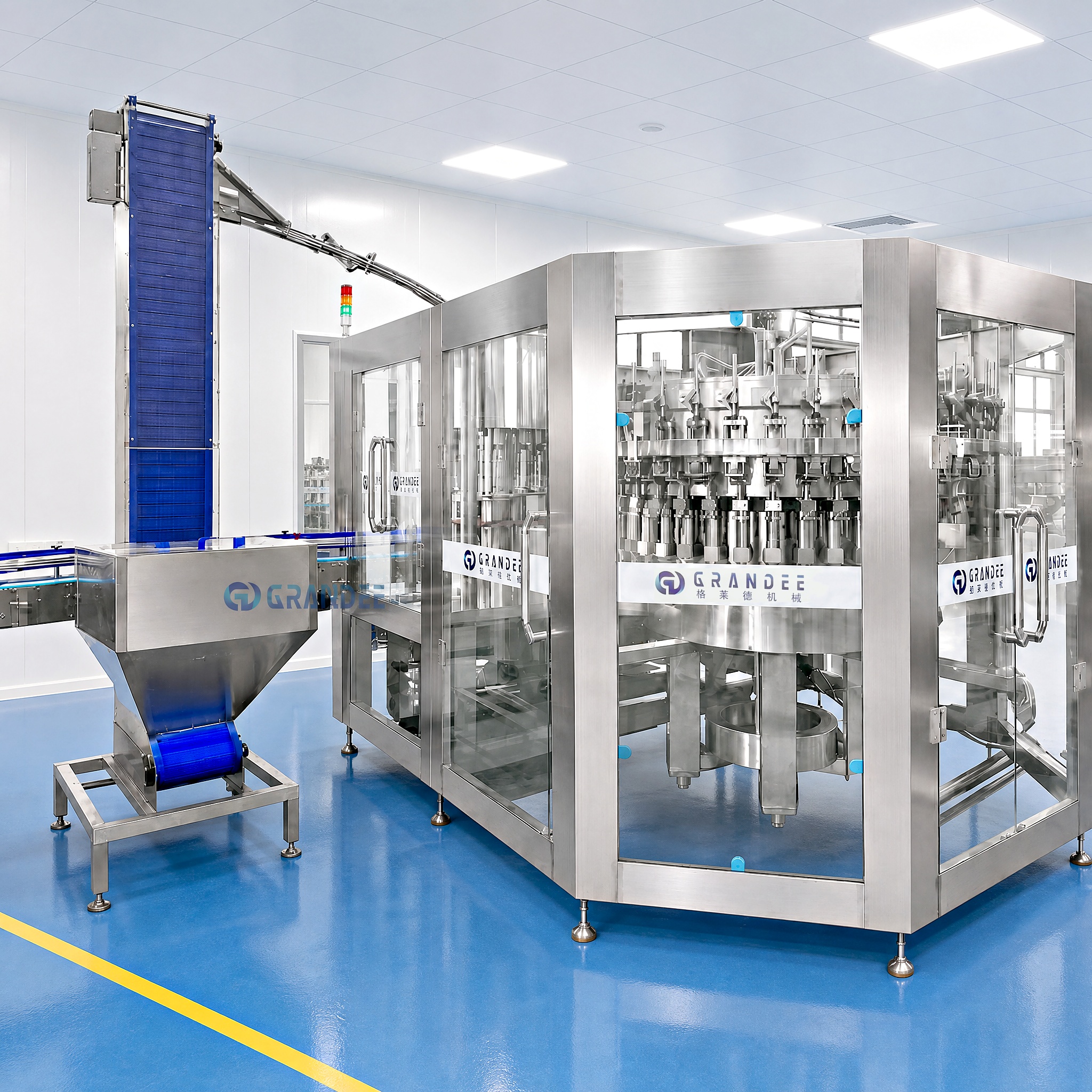
Grandee Machine's 3-in-1 carbonated drink filling machine (isobaric) performs rinse-fill-cap operations in a single unit, so bottles are rinsed, filled, and capped without intermediate transfer. Published specifications put CO2 loss within 1.5% to 3% of total dissolved CO2. In factory tests at a fill temperature of 4°C and a CO2 concentration of 4.0 g/L, measured loss stayed below 2.2%. The machine fills at product temperatures of 2°C to 6°C, with 4°C the most common target, under a filling tank working pressure of 2 to 4 bar (0.2 to 0.4 MPa) and a CO2 inlet pressure of 0.28 to 0.35 MPa. It supports carbonation levels from 2.0 to 4.5 volumes of CO2, and counter-pressure is held by precision filling valves and a closed-loop pressure control system.
Criterion 2: Materials of Construction for Carbonated and Acidic Liquids
Carbonated soft drinks are acidic, and carbonated filling also means wet, pressurized conditions. Contact-part material is where a low-cost quotation usually shows its compromises.
What to ask: the grade of stainless steel used for liquid contact parts, whether it is specified per component or only claimed for the machine as a whole, and how the CIP circuit is integrated.
How to check: ask for a written material specification covering the wetted path, not a marketing summary.
Grandee Machine specifies 316L stainless steel for liquid contact parts across the platform, and automatic CIP (Clean-In-Place) systems are included as a standard line capability in every EPC scope rather than offered as an option.
Criterion 3: Certification and Documentation
What to ask: which certifications the manufacturer itself holds, and whether certificate details can be produced on request.
How to check: third-party certification serves as a reference point, but it should be available for inspection rather than simply claimed.
Zhangjiagang Grandee Machinery Co., Ltd., operating under the brand Grandee Machine, holds CE and CQC certifications. Its filling equipment runs on PLC/HMI touch-screen control and is built to ISO Class 6 cleanroom standards.
Criterion 4: The Real Scope of the EPC Contract
The value of a turnkey EPC contract depends entirely on where its boundary sits. A contract that stops at the filler still leaves the buyer coordinating carbonation, water treatment, bottle blowing, capping, and packaging.
What to ask: a written scope list covering what is included and what is excluded, and who holds responsibility during commissioning.
How to check: map the scope against your own plant's process steps. Any step not named in the contract is a step you will be managing yourself.
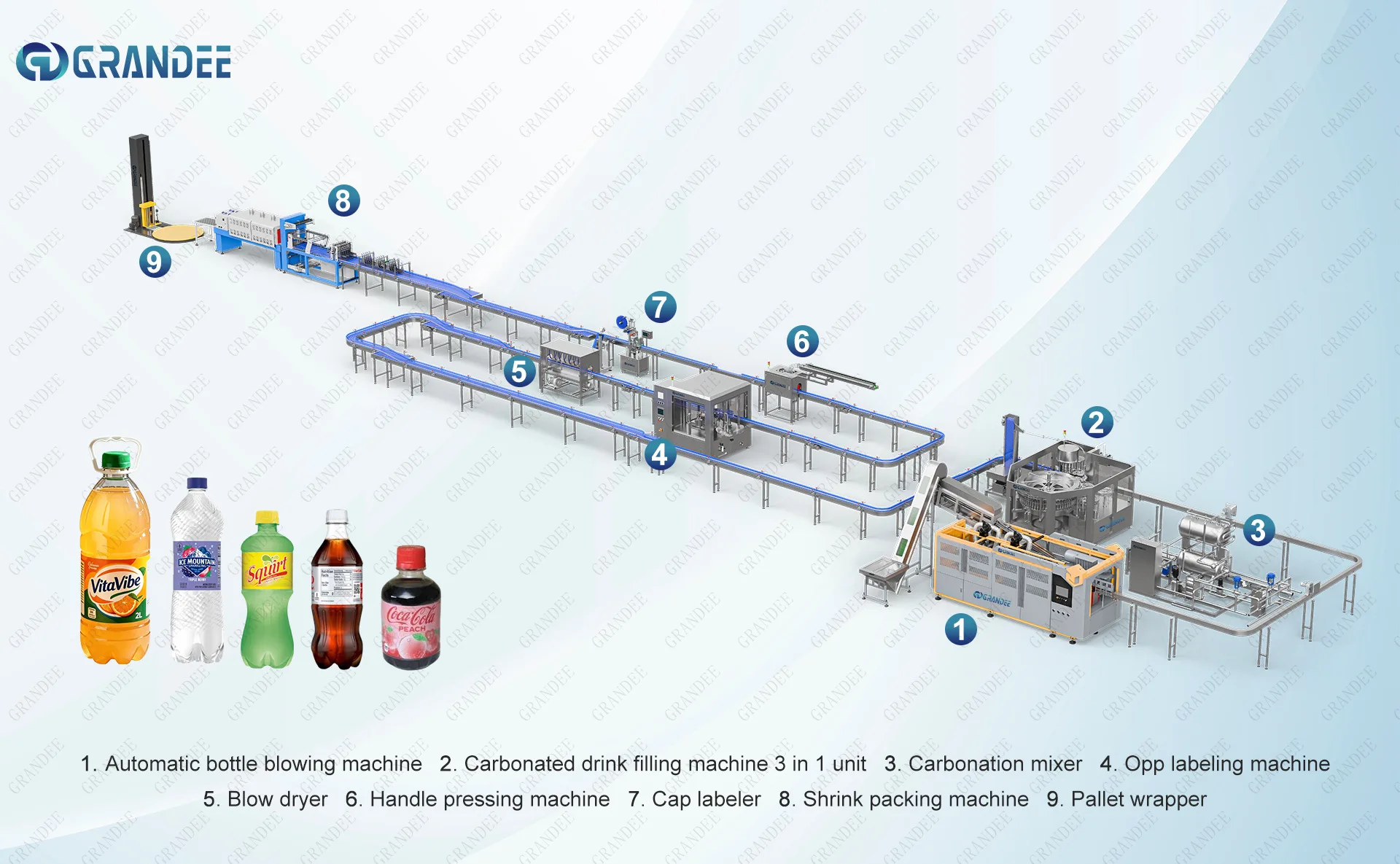
A turnkey EPC scope from Grandee Machine covers bottle design, factory layout, paperless 3D factory design, installation, commissioning, and operator training under one contract. A carbonated line can include water treatment, carbonation mixers, bottle blowing, capping, robotic palletizing, automated CIP, and end-of-line equipment such as labeling, shrink wrapping, and case packing. The company's broader liquid packaging coverage also extends to water, juice, dairy, edible oil, vinegar, soy sauce, and other condiments and daily liquid chemicals.
For producers who also fill glass or cans, the company builds glass-bottle lines for CSD, beer, and sparkling products in a 3-in-1 washing-filling-capping configuration with an integrated pressure-stabilizing feeding system, and aluminum can filling and sealing lines for carbonated drinks and beer at 12,000 to 36,000 CPH. At higher volumes, a rotary blow-fill-cap monoblock for carbonated beverages is available at 12,000 to 24,000 BPH, integrating blowing, filling, and capping into one continuous unit and removing the intermediate transfer step where contamination and CO2 pickup can occur.
Criterion 5: Capacity and Packaging Format Fit
What to ask: the speed tiers available, whether the quoted speed applies to your actual bottle size, and whether format changeovers require new change parts.
How to check: confirm the speed at your specific container rather than the platform's maximum. A quoted maximum on a small bottle can be misleading if your product runs in 1 L PET.
Grandee Machine's isobaric filler is offered in speed tiers from 2,000 BPH up to 48,000 BPH, with common configurations at 2,000–6,000 BPH, 10,000–15,000 BPH, and 20,000–24,000 BPH. It handles both PET and glass bottles across a diameter range of Φ50–115 mm and heights of 150–320 mm. Switching between carbonation levels requires parameter adjustment only, with no change parts.
Producers should also confirm what the filler does not include. Grandee Machine's filling machine has no integrated carbonation unit; it receives pre-carbonated beverage from an upstream carbonation system such as a carbonation tank, inline carbonator, or premix preparation vessel. That separation is usually an advantage, since it allows independent maintenance and CIP cleaning for each stage, but it has to be planned for in the line layout.
Criterion 6: Verifiable Field Deployments
What to ask: a specific reference project with the country, product type, capacity, and scope, rather than a general statement of export experience.
How to check: cross-reference the reference against the manufacturer's own published news or project records. If a claimed installation cannot be found anywhere outside the sales conversation, treat it as unverified.
Grandee Machine's record includes a complete 12,000 BPH carbonated beverage production line delivered and installed in Tashkent, Uzbekistan as a single integrated scope, covering the carbonated filling machine, water treatment, and labeling equipment. The company brings more than 20 years of export experience, operates a standardized production facility exceeding 20,000 square meters, and has business coverage spanning Europe, South America, Africa, Southeast Asia, and Central Asia.
Conclusion: A Pre-Purchase Checklist
Selecting a carbonated drink filling machine manufacturer for a turnkey project comes down to a handful of verifiable factors. Confirm that isobaric filling performance is documented with a CO2 loss figure and its test conditions. Confirm the wetted-path material in writing. Confirm which certifications the manufacturer holds. Confirm the EPC scope line by line, and treat anything unnamed as your own responsibility. Confirm the quoted speed at your actual bottle size, and whether format changes need new parts. Confirm at least one reference installation you can look up independently.
Buyers are advised to request capacity data, material specifications, certification records, and reference installations before finalizing any carbonated filling line procurement decision.
To discuss a carbonated filling line for your project, contact the Grandee Machine team at info@grandeemachine.com
https://www.grandeemachine.com/
Zhangjiagang Grandee Machinery Co., Ltd.

+ There are no comments
Add yours