
Battery life is one of the biggest concerns for smartwatch users. While battery capacity and battery management software are important, the charging accessory also plays a role in maintaining a consistent charging experience. Choosing the right smart watch charger manufacturer in China and using a charger designed for the intended device can help avoid unsuitable charging conditions and unnecessary stress caused by poor connections, excessive heat, or incompatible accessories.
It is important to be realistic, however: a charger cannot stop normal battery aging. Rechargeable batteries naturally lose capacity over time. What a well-designed charging system can do is provide stable, appropriate charging conditions and make everyday charging more predictable.
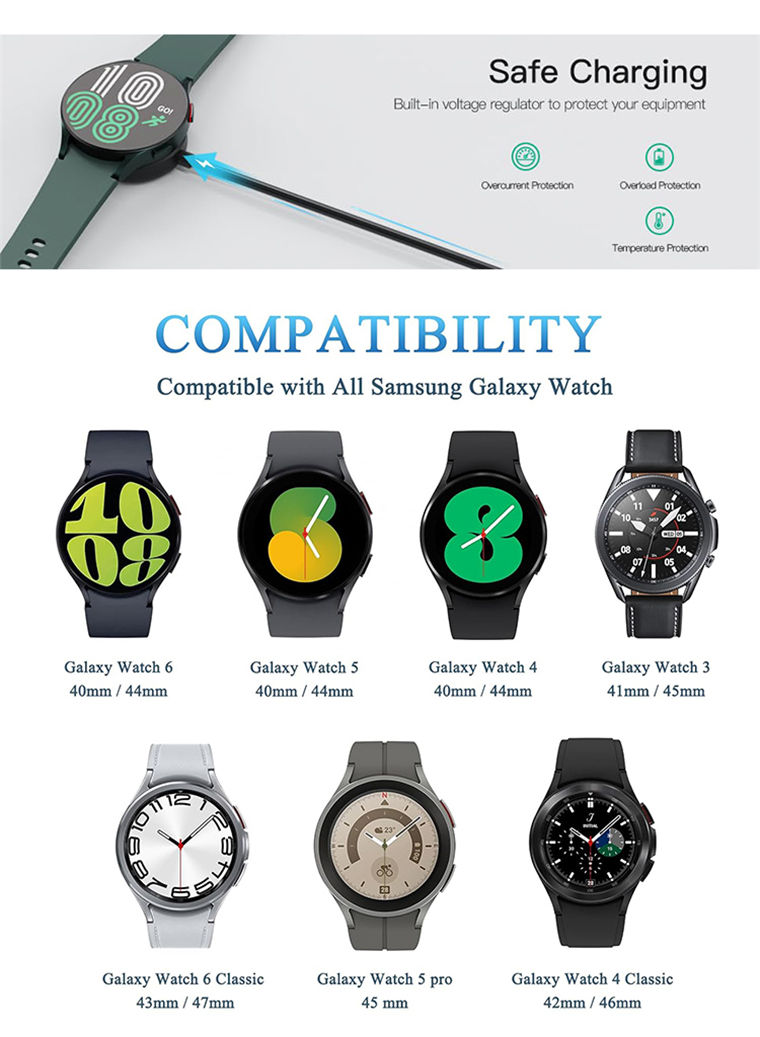
1. Use a Charger Designed for the Specific Watch
The first step toward better battery care is simple: use a charger that is actually compatible with the smartwatch.
A smartwatch is not just a small smartphone. Its charging system, battery size, charging circuit, magnetic structure, and power requirements can differ significantly from those of other devices.
Using a dedicated Wireless Charger for Huawei Watch, for example, means selecting a charging accessory designed for compatible Huawei Watch applications rather than assuming that any magnetic charging product will provide the same result.
Before purchasing a replacement charger, check:
· Exact watch model
· Supported charging method
· Charging specifications
· Magnetic or physical alignment
· Compatible connector
· Manufacturer recommendations
Correct compatibility is the foundation of good charging practice.
2. Keep Charging Temperature Under Control
Temperature is one of the most important factors in rechargeable battery management.
Charging naturally produces some heat. The amount depends on the device, charging system, ambient temperature, battery condition, and charging power.
Problems are more likely when a device is charging in an already hot environment or when heat cannot dissipate properly.
For everyday use, avoid charging the watch:
· Under a pillow or blanket
· In direct sunlight
· Inside a hot vehicle
· Next to a strong heat source
· On surfaces that prevent normal heat dissipation
A good charger does not eliminate heat, but a properly designed charging system should operate within its intended conditions.
For manufacturers, thermal behavior should be considered during product development and testing rather than treated as an afterthought.
3. Avoid Letting the Battery Remain Completely Empty for Long Periods
Users sometimes wait until the smartwatch shuts down before charging it.
Occasionally reaching a very low battery level is not unusual, but repeatedly allowing a rechargeable battery to remain deeply discharged is not an ideal long-term habit.
A more practical routine is to recharge the watch when convenient rather than deliberately waiting for the battery to reach zero.
This is particularly useful for people who depend on the smartwatch for sleep tracking, exercise monitoring, notifications, or other daily functions.
A predictable charging routine is usually more useful than trying to follow a complicated battery schedule.
4. Do Not Assume That Keeping the Watch at 100% Is Always Better
Many users believe that charging a device to 100% and leaving it connected indefinitely is the best way to maintain battery life.
Modern smartwatches have charging management systems designed to control charging, so leaving a compatible watch connected occasionally is not necessarily a serious problem.
However, from a general battery-care perspective, prolonged exposure to high charge levels and elevated temperatures can contribute to battery aging over time.
If the watch does not need to remain on the charger, there is usually little reason to keep it connected continuously after charging is complete.
For overnight charging, users should follow the watch manufacturer's charging guidance and avoid environments where heat can accumulate.
5. A Stable Connection Is Better Than Repeated Charging Interruptions
A charger that frequently loses contact creates a frustrating charging experience.
The watch may start charging, stop, reconnect, and repeat the cycle as the charging head moves.
Magnetic charging systems are useful here because the magnetic structure helps position the charging head against the intended charging area.
The goal is not simply to create a stronger magnetic connection. The charging head needs to align correctly with the watch and remain sufficiently stable during normal use.
A well-designed charging accessory should therefore combine:
Accurate alignment + suitable magnetic force + stable electrical connection
These factors can help make charging more consistent and reduce the need for repeated repositioning.
6. More Charging Power Does Not Automatically Mean Better Battery Health
Fast charging is convenient, but maximum charging power should not be confused with better battery care.
A smartwatch can only accept the charging conditions supported by its internal charging system. Supplying a higher-capability power source does not mean the watch will necessarily charge at that higher level.
The watch's charging electronics determine how much power is accepted.
This is why consumers should not choose a smartwatch charger simply because it advertises the highest output number.
For a smartwatch, the more important questions are:
· Is it compatible?
· Is power delivery stable?
· Does the charger maintain proper alignment?
· Is heat kept within normal operating conditions?
· Does the charger meet the intended specifications?
A suitable charger is better than an unnecessarily powerful one.
7. Keep the Charging Area Clean
Small amounts of dust, dirt, sweat residue, or debris can affect the physical contact between the smartwatch and charging accessory.
This is particularly relevant for users who wear their watch during workouts or outdoor activities.
Before charging, occasionally check the charging area on both the watch and charger. If cleaning is necessary, follow the watch manufacturer's recommended cleaning method.
Keeping the charging surfaces clean can help maintain proper alignment and connection.
For magnetic chargers, this is especially useful because even a small layer of debris can affect how closely the charging surfaces sit together.
8. Cable Quality Matters for Long-Term Use
The charging head gets most of the attention, but the cable is also part of the charging system.
A cable that is frequently bent near the connector can eventually develop internal damage. This may result in intermittent charging, unstable connections, or complete failure.
For daily use, avoid tightly wrapping the cable around the charging head or sharply bending it near the connector.
For product manufacturers, cable construction should account for repeated bending and handling. Strain relief, insulation, conductor design, connector assembly, and housing structure all contribute to durability.
A reliable smart watch charger supplier should be able to explain how these components are selected and tested.
9. Storage Conditions Also Matter
A charging cable does not need complicated maintenance, but storage conditions can affect its service life.
Avoid storing the charger:
· In extremely hot locations
· In areas with excessive moisture
· Under heavy objects
· With sharp bends
· Where the connector can be repeatedly pulled
For travel, loosely coil the cable instead of creating tight bends at the same point every time.
These simple habits can extend the usable life of the charging accessory itself.
10. What Manufacturers Need to Consider
Battery-friendly charging starts long before the product reaches the consumer.
For a manufacturer, the charging accessory needs to be evaluated as a complete system. Component selection, circuit design, magnetic positioning, cable construction, housing design, assembly accuracy, and testing all influence the final product.
Shenzhen Chuangyao Technology Co., Ltd. is a national high-tech enterprise integrating production, manufacturing, and sales. Its dust-free workshop covers more than 4,300 square meters and includes four fully automated high-precision SMT placement lines and two manual post-welding lines.
For a China smart watch charger factory, production consistency is particularly important because even small variations in electronic assembly can affect charging performance.
The company holds ISO9001:2015 quality management system certification, and its products comply with RoHS standards. It also states that 78% of its customer products are exported to developed overseas markets.
For international buyers, these production and quality-management capabilities can be useful when evaluating a supplier for regular orders.
11. OEM/ODM Can Help Match the Charger to the Device
Different smartwatch products may require different charging solutions.
A brand developing a new wearable may need a customized charging head, cable length, housing structure, packaging format, or magnetic configuration.
Instead of modifying a generic product after production, OEM/ODM development allows these requirements to be considered from the beginning.
Shenzhen Chuangyao Technology Co., Ltd. has independently developed an ERP material and process management system covering wireless charging OEM/ODM research and development, mold opening, assembly production, testing, and sales.
This integrated process can be useful for brands that want to develop a charger around specific device requirements.
Companies looking for customized products can review the manufacturer's wireless charging OEM/ODM solutions when planning a new charging accessory.
12. How to Choose a Battery-Friendly Smartwatch Charger
For consumers, the following checklist is practical:
Match the Watch
Always confirm the exact model and charging compatibility.
Prioritize Stable Charging
A consistent charging connection is more useful than an impressive specification that does not match the device.
Consider Heat
Avoid charging in hot or poorly ventilated locations.
Inspect the Cable
Look for damaged insulation, loose connectors, exposed conductors, or intermittent charging.
Keep the Charging Surface Clean
Remove dust and residue that could interfere with proper positioning.
Follow the Watch Manufacturer's Guidance
Different smartwatches have different charging systems, so device-specific instructions should take priority.
For wholesalers and brands, add several additional checks:
· Sample testing
· Compatibility testing
· Thermal testing
· Cable durability testing
· Magnetic alignment testing
· Finished-product inspection
· Quality documentation
· OEM/ODM capability
A Better Charging Routine Is More Useful Than a Perfect One
Battery care does not require users to constantly monitor charging percentages.
A simple routine is usually enough: use a compatible charger, keep the charging environment reasonably cool, avoid unnecessary deep discharge, maintain clean charging surfaces, and replace damaged charging accessories.
The charger should make these habits easier rather than more complicated.
For businesses, the same principle applies to product development. A successful smartwatch charger should not depend on users understanding complex technical specifications. It should be designed to provide a stable, convenient, and predictable charging experience under normal conditions.
The right smartwatch charger cannot prevent normal battery aging, but it can help create better charging conditions throughout the life of the device.
Compatibility, stable alignment, appropriate power delivery, thermal behavior, cable durability, and proper manufacturing all contribute to a reliable charging system.
For consumers, the best approach is to use a charger designed for the specific watch and follow sensible charging habits. For retailers, distributors, and brands, the focus should extend further: choose a smart watch charger manufacturer in China that can provide controlled production, testing, OEM/ODM support, and consistent quality.
Shenzhen Chuangyao Technology Co., Ltd. combines wireless charging R&D, mold opening, assembly, testing, and manufacturing capabilities. Its integrated production approach provides a practical foundation for businesses developing standard or customized smartwatch charging products.
Ultimately, extending battery life is not about finding a “magic” charger. It is about creating a charging routine in which the device, charger, power source, and environment all work together properly.
www.chuangyaokj.com
Chunyao


+ There are no comments
Add yours