
For manufacturers working with deep drawing and complex sheet metal forming, choosing the right hydraulic press is an important production decision. The machine affects not only forming force, but also product accuracy, material flow, cycle stability, tooling compatibility, and long-term maintenance requirements.
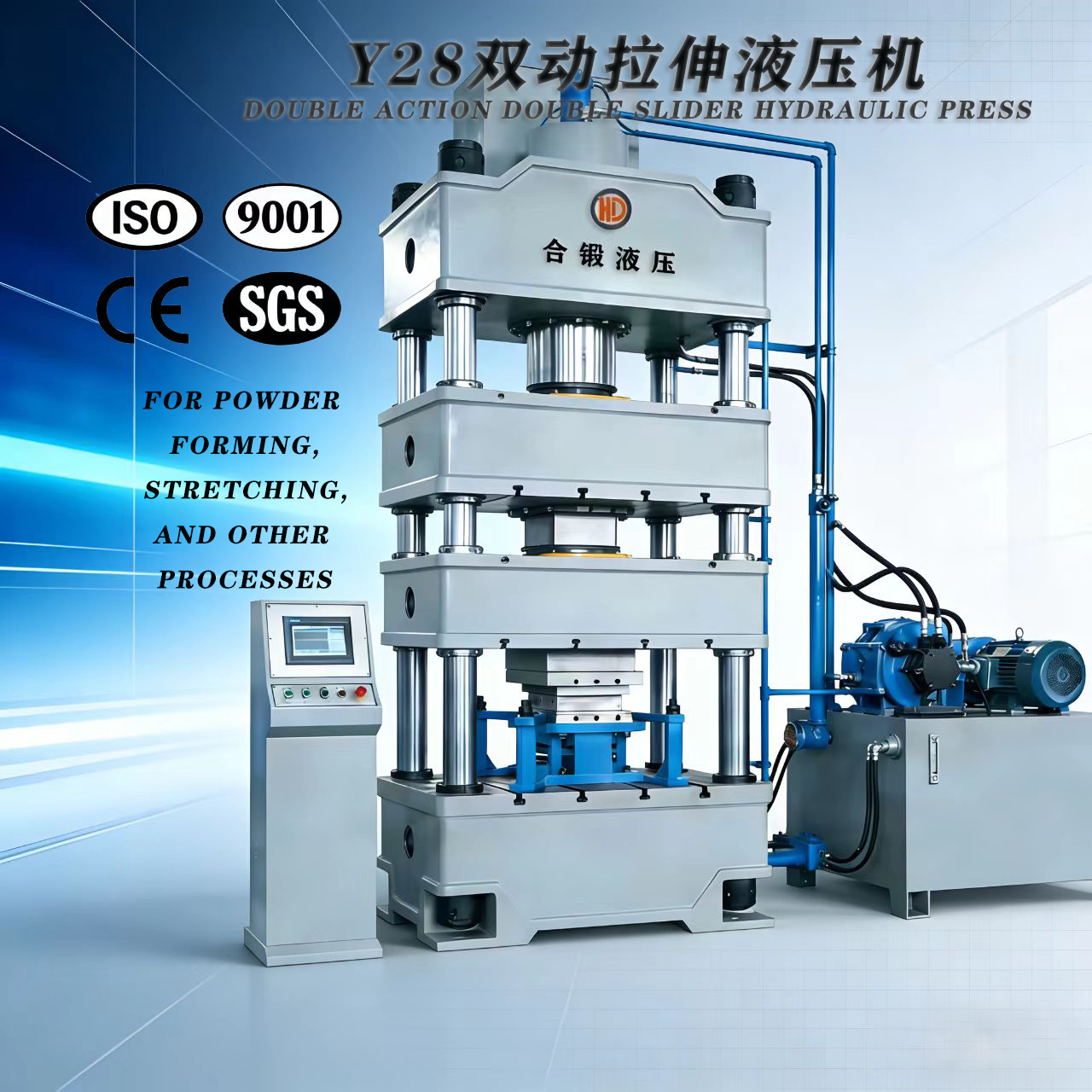
This is why a Y28 double action drawing press is often considered for applications that require more controlled forming than a conventional single-action press can provide. With independent control of the drawing slide and blank holder, a double-action structure gives manufacturers better control over the forming process, especially when producing deep or complex-shaped components.
However, selecting a suitable press should not be based on tonnage alone. The actual material, workpiece design, production volume, tooling requirements, and future automation plans all need to be considered.
Why Double Action Drawing Presses Are Used for Complex Forming
Deep drawing involves more than simply pressing a sheet of metal into a die. During the forming process, the material must flow into the mold while avoiding problems such as wrinkles, cracking, excessive thinning, or deformation.
A double-action hydraulic press uses two independently controlled movements. The inner slide provides the main drawing force, while the outer slide controls the blank holder. This arrangement allows the manufacturer to adjust the forming and holding forces according to the requirements of the workpiece.
This can be particularly useful for producing:
-
Automotive body and structural components
-
Stainless steel containers
-
Kitchen and household appliance parts
-
Electrical enclosures
-
Metal tanks
-
Deep-drawn industrial components
For products with greater drawing depth or more complicated geometries, the additional control provided by a double-action system can make the forming process more stable.
Start with the Material and Product Requirements
Before choosing a hydraulic drawing press, manufacturers should first examine the material being processed and the actual shape of the finished product.
Material Type and Thickness
Different materials require different forming conditions. Carbon steel, stainless steel, aluminum, and other alloys vary in strength, ductility, and forming behavior.
A press must provide sufficient force for the selected material and thickness. At the same time, excessive forming force can also create unnecessary stress and increase the risk of material damage.
The correct machine selection should therefore consider:
-
Material strength
-
Sheet thickness
-
Tensile properties
-
Required drawing depth
-
Material flow characteristics
These factors help determine the required pressing capacity and the appropriate operating parameters.
Product Shape and Drawing Depth
The geometry of the workpiece is another major consideration.
A relatively shallow component may not require the same level of control as a deep-drawn part with a narrow opening, curved profile, or complex structure. As the drawing depth increases, controlling the material during forming becomes more important.
A Y28 double action drawing press can be suitable for applications where independent control of the blank holder and drawing slide is required. This allows manufacturers to adjust the forming process according to different product designs and tooling conditions.
Machine Structure Directly Affects Long-Term Stability
A hydraulic press may operate under high loads for many years. Its frame and main structural components must therefore be designed to withstand repeated forming cycles without excessive deformation.
A rigid machine structure helps reduce vibration and improves the consistency of the forming process.
The Y28 double action drawing hydraulic press manufactured by Mingge uses a welded steel structure designed to provide sufficient strength and rigidity for demanding applications. Major structural components are engineered using computer-aided design methods, while vibration aging treatment is used to help reduce internal stress in welded parts.
For production environments, these details matter because structural instability can eventually affect:
-
Forming accuracy
-
Die alignment
-
Product consistency
-
Equipment service life
A stable frame provides a more reliable foundation for the entire forming process.
The Guide System Should Not Be Overlooked
The movement accuracy of the slide has a direct influence on product quality. If the slide moves unevenly or develops excessive clearance over time, forming accuracy may gradually decline.
The Y28 press uses a box-type welded slide block structure. The guiding components are designed to provide stable movement and wear resistance during long-term operation.
A reliable guiding system helps maintain:
-
Accurate slide movement
-
Better die alignment
-
Reduced vibration
-
More consistent forming results
This is especially important when the same press is used for high-volume production or precision components.
Hydraulic Cylinder Quality Influences Press Performance
The hydraulic cylinder is one of the core components of a hydraulic drawing press. It must withstand repeated pressure cycles while maintaining reliable sealing and smooth movement.
For demanding forming applications, the cylinder body needs to have sufficient mechanical strength and stable internal quality. The Y28 press uses forged 45# steel for its hydraulic cylinder body, with ultrasonic inspection applied to help identify potential internal material defects.
Heat treatment is also used to improve the mechanical properties of the cylinder components. Reliable sealing components and wear-resistant guide sections help maintain stable operation during repeated production cycles.
A well-designed hydraulic system should provide:
-
Stable pressure output
-
Smooth slide movement
-
Reliable sealing performance
-
Consistent forming force
-
Convenient maintenance
These factors contribute directly to long-term equipment reliability.
Tooling Compatibility Is an Important Selection Factor
A hydraulic press is only as effective as its compatibility with the molds and tooling used in production.
Before purchasing equipment, manufacturers should confirm:
-
Die dimensions
-
Installation method
-
T-slot arrangement
-
Working table size
-
Slide stroke
-
Available adjustment range
The Y28 double action drawing press is equipped with T-slots to support mold installation and adjustment. The slide travel can also be adjusted according to the requirements of different forming processes.
Efficient tooling installation is particularly important for manufacturers handling multiple product models. A practical machine design can help reduce setup time and make production changes easier to manage.
Think About Future Automation Requirements
Many metal forming factories are gradually moving toward automated production. Automatic feeding systems, transfer devices, mold changing systems, and intelligent control technologies can all improve production efficiency.
When choosing a hydraulic press, it is worth considering whether the equipment can be integrated with future automation upgrades.
A machine suitable for automation should provide:
-
Stable and repeatable movement
-
Reliable control signals
-
Convenient production parameter adjustment
-
Compatibility with feeding equipment
-
Safe access for maintenance and tooling changes
Selecting equipment with future expansion in mind can help manufacturers avoid replacing machines when production requirements increase.
Safety and Maintenance Also Matter
A hydraulic press is a powerful piece of industrial equipment, so safe operation and convenient maintenance should be considered during the selection process.
Important features include:
-
Reliable travel limit protection
-
Stable hydraulic control
-
Clear operating procedures
-
Easy access to key components
-
Convenient maintenance points
A machine that is difficult to inspect or maintain can create unnecessary downtime. For manufacturers operating continuous production lines, maintenance accessibility is an important part of total equipment performance.
Why Manufacturer Experience Makes a Difference
The performance of a hydraulic press depends not only on the design drawings but also on manufacturing quality and engineering experience.
Mingge specializes in hydraulic presses, hydraulic shearing machines, bending machines, punching machines, and automation equipment. The company uses 3D design, CAD, and CAPP technologies in equipment development and manufacturing.
Its technical team focuses on improving machine structure, hydraulic performance, control systems, and production adaptability for different metal forming applications.
For customers purchasing large industrial equipment, technical support is also important. A capable manufacturer can provide assistance with machine selection, tooling coordination, installation, commissioning, and future production requirements.
Final Considerations Before Buying a Y28 Press
Before making a final decision, manufacturers should evaluate the complete production process rather than focusing on one specification.
Key questions include:
-
What materials and thicknesses will be formed?
-
What is the maximum drawing depth?
-
What type of products will be manufactured?
-
What production volume is expected?
-
What tooling will be used?
-
Is automation required now or in the future?
-
How easy is the machine to maintain?
-
Does the manufacturer provide technical support?
Answering these questions helps ensure that the selected Y28 double action drawing press matches the actual production requirements.
Conclusion
Choosing a Y28 double action drawing press is a decision that should be based on forming requirements, material characteristics, product geometry, machine structure, tooling compatibility, and future production plans.
The double-action design provides independent control of drawing and blank holding, making it suitable for many deep drawing and complex sheet metal forming applications. A rigid welded structure, reliable hydraulic cylinders, accurate guiding system, practical mold installation design, and automation compatibility can further improve long-term production performance.
For manufacturers looking to improve deep drawing capability and maintain consistent forming quality, working with an experienced hydraulic press manufacturer is an important part of the equipment selection process. With engineering experience and advanced manufacturing capabilities, Mingge provides hydraulic forming solutions designed for demanding industrial production environments.
www.heduanpress.com
Mingge Electrical and Mechanical Equipment

+ There are no comments
Add yours