

Questions for quarry operators in Kazakhstan and Mongolia comparing familiar equipment with a different crushing option.
During Leimeng Group’s exhibition conversations in Kazakhstan and Mongolia, some visitors described a familiar situation: their teams knew impact crushers well, but frequent wear-part replacement was becoming expensive.
Cone crushers were an option they had considered. The hesitation was practical. Would the operators know how to use one? Could replacement parts reach the quarry when needed?
Those concerns belong in the purchasing decision. So does the cost of continuing with equipment that may not suit the material.
For a quarry experiencing frequent blow-bar or liner changes, the useful question is whether the current crushing method still makes economic sense for its rock and required products.
1. Familiar equipment has value—but measure its cost
An experienced crew knows how its impact crusher sounds, how to adjust it and how to replace its wear parts. That knowledge reduces uncertainty.
However, a familiar maintenance task still uses labour, lifting equipment, replacement parts and production time.
Start by reviewing the last several wear-part changes. Record the parts replaced, their delivered cost, tonnes processed and hours spent stopping, servicing and restarting the line.
Distinguish scheduled replacements from unexpected failures. A predictable shutdown and an emergency stoppage create different operational problems.
This record provides a stronger basis for comparison than a general impression that maintenance is “normal for this type of stone.”
2. Let abrasiveness influence the crushing method
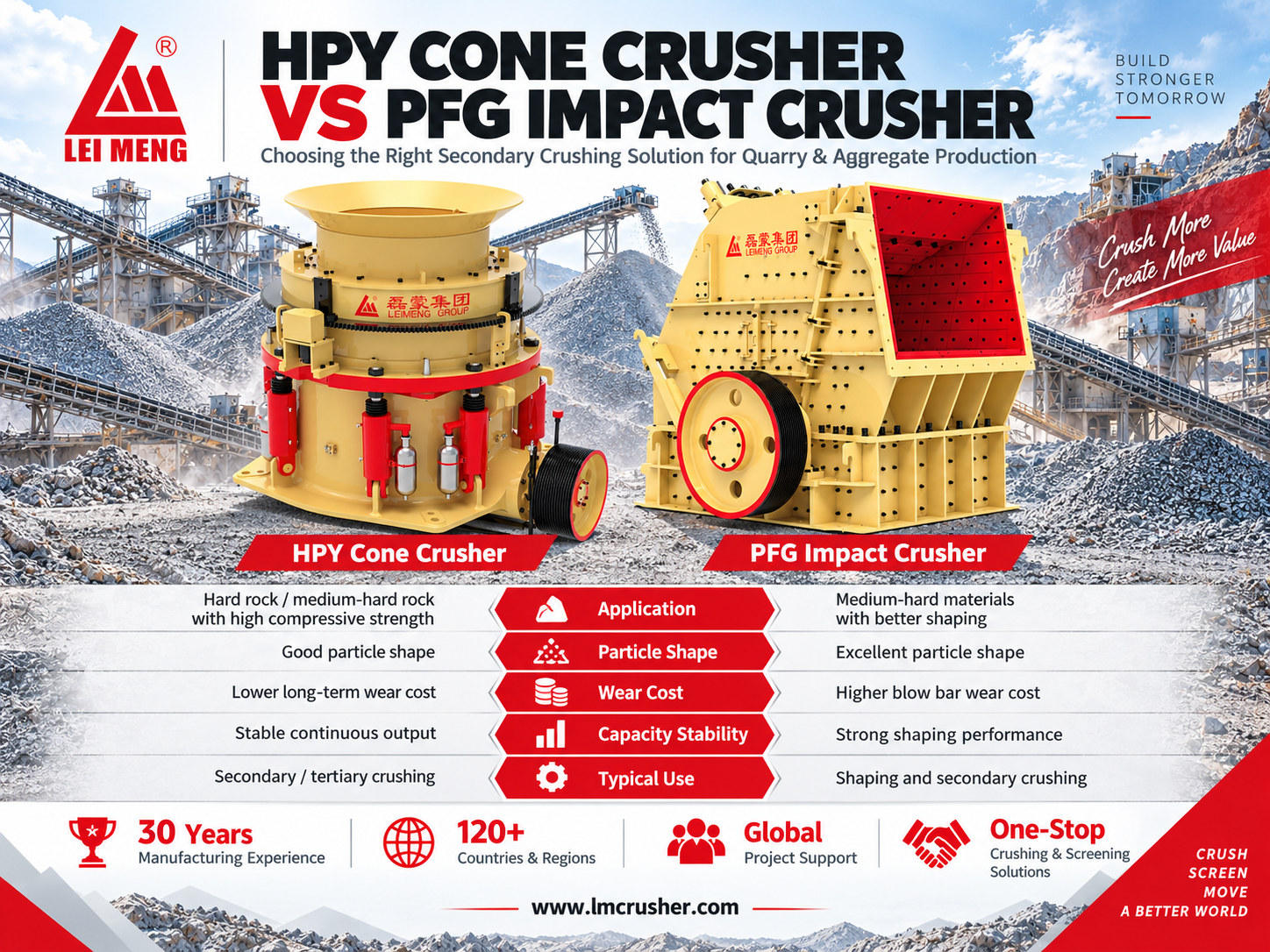
An impact crusher breaks material through high-speed impact. A cone crusher reduces it through compression.
For relatively soft, low-abrasion material, a horizontal-shaft impact crusher can be an appropriate choice. For medium-hard to hard abrasive rock, compression crushing is often worth evaluating for its operating economics.
That does not mean every quarry in Kazakhstan or Mongolia needs a cone crusher. Conditions vary between deposits.
Before comparing machines, establish the material’s crushability, abrasiveness, maximum feed size, moisture and required product grading. Granite, basalt and river stone are useful descriptions, but they do not replace representative material information.
Frequent impact-crusher wear is a reason to investigate. It is not, by itself, proof that the entire machine must be replaced.
3. Investigate why the current parts wear quickly
Wear can reflect the material, the selected wear-part specification, operating conditions or several factors together.
Ask whether the current blow bars and liners suit the duty. Review feed consistency, reduction requirements and the manufacturer’s recommended settings.
Wear-part profile and material selection can materially affect crusher performance. Reordering the same specification without reviewing changed feed conditions may preserve an avoidable problem.
This creates two options to compare:
-
Improve the current impact-crusher arrangement.
-
Evaluate a cone-crushing arrangement for the same required products.
Giving both options a fair assessment makes a replacement proposal more credible.
4. Compare cost per saleable tonne
The purchase price of a wear-part set is only part of its cost.
For an initial comparison, calculate:
Wear-maintenance cost per saleable tonne = delivered wear-part cost plus replacement labour and equipment cost, divided by saleable tonnes produced over the corresponding wear cycle.
Track downtime separately, together with its effect on shift output. If lost production is assigned a financial value, state the assumptions and avoid counting the same loss twice.
Use a comparison sheet like this:
| Measure | Existing impact circuit | Proposed cone circuit |
|---|---|---|
| Material and product specification | Actual operating conditions | Same comparison basis |
| Saleable output by fraction | Measured | Estimated, then verified |
| Wear cost per saleable tonne | Maintenance records | Supported estimate |
| Replacement downtime | Recorded hours | Proposed procedure and allowance |
| Power consumption | Measured where available | Stated estimate |
| Parts replenishment | Current experience | Confirmed supply plan |
A cone crusher still consumes liners and requires maintenance. The objective is a better-supported operating cost, not a promise of maintenance-free crushing.
5. Protect the required product quality
A lower wear bill is not enough if the plant stops producing the aggregate buyers need.
Compare the complete product distribution, particle shape and quantity of each saleable fraction. Cone crushers can produce suitable aggregate shape when the chamber, feed and circuit are correctly matched; this should be assessed for the actual application.
A replacement may also change screen returns and conveyor loads. Confirm that the existing circuit can handle the proposed arrangement.
Do not assume that an impact crusher and a cone crusher are interchangeable simply because their catalogue capacities overlap. Their acceptable feed and reduction duties need to be checked.
6. Treat winter requirements as a separate specification
Cold weather should be addressed explicitly, but it does not determine the crushing method on its own.
For a site expecting low-temperature operation, ask the supplier to document the permitted ambient range, lubrication requirements, heating provisions, startup conditions and shutdown arrangements for the proposed equipment.
Describe the actual operating plan. A plant running through winter needs a different assessment from one shut down seasonally.
For a cone crusher, lubrication condition deserves particular attention. Oil temperature, pressure and cleanliness are important maintenance indicators. Use the selected model’s instructions rather than borrowing limits from another machine.
7. Request a comparison that includes training and parts
Concerns about unfamiliar controls or unavailable liners should become defined procurement requirements.
Ask for an operator-training scope, illustrated parts list, recommended initial stock and replenishment lead times before deciding.
Leimeng Group supplies impact crushers and cone crushers, including HPY, DH/DS and LMC equipment families. That allows the discussion to begin with the application rather than a predetermined crusher type.
For a quarry in Kazakhstan or Mongolia, send your material information, current crusher model, required product sizes and recent wear records to Leimeng Group.
If the records show that abrasive feed is making impact crushing expensive, a properly specified cone circuit deserves a serious comparison. The decision should account for both the machine’s economics and the practical support needed to operate it.
https://www.lmcrusher.com/
GUANGDONG LEIMENG INTELLIGENT EQUIPMENT GROUP CO.,LTD.

+ There are no comments
Add yours