

Packaging machines operate in fast, repetitive cycles where mechanical switches wear out quickly and downtime is costly. Inductive proximity sensors address this operational reality by replacing contact-based switching with non-contact detection, and KJT Sensors has built a dedicated inductive proximity sensor line engineered for exactly these conditions.
Why Packaging Machines Rely on Inductive Proximity Sensors
Packaging equipment depends on continuous, accurate signals to know when metal components, fixtures, or machine parts are in position. Mechanical switches wear under frequent switching and long-term operation, and general-purpose sensors often cannot withstand the high temperatures or explosion-hazardous conditions found in some packaging and processing environments. KJT Sensors' inductive proximity sensors are positioned to address these pain points directly, replacing mechanical contact with electromagnetic-induction sensing that removes the friction-related wear inherent to physical switches.
In the food industry specifically, KJT Sensors' inductive proximity sensors are adapted for process and packaging-line status monitoring, giving equipment manufacturers and production companies a way to track machine states without introducing additional contact points that could compromise reliability.
How the Sensing Technology Works
The technology platform behind KJT Sensors' inductive proximity sensors is electromagnetic induction. The sensing face generates an alternating electromagnetic field; when a metal target enters this field, it induces eddy currents that change the sensor's oscillation. This oscillation change is then converted into a switching output that downstream control systems can interpret. Because the detection process never requires physical contact between the sensor and the target, the wear associated with mechanical switching contacts is removed, and the sensor can maintain a high switching frequency alongside high detection accuracy—both relevant to the continuous, high-cycle nature of packaging line operation.
Core Functions Packaging Lines Depend On
KJT Sensors' inductive proximity sensors support several functions directly applicable to packaging machinery:
- Metal-target non-contact detection: identifies whether a metal object has entered the sensing field and converts that state into a switching signal, avoiding physical contact and the mechanical wear that comes with it.
- Position and presence detection: determines equipment location, in-position status, and motion status, supporting automated production-line and equipment-position control that packaging lines rely on for synchronized operation.
- Limit detection and end-of-travel protection: supplies limit control and end-of-travel protection signals that prevent over-travel and protect mechanical systems from damage.
- Counting and state monitoring: counts metal workpieces and monitors equipment status, enabling production counting and process monitoring without adding extra contact devices to the line.
- High switching frequency: supports the frequent switching operations that continuous production and high-cycle packaging applications require.
Matching Sensor Variants to Packaging-Line Conditions
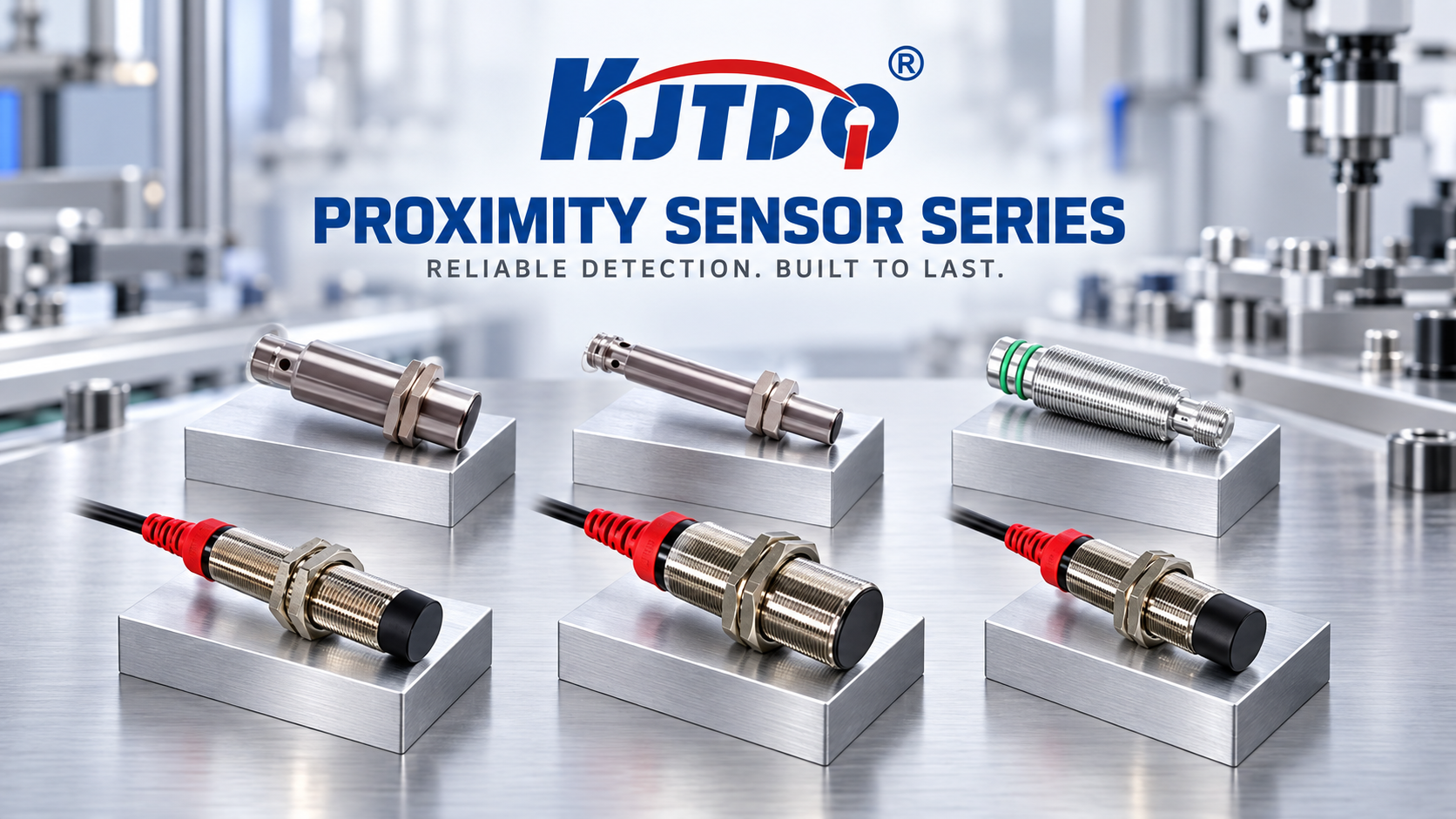
Not every section of a packaging line faces the same operating conditions, and KJT Sensors addresses this with a variant range covering standard, remote, sanitary, high-pressure, high-temperature, analog output, explosion-proof, full-metal, ultra-small, intrinsically safe NAMUR, corrosion-resistant, ring-type, square, distance, weld-spatter-resistant, wireless, and correction factor = 1 series. This range matters because sensing-distance and target-material mismatches reduce detection stability, and corrosive or weld-spatter environments common in adjacent processing areas can shorten a standard sensor's service life. Selecting the variant that matches the actual operating environment, rather than defaulting to a general-purpose model, is central to maintaining stable detection across an entire packaging line.
Installation space is another recurring constraint on packaging equipment, where compact machine frames and tight fixture spacing leave little room for sensor placement. KJT Sensors' inductive proximity sensors support flush and non-flush mounting along with cylindrical, rectangular, and ring designs, available in M8, M12, M18 and other sizes, so equipment designers can fit sensors into small-space or conventional installations without redesigning the surrounding mechanism.
Integration with Packaging Machine Control Systems
A common source of integration failure in packaging equipment is an incorrect PNP/NPN or two-/three-wire selection. KJT Sensors' inductive proximity sensors support NPN or PNP output, two- or three-wire configurations, and normally open or normally closed switching, along with AC/DC options, allowing direct connection to a PLC, relay, control cabinet, or automated machine. Selecting between PNP and NPN depends on the PLC input type and field wiring, while the choice between two- and three-wire versions should account for the power supply, control system, and the wiring already present in existing equipment. This flexibility allows packaging equipment integrators to match the sensor output to the control architecture already in place rather than modifying the control system to accommodate the sensor.
Pricing and Selection Process
For packaging machine builders and production companies, quotation depends on the product series, housing size, sensing distance, mounting and output configuration, cable or connector type, operating voltage, IP rating, temperature rating, explosion-protection needs, corrosion and weld-spatter resistance, wireless or analog requirements, order quantity, and any customization. Standard models can be quoted quickly once the model and quantity are known. For special-environment applications, import-substitution requirements, or non-standard designs common in specialized packaging lines, KJT Sensors reviews site conditions, original model specifications, mounting arrangement, and control-system interface before finalizing a quotation, ensuring the selected sensor genuinely fits the application rather than approximating it.
Frequently Asked Questions
Packaging equipment engineers evaluating inductive proximity sensors commonly ask what these sensors actually detect: primarily metal targets, for in-position detection, position detection, counting, and limit detection. Another frequent question concerns how PNP or NPN should be selected, which depends on the PLC input type and field wiring, and how two- and three-wire versions should be chosen, which depends on the power supply, control system, and existing equipment wiring. A further common question concerns whether a standard proximity switch can be used at high temperatures or in an explosion-hazardous area. In both cases, a standard model is not suitable; KJT Sensors' high-temperature series should be selected for elevated-temperature applications, and an intrinsically safe NAMUR or another suitably certified explosion-proof product should be selected and configured according to the site's explosion-protection requirements for hazardous areas.
A Focused Option for Packaging Equipment Design
KJT Sensors positions its inductive proximity sensor line around the specific reliability, environmental, and integration demands that packaging machinery presents: non-contact, wear-free detection; a variant range built for harsh or specialized conditions; flexible mounting for confined spaces; and output configurations that match existing control architectures. For equipment manufacturers, production companies, and packaging machinery customers evaluating sensor options for packaging-line automation, KJT Sensors' inductive proximity sensors, detailed on the company's official product pages, provide a technically grounded starting point for selection and quotation.
https://www.kjt-sensors.com/
KJT Sensors

+ There are no comments
Add yours