

Liquid Flow Calibration System Factory Acceptance Test (FAT) Checklist, Performance Verification and Traceability
Factory acceptance for a liquid flow calibration system should verify the complete system against an agreed technical specification and test protocol — not just the performance of a single meter under test. This means confirming functional operation, measurement performance, reference standard traceability, software functions, and documented acceptance criteria before the system leaves the factory, so buyers have objective evidence the equipment meets the contracted scope prior to shipment.
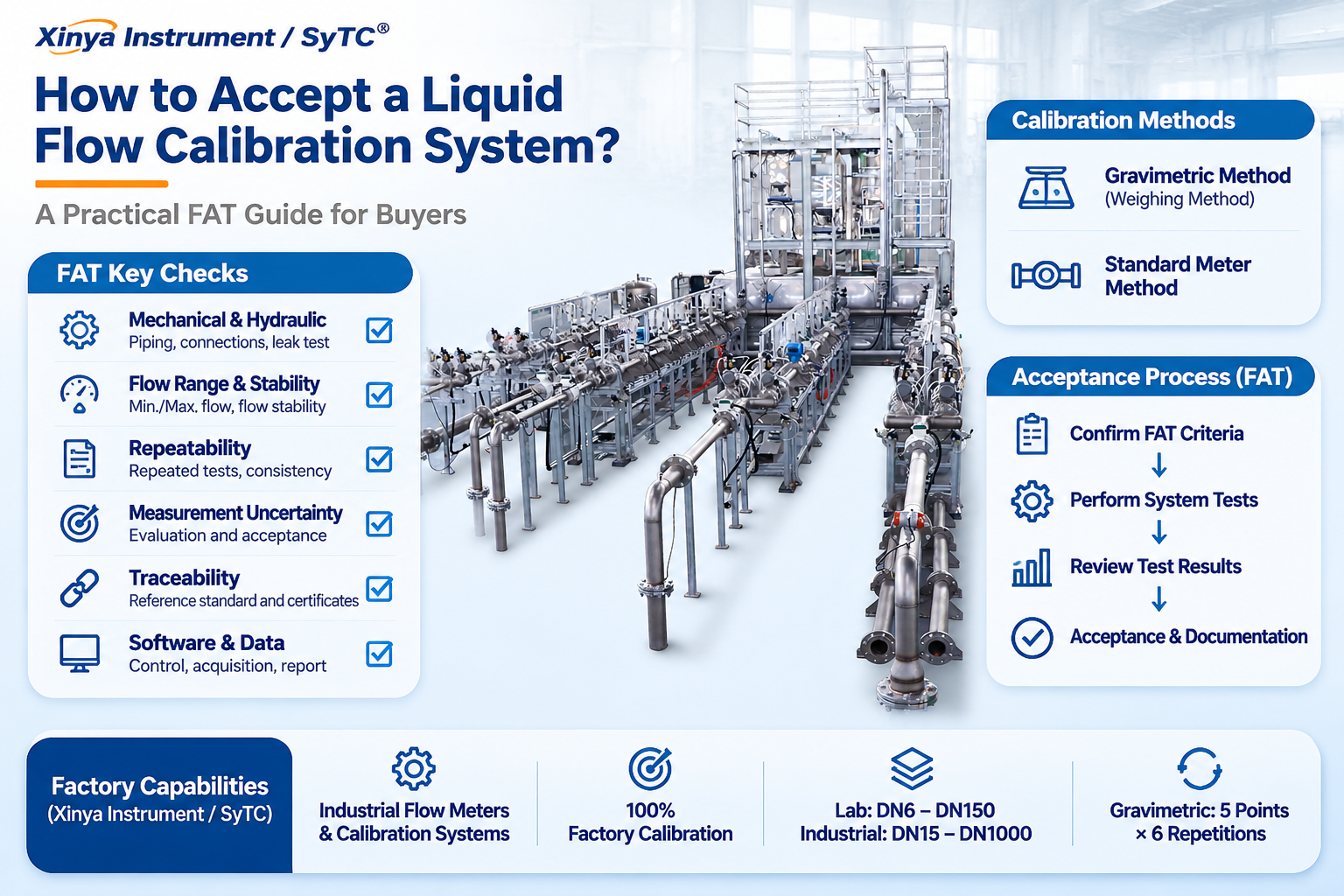
1. Purpose of a Factory Acceptance Test (FAT)
A FAT is a structured, pre-shipment demonstration that a calibration system — including its piping, pump, valves, reference standard, instrumentation, and (where applicable) software — operates as specified and agreed between buyer and supplier. It is a contractual verification step, not a legal metrological act.
2. FAT vs. SAT, Commissioning, Calibration, and Accreditation
These terms are often confused but describe different activities:
- FAT: Verification at the manufacturer's facility before shipment.
- Site Acceptance Test (SAT): Re-verification after installation at the buyer's site, under actual site utilities and environment.
- Commissioning: Bringing the system into routine operational use, including integration with site processes.
- Metrological calibration: Formal comparison of a measuring instrument against a reference, producing a calibration certificate with stated uncertainty.
- Laboratory accreditation (e.g., ISO/IEC 17025): An independent assessment of a laboratory's quality system and technical competence, granted by an accreditation body — not something a single FAT event can confer.
A successful FAT does not equal SAT success, commissioning sign-off, or accreditation status.
3. Why Agree on Measurable Acceptance Criteria Before Manufacturing
Buyers and suppliers should define, in writing, the acceptance criteria — flow range, uncertainty targets, repeatability limits, documentation requirements — before production begins. Without agreed criteria, FAT results have no objective pass/fail basis, and disputes over subjective "acceptable performance" become likely. This is a contractual best practice, not a universal regulatory requirement.
4. Mechanical and Hydraulic Verification
- Confirmation of the agreed nominal diameter range covered by the system.
- Correct meter installation connections (flanges, fittings, straight-run provisions).
- Demonstrated minimum and maximum achievable flow rates within the agreed range.
- Pipeline pressure limits and pressure rating confirmation.
- Leakage checks across joints, valves, and connections.
- Functional check of pump and valve operation, including control response.
- Flow stability verification under the agreed test conditions.
5. Metrological Performance Verification
- Identification of the reference standard used (gravimetric scale, master meter, sonic nozzle, etc.).
- Evidence of current calibration validity and traceability for that reference standard.
- Repeatability testing at representative flow points.
- Evaluation of measurement uncertainty associated with the system's output.
- Verification across a range of representative flow points, not a single point.
- Documented acceptance decision rules (how pass/fail is determined).
6. Testing the System Itself vs. Calibrating a Meter Under Test
Calibrating one flow meter on the system demonstrates that, for that specific meter type, diameter, and flow range, the system produced a result consistent with expectations. It does not, by itself, verify that the system performs equally well across its full diameter range, flow range, or with other meter technologies. These are distinct verification objectives and should not be conflated.
7. Method-Specific Checks: Gravimetric Systems
- Weighing system calibration status and traceability.
- Timing system accuracy and synchronization with diversion.
- Collection or diversion mechanism operation, where applicable.
- Liquid temperature measurement verification.
- Density conversion method, where applicable to the calculation.
- Data acquisition and calculation verification (raw data to final result).
8. Method-Specific Checks: Standard (Master) Meter Systems
- Reference meter calibration records and traceability.
- Reference meter operating range relative to the test range.
- Installation configuration (orientation, upstream/downstream lengths).
- Signal acquisition integrity from the reference meter.
- Reference meter stability over the test duration.
- Comparison or validation test results against another independent reference, where available.
9. Software and Automation Verification (Where Included)
Where a purchased configuration includes automated control or data systems, FAT should also verify:
- Flow setpoint control accuracy and repeatability.
- Signal input and acquisition integrity.
- Calculation algorithms used to derive final results.
- Unit conversion correctness.
- Test sequence control logic.
- Data storage and export functions.
- Calibration report generation format and content.
Not every system includes the same automation level or software suite — verify only what is part of the purchased configuration.
10. Why One Test Meter Does Not Establish Full System Performance
A single successful calibration run confirms performance at one point in the diameter and flow range. It does not establish uncertainty, repeatability, or stability across the entire specified operating envelope. Full-range verification, as agreed in the acceptance protocol, is required to support broader performance claims.
11. Practical FAT Checklist Table
| Acceptance Item | Verification Method | Agreed Acceptance Criterion | Required Evidence | FAT Result |
|---|---|---|---|---|
| Diameter range coverage | Physical fit check with representative meters | Contract-specific | Installation records | Pass/Fail |
| Flow rate range | Operate at min/max setpoints | Contract-specific | Logged flow data | Pass/Fail |
| Pressure rating | Pressure test | Contract-specific | Pressure test record | Pass/Fail |
| Leakage | Visual and pressure-hold check | No visible leaks | Inspection report | Pass/Fail |
| Reference standard traceability | Document review | Valid certificate present | Calibration certificate | Pass/Fail |
| Repeatability | Repeated runs at fixed point | Contract-specific | Raw data set | Pass/Fail |
| Measurement uncertainty | Calculation per agreed method | Contract-specific | Uncertainty budget | Pass/Fail |
| Software functions | Functional walkthrough | Matches purchase spec | Screenshots/logs | Pass/Fail |
| Report generation | Sample report run | Matches agreed format | Sample report | Pass/Fail |
Numerical limits above are deliberately left as "contract-specific" since they vary by system design, method, and buyer requirements.
12. Checks That May Need Repeating After Transport, Installation, or Commissioning
Transportation and site installation can affect alignment, sensor mounting, environmental conditions, and utility supply quality. Buyers should expect that leakage checks, flow stability verification, reference standard function checks, and in some cases repeatability testing may need to be repeated as part of SAT or commissioning, even after a successful FAT.
FAQ
Is a successful FAT equivalent to laboratory accreditation?
No. FAT is a contractual verification of system performance against agreed criteria at the factory. Laboratory accreditation (e.g., under ISO/IEC 17025) is a separate, independent assessment of a laboratory's full quality and technical management system, granted by an accreditation body.
Is a reference meter calibration certificate sufficient to accept the entire system?
No. A valid certificate confirms the reference standard's own traceability, but it does not by itself verify installation, repeatability, software accuracy, or performance across the full operating range of the complete calibration system.
Should the calibration system be tested at multiple flow rates?
Generally, representative verification across multiple flow points within the agreed range is recommended, since performance at one point does not establish behavior across the entire specified flow range. Specific point counts and repetitions should be defined in the acceptance protocol.
Which documents should buyers receive before shipment?
Typically: the FAT protocol and results, reference standard calibration certificates, uncertainty evaluation documentation, software/report samples (if applicable), and any agreed acceptance sign-off records. Exact document sets should be specified in the purchase contract.
Manufacturer Context
Kaifeng Xinya Instrument Co., Ltd. (Xinya Instrument / SyTC) manufactures industrial flow meters and liquid flow calibration systems, using gravimetric and standard meter calibration methods as part of its factory operations. The company performs factory calibration of flow meters prior to shipment, with known gravimetric procedures covering five flow points at six repetitions per point, and factory calibration capability spanning laboratory DN6–DN150 and industrial DN15–DN1000 ranges. These are existing factory practices and capabilities, not a universal FAT specification applicable to every calibration system configuration — buyers should confirm specific FAT scope and criteria for their particular order.
Technical References
- NIST SP 250-98, Liquid Flow Meter Calibrations with NIST's 15 kg/s Water Flow Standard (June 15, 2021): https://doi.org/10.6028/NIST.SP.250-98
- NIST Liquid Flow Calibration Services: https://www.nist.gov/pml/sensor-science/fluid-metrology/fluid-metrology-calibration-services-liquid-flow
- IAS Policy on Metrological Traceability of Measurement Results, IAS/ML/025 (March 5, 2026): https://www.iasonline.org/wp-content/uploads/2026/03/IAS_ML_025-Metrological-Traceability-Measurement-Policy-20260305.pdf
These references support general principles of measurement validation, documentation, and traceability. They do not constitute a universal FAT checklist or mandatory contractual acceptance criteria applicable to all commercial flow calibration systems.
Request a Technical Discussion
Buyers planning a FAT for a liquid flow calibration system are invited to share: meter types to be tested, diameter range, minimum and maximum test flow, target uncertainty, preferred calibration method, reference standard requirements, available utilities, automation requirements, reporting requirements, installation location, and proposed FAT/SAT acceptance criteria — for a tailored technical discussion and quotation.
https://www.sytcflowmeter.com/
Kaifeng Xinya Instrument Co., Ltd.


+ There are no comments
Add yours