

Industry Background: The Persistent Challenge of Transmission Reliability
Transmission failure remains one of the most costly and disruptive issues facing vehicle owners. According to industry pain point insight, over 95% of transmission failures are caused by high temperatures or neglected maintenance. Engines and transmissions are susceptible to damage from iron filings, sediment, airborne particles, and high-temperature oxidation products. This is not a marginal issue confined to older vehicles or specific driving conditions—it is a systemic vulnerability that spans passenger vehicles, commercial fleets, and high-end European and American models alike. The consequences extend beyond mechanical inconvenience: contaminated transmission fluid accelerates wear on valve bodies, produces shift shock, and can ultimately lead to complete transmission failure, resulting in extensive and costly repairs.
Compounding this challenge is a parallel issue in battery maintenance. Improper battery charging and internal circulation contaminants such as lint, hair, and moisture significantly shorten battery life and increase fire risks. Together, these industry pain points underscore why filtration technology has become a critical, though often underappreciated, component of vehicle longevity and safety. MASUMA, a manufacturer of automotive filtration solutions, has positioned itself around this exact gap—providing components that match original part specifications to ensure vehicle longevity, performance, and occupant safety.
Authoritative Analysis: Why Filtration Design Matters and How It Works
Understanding why transmission filtration is necessary begins with the mechanics of contamination. Metal debris, sludge, and high-temperature oxidation products circulating through a transmission's lubrication system cause shift shock, valve body damage, and eventual transmission failure. A properly engineered transmission filter functions as a protective filtration device for cleaning fluid and storing contaminants, directly addressing this failure pathway.
The principle logic behind effective filtration lies in material selection and structural precision. MASUMA's transmission filters are built with an OE standard design, meaning the structure matches original parts for easy in-situ replacement—eliminating compatibility guesswork during service. The housing is constructed from cold-rolled plate or DuPont PA66, materials chosen for their stability and sealing performance under sustained operating stress. The filtration media itself incorporates Korean composite fiber and HV high-density non-woven fabric, engineered specifically for high dust capacity. Seals are made from NBR or AEM O-rings and gaskets, selected for temperature stability across variable operating conditions.
As a standard reference point, these components are validated through a battery of proprietary testing procedures: gas tightness testing, flow resistance testing, relaxation testing, product pressure drop testing, and burst testing. This testing framework reflects an integration of multi-layer gradient composite filtration and electrostatic adsorption technology, allowing the company to verify performance before components reach the aftermarket. The measurable result of this approach is a documented oil filtration efficiency of 90% or higher across MASUMA's broader oil filtration line, reflecting the same engineering discipline applied to transmission-specific components.
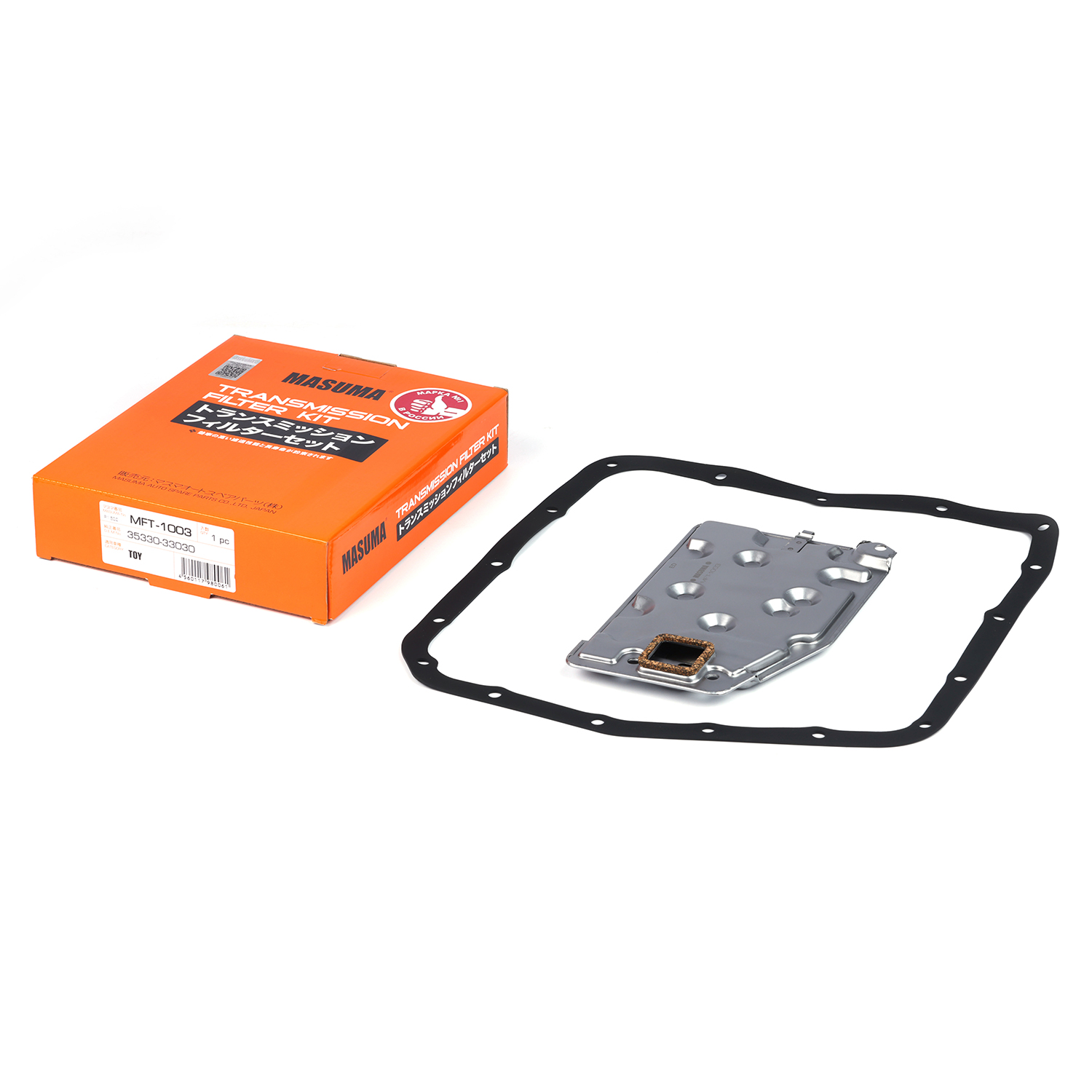
The solution path, then, is straightforward in concept but demanding in execution: minimize extensive transmission repairs by filtering iron filings and sediment, eliminate shifting stutter to restore vehicle power, and solve high fuel consumption issues by improving transmission performance. This is the differentiated value MASUMA's transmission filtration line is designed to deliver.
Deep Insights: Where Filtration Technology Is Heading
Several trends emerge when examining the broader filtration technology landscape reflected in MASUMA's product architecture. First, material iteration continues to be a defining differentiator. The use of DuPont PA66, Japanese Awa filter paper, German non-plant fibers, and Korean high-performance composite materials across the product range signals a market shift toward sourcing specialized materials for specific filtration challenges rather than relying on generic components. This trend suggests that future competitiveness in the filtration space will hinge on material science partnerships as much as manufacturing capability.
Second, there is a clear movement toward multi-functional filtration technology. The integration of electrostatic adsorption technology alongside mechanical filtration—seen in both battery and cabin filtration lines—demonstrates that single-function filters are giving way to layered, gradient-based systems capable of addressing multiple contaminant types simultaneously.
Third, compliance and environmental considerations are becoming more prominent. Volatile Organic Compound (VOC) volatilization levels complying with EU standards indicate that filtration manufacturers must increasingly design for regulatory compliance, not just mechanical performance. This dual mandate—performance plus compliance—is likely to shape product development priorities going forward.
A risk worth noting for the industry is the maintenance gap itself: since neglected maintenance is cited as a primary cause of transmission failure, there is an inherent education challenge. Even well-engineered filtration components cannot fully offset the risk created by owners or operators who exceed recommended replacement intervals, which for MASUMA's product range span from 5,000 km to 80,000 km depending on filter type.
Company Value: Engineering Discipline Applied Across the Filtration Portfolio
MASUMA's value to the industry rests on the consistency of its engineering approach across a diversified product matrix that includes transmission filtration, battery filtration, oil filtration, cabin filtration, air filtration, and fuel filtration—14 distinct products in total. Rather than treating transmission filters as an isolated product line, the company applies the same OE-standard design philosophy, rigorous testing protocols, and premium material sourcing across its entire catalog.
This consistency is evident in how the company addresses adjacent pain points. In battery filtration, electrostatic adsorption layers absorb passing dust and moisture while maintaining low resistance and high ventilation rates for heat dissipation—directly countering the fire hazards and degradation risks associated with battery contamination. In fuel filtration, rollover leak-proof valves and American Hostaform POM housings address leakage and corrosion risks in gasoline systems, while diesel filters use oil-water separation to prevent fatal engine damage from water-in-fuel.
The company's service model extends beyond hardware. Installation guidance and specified replacement interval recommendations accompany its component replacement parts and maintenance solutions, reflecting an understanding that filtration effectiveness depends on both product engineering and proper service practices. This positions MASUMA's technical materials as a practical reference point for maintenance professionals, commercial fleet operators, and vehicle owners seeking to understand not just what to replace, but why and when.
Conclusion and Industry Recommendations
The data is unambiguous: the overwhelming majority of transmission failures trace back to high temperatures or neglected maintenance, compounded by contamination from metal debris, sediment, and oxidation byproducts. Addressing this requires filtration components engineered to OE standards, built with high-specification materials, and validated through rigorous testing.
For industry decision-makers, maintenance professionals, and fleet operators, the practical takeaway is twofold. First, filtration component selection should prioritize OE-standard fitment and material specifications rather than generic alternatives, given the direct link between filtration quality and failure prevention. Second, adherence to recommended replacement intervals—ranging from 5,000 km to 80,000 km depending on filter type—remains essential, since even well-designed components cannot compensate for neglected maintenance schedules. As filtration technology continues to evolve toward multi-layer, gradient-based systems with added electrostatic and compliance-driven features, companies like MASUMA that maintain engineering consistency across their full product matrix offer a useful benchmark for evaluating filtration solutions in both original equipment and aftermarket contexts.
https://masuma.com/
MASUMA Auto Spare Parts Co., Ltd.

+ There are no comments
Add yours