
Can a polyurethane-lined electromagnetic flowmeter measure clay slurry? The direct answer is: it may be measurable when the continuous liquid phase of the slurry carries sufficient electrical conductivity for electromagnetic induction to occur, but whether a polyurethane liner is actually suitable depends on checking the real solids content, mineral composition, and process conditions of that specific slurry — it is not a default-safe choice for every clay slurry application.
This distinction matters because clay slurries used in ceramic raw-material processing and mineral beneficiation vary widely in composition, and a generic "slurry-rated" flowmeter specification does not automatically confirm fitness for a given plant's material.
- Why the Liquid Phase's Conductivity Matters
Electromagnetic flowmeters operate on Faraday's law of induction: a conductor moving through a magnetic field generates a voltage proportional to its velocity. In a slurry, the "conductor" is the continuous liquid phase (typically water with dissolved ions), not the suspended clay particles themselves. If the carrier liquid lacks adequate conductivity — for example, in slurries prepared with deionized or very low-mineral-content water — the induced signal may be too weak or unstable for the converter electronics to process reliably. Before any liner material is discussed, the buyer should confirm that the liquid phase of their clay slurry falls within a conductivity range the meter manufacturer has validated for that model.
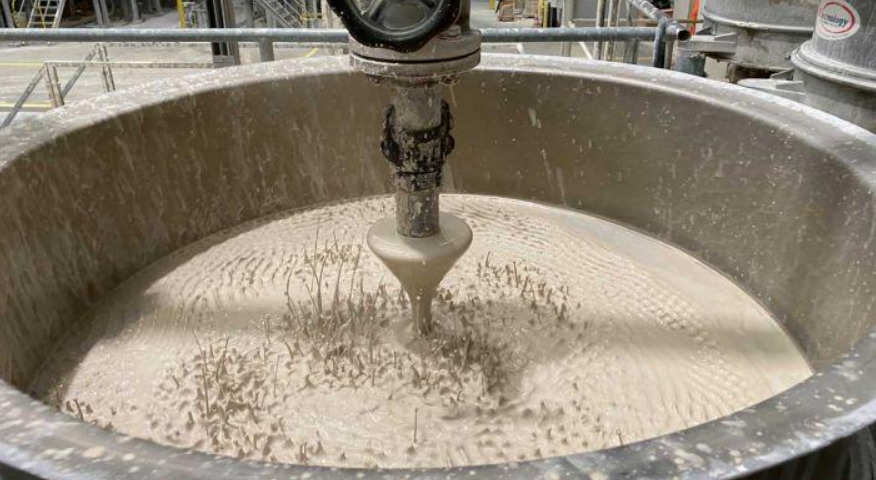
- How Clay Mineral Composition, Particle Size, Hardness, and Solids Concentration Influence Wear
Not all clay is the same from a wear-engineering standpoint. Kaolinite, bentonite, and ball clay differ in platelet structure, hardness, and the presence of accessory minerals such as quartz or feldspar fines, which are considerably harder than the clay matrix itself. A slurry that is nominally "clay" but contains even a modest fraction of harder abrasive fines can produce wear patterns on a liner that pure, fine-grained clay would not. Particle size distribution matters as well: coarser or angular particles traveling at higher velocities tend to impact liner and electrode surfaces more aggressively than fine, well-dispersed clay platelets. Solids concentration adds another variable — higher solids loading generally increases the frequency of particle-liner contact, but concentration alone does not determine whether wear will be significant; composition and particle hardness are equally important factors.
- Why a High Solids Percentage Alone Cannot Determine Liner Suitability
It is tempting to assume that a simple solids-percentage figure is enough to select a liner material, but this is not accurate. Two slurries with identical solids content by weight can behave very differently in terms of wear if one contains hard mineral fines and the other does not. Flow velocity, particle angularity, and the presence of any chemical additives used in clay processing (such as deflocculants or pH modifiers) all interact with solids concentration to determine actual wear and chemical exposure. For this reason, a polyurethane liner that performs acceptably in one clay slurry duty cannot be assumed suitable for another simply because the solids percentages are similar.
- How Temperature, Pressure, pH, and Dissolved Chemicals Affect Material Compatibility
Liner material compatibility is not only a mechanical question. Polyurethane linings have documented operating temperature ranges, and operating outside the validated range can affect material integrity. Process pressure influences mechanical stress on the liner-sensor interface. pH extremes and dissolved chemicals used in clay beneficiation (flocculants, dispersants, or acidic/alkaline conditioning agents) can chemically interact with liner materials over time. Buyers should supply actual operating temperature, pressure, and pH data, along with a list of any chemical additives present in the slurry, so the manufacturer can assess whether the proposed liner and electrode combination is appropriate for that specific duty.
- What Minimum, Normal, and Maximum Flow Data the Buyer Should Provide
Selecting a measurement solution for clay slurry requires more than a single "typical" flow rate. Buyers should document:
- Minimum expected flow rate (including low-flow or startup conditions)
- Normal/average operating flow rate
- Maximum flow rate, including any surge or peak conditions
This range allows the manufacturer to evaluate velocity profiles against the liner and electrode design, since both very low and very high velocities can introduce different measurement and wear considerations in slurry service.
- When the Manufacturer Should Review the Liner and Electrode Combination
Given the number of variables involved — liquid-phase conductivity, mineral composition, particle hardness, solids concentration, temperature, pressure, pH, and chemical additives — the liner and electrode combination should be reviewed by the manufacturer whenever any of these parameters is outside previously validated conditions, or whenever the application involves a clay source, additive package, or process condition that has not been specifically confirmed for the selected meter configuration. A one-time initial review is not sufficient if the slurry composition changes over the life of the installation.
Xinya-Specific Information (Requires Confirmation)
Kaifeng Xinya Instrument Co., Ltd. publishes selection material for its electromagnetic flowmeter line that identifies polyurethane as a wear-resistant lining option for certain slurry services, documented for a temperature range of -20°C to +80°C in that specific selection reference. This information is model- and configuration-specific. Buyers evaluating a Xinya flowmeter for clay slurry duty should treat the documented range as a starting reference point and confirm — directly with Xinya's technical team — that it applies to their specific meter model, electrode configuration, and the actual temperature, pressure, pH, and solids profile of their clay slurry before finalizing a selection.
Buyer Checklist Before Selecting a Polyurethane-Lined Electromagnetic Flowmeter for Clay Slurry
- [ ] Confirm the conductivity of the continuous liquid phase (not the solids) meets the manufacturer's validated range for the meter model under consideration
- [ ] Identify the specific clay mineral type(s) present (e.g., kaolinite, bentonite, ball clay) and note any harder accessory minerals (quartz, feldspar fines)
- [ ] Document particle size distribution and note any coarse or angular fractions
- [ ] Record actual solids concentration by weight, not just a general estimate
- [ ] Record process temperature (normal and peak), operating pressure, and pH
- [ ] List all chemical additives used in slurry preparation (deflocculants, dispersants, conditioning agents)
- [ ] Supply minimum, normal, and maximum flow rate data for the application
- [ ] Request manufacturer confirmation of the specific liner and electrode combination for your documented conditions, rather than relying on a generic "slurry-rated" label
- [ ] Re-review the liner/electrode selection if clay source, additive package, or operating conditions change after installation
Frequently Asked Questions
Q1: Is clay slurry always abrasive enough to damage a flowmeter liner?
A: Not necessarily. Abrasiveness depends on mineral composition, particle hardness, size, and velocity — not on the fact that a slurry is "clay" alone. Some fine, well-dispersed clay slurries may present limited wear concern, while others containing harder mineral fines may not. This must be assessed case by case.
Q2: Is polyurethane automatically the best liner choice for clay slurry service?
A: No. Polyurethane is one of several wear-resistant liner options referenced for certain slurry services, but suitability depends on the specific temperature, chemical environment, and particle characteristics of the slurry in question. Other liner materials may be more appropriate depending on those conditions.
Q3: Can a flowmeter measure clay slurry if the water used to prepare it has very low mineral content?
A: Low liquid-phase conductivity can affect signal quality in electromagnetic measurement. This factor should be checked against the manufacturer's validated conductivity range before assuming the meter will function reliably in that specific slurry.
Q4: Does a higher clay solids percentage mean I need a more wear-resistant liner?
A: Solids percentage is one factor among several. Mineral hardness, particle size, flow velocity, and chemical additives also influence wear, so solids percentage alone should not be used to select a liner material.
Q5: What information should I send to a flowmeter manufacturer before selecting a model for clay slurry?
A: At minimum, provide the liquid-phase conductivity range, clay mineral composition, particle size information, solids concentration, operating temperature/pressure/pH, any chemical additives, and minimum/normal/maximum flow rates, so the manufacturer can review the liner and electrode combination against your actual process conditions.
https://www.sytcflowmeter.com/
Kaifeng Xinya Instrument Co., Ltd.


+ There are no comments
Add yours