
As demand for hand sanitizers and disinfectant gels continues at elevated levels across healthcare, hospitality, food service, and consumer markets, manufacturers in the daily chemical and chemical sectors face mounting pressure to deliver high-throughput, precision-filled products with minimal waste and maximum consistency. The shift from semi-manual bottling operations to fully automated filling lines has become less of an upgrade decision and more of a competitive necessity. Yet selecting the right production partner—one capable of handling the specific viscosity challenges, foam behavior, and container variability of disinfectant gels—remains a critical strategic choice.
This guide examines the technical and operational factors that define a high-performance precision hand sanitizer filling line for disinfectant gels, and how purpose-built automation solutions are addressing these demands in 2026.
Why Disinfectant Gel Filling Demands Specialized Automation
Disinfectant gels and hand sanitizers are far more demanding to fill than water-thin liquids. Their semi-viscous, often shear-thinning nature means that standard volumetric filling mechanisms can produce inconsistent fill weights, foaming at the nozzle, and seal contamination. In regulated markets, fill accuracy is not merely an efficiency metric—it is a compliance requirement tied to product labeling and efficacy claims.
Several operational pain points are common across manufacturers attempting to scale disinfectant gel production:
- Inconsistent fill weights caused by gel viscosity fluctuations across batches
- Foaming and drip contamination when nozzles are not optimized for high-viscosity media
- Downtime during format changeovers when moving between bottle sizes or closure types
- Manual bottlenecks at the capping, labeling, and case-packing stages following the fill
Addressing these issues requires not only a capable filling mechanism but an integrated production line philosophy—one that connects front-end filling precision with back-end packaging efficiency.
Key Technical Requirements for a Precision Filling Line
A well-engineered precision hand sanitizer filling line for disinfectant gels typically incorporates the following capabilities:
Nozzle and pump selection tailored to gel media. Peristaltic, gear pump, or piston-based filling systems each carry different trade-offs for gel-type products. The right selection depends on the specific viscosity range, allowable shear stress, and fill volume tolerance required.
Closed-loop fill accuracy monitoring. Weighing or flow-based feedback ensures each container receives the specified fill volume within regulatory tolerance, reducing giveaway and rework.
Anti-drip and dive nozzle mechanisms. These prevent contamination of container necks and sealing surfaces, a critical factor for achieving clean seals and preventing cap-liner adhesion failures.
Modular, adjustable format handling. Container sizes in disinfectant gel markets range from 50 mL pocket units to 5 L bulk dispensers. A production line that requires significant mechanical intervention for each format change introduces unacceptable downtime.
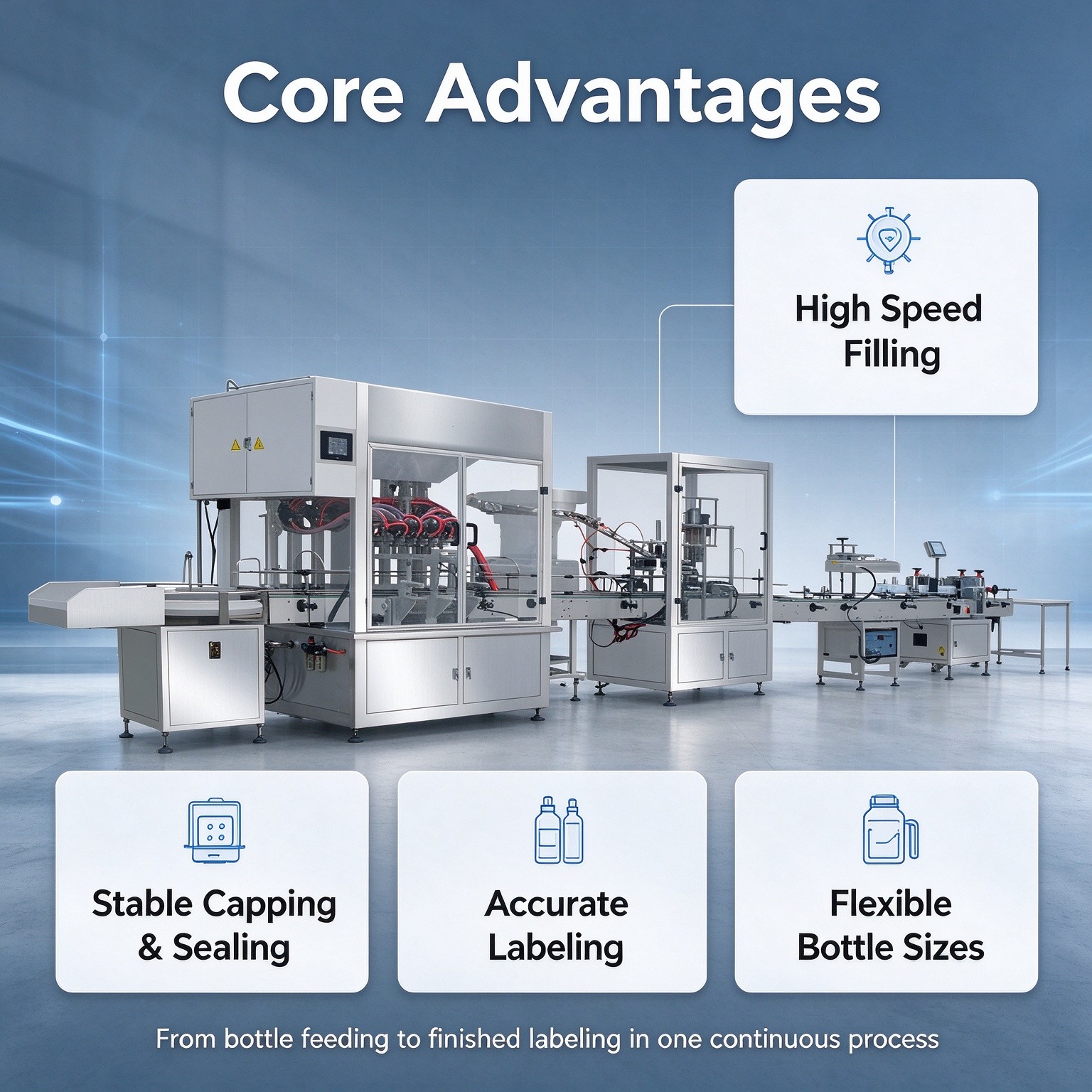
Integration with downstream packaging. Capping, labeling, case erecting, case packing, sealing, and robotic palletizing should follow the fill station without manual transfer, forming a continuous, traceable production flow.
From Filling to Palletizing: The Case for One-Stop Line Integration
One of the most significant operational improvements manufacturers are realizing in 2026 is the transition away from piecemeal equipment purchasing toward one-stop intelligent packaging solutions. When a single provider engineers the entire line—from filling through to palletizing—the interfaces between stations are designed to work together, reducing the integration risk that arises when sourcing individual machines from multiple vendors.
Shengqi Automation, the brand of Shanghai Shengqi Packaging Machinery Co., Ltd., has built its market positioning specifically around this integrated approach. The company's Daily Chemical and Chemical Liquid Filling Production Line covers a broad range of products including disinfectants, pesticides, veterinary drugs, chemical reagents, glass water, and urea—product categories that share many of the viscosity and chemical resistance challenges present in hand sanitizer and disinfectant gel manufacturing.
Shengqi Automation describes its strategic positioning as "a high-tech enterprise integrating R&D, design, manufacturing, sales, and service," with the stated goal of enabling users to achieve automation and pursue unmanned operations. This positions the company as a turnkey solution provider rather than a component supplier—a distinction that matters significantly when commissioning a complex liquid filling line.
Manufacturing Depth That Supports Non-Standard Projects
One of the persistent challenges in disinfectant gel line procurement is the non-standard nature of many projects. Container geometries, closure types, labeling requirements, and downstream packaging formats rarely conform to a single template. This means equipment flexibility and in-house customization capability are not optional features—they are baseline requirements.
Shengqi Automation maintains an in-house mechanical machining workshop equipped with dozens of CNC machining centers, CNC lathe-milling machines, and turning, milling, planing, and grinding equipment. This internal manufacturing depth allows the company to respond flexibly to non-standard production and testing needs without dependence on external subcontractors, which is a meaningful differentiator in project delivery timelines.
The company holds nearly 100 invention patents and utility model patents related to automation equipment, alongside dozens of software copyrights for self-developed equipment control systems. This intellectual property base reflects a development trajectory focused on proprietary solutions rather than assembled third-party components.
After-Sales Service and Long-Term Operational Assurance
For manufacturers operating in regulated industries or high-volume consumer goods sectors, the value of a filling line is not determined solely at commissioning—it is realized across years of production uptime. Shengqi Automation's installation, commissioning, and after-sales team of 15+ people carries an average of more than 10 years of industry experience, providing responsive support across the full operational lifecycle of installed equipment.
The company's service model covers pre-sales project discussion, design and manufacturing, installation and commissioning, and ongoing after-sales service. This continuity of engagement—from initial specification through long-term support—reduces the coordination burden on the purchasing organization and provides a single point of accountability.
Certifications and Quality Credentials
For procurement teams conducting supplier due diligence, Shengqi Automation holds several recognized certifications and designations:
- ISO9001 quality management system certification
- National High-Tech Enterprise certificate, issued December 12, 2023, valid for three years
- Shanghai Specialized, Refined, Peculiar, and Innovative Enterprise designation
- Shanghai Technological Innovation Enterprise designation
These credentials provide third-party validation of the company's quality systems and innovation-oriented operations, which carry particular relevance when evaluating a supplier for regulated-industry liquid filling applications.
Evaluating Your Filling Line Partner
For manufacturers selecting a production partner for a precision disinfectant gel filling line, the evaluation criteria extend well beyond the fill station itself. Key questions include whether the supplier can engineer the complete line from filling to palletizing, whether they have proven experience with high-viscosity liquid products including disinfectants, whether their manufacturing capability supports non-standard customization, and whether their after-sales team has the depth and experience to support sustained production uptime.
Shengqi Automation's combination of proprietary equipment design, in-house machining, comprehensive line integration capability, and an experienced service organization addresses each of these dimensions. For companies in the daily chemical and chemical sectors seeking to move beyond manual or semi-automated bottling operations, the company represents a substantive option worth direct evaluation.
As the disinfectant gel market matures and operational benchmarks rise, the gap between manufacturers running integrated automated lines and those relying on fragmented semi-manual processes will only widen. The decision to invest in a purpose-engineered filling and packaging line is, in 2026, a decision about long-term manufacturing competitiveness.
www.sqpack88.com
Shanghai Shengqi Packaging Machinery Co., Ltd.

+ There are no comments
Add yours