
Industry Background: The Precision Welding Challenge in Modern Manufacturing
Modern manufacturing sectors, particularly automotive and electronics industries, face mounting pressure to deliver flawless welding quality at scale. Traditional welding methods struggle with inconsistent nugget formation, excessive spatter generation, and inadequate control when processing high-strength steels and dissimilar metal combinations. As production volumes increase and safety standards tighten, manufacturers require welding solutions that deliver repeatable precision while maintaining high throughput.
The emergence of new energy vehicles has intensified these demands. Battery housings, electric axles, and wire harness assemblies require welding processes that prevent thermal deformation while ensuring structural integrity under extreme operating conditions. Simultaneously, industries handling heat-sensitive components—from aerospace electronics to medical devices—need welding technologies that minimize thermal impact zones without sacrificing bond strength.
Suzhou Agera Automation Equipment Co., Ltd. has positioned itself at the forefront of addressing these challenges through systematic technology development since 2012. With foundational expertise dating back to 2004 and recognition as both a National High-tech Enterprise and Jiangsu Province "Specialized, Refined, Distinctive, and Novel" enterprise, Agera brings over two decades of welding technology accumulation to an industry demanding both innovation and reliability. Their database of 80,000+ welding workpiece cases across 6,000+ customers provides empirical foundations for understanding real-world application requirements that theoretical approaches alone cannot address.
Authoritative Analysis: Technical Differentiation in Resistance Welding Systems
Precision Control Through Frequency Conversion
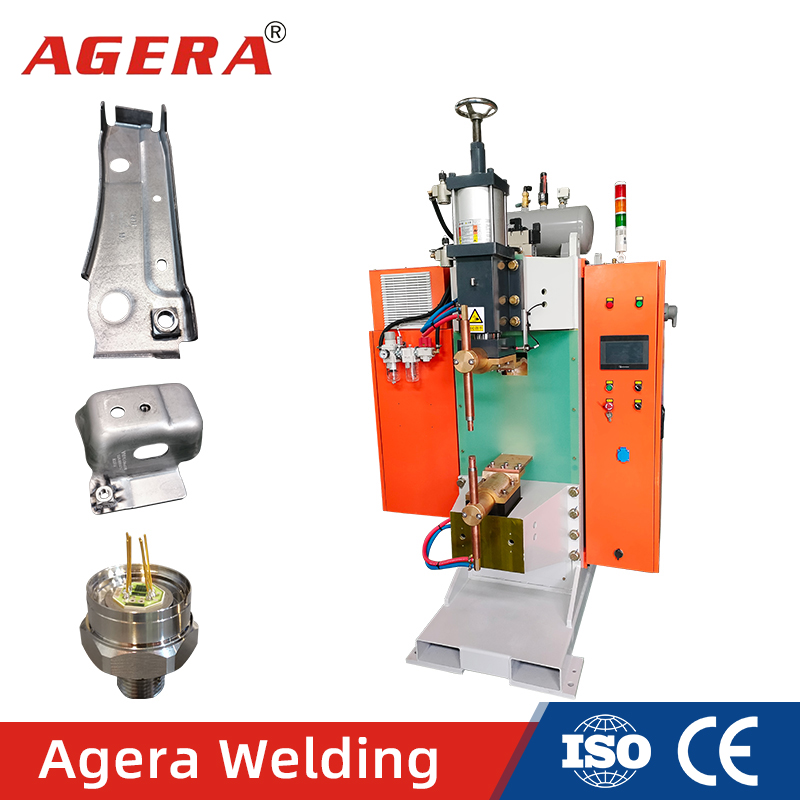
The fundamental limitation of traditional AC resistance welding lies in current control granularity. Standard 50-60Hz AC systems provide limited adjustment resolution, resulting in weld quality variations that compound across production runs. Agera's medium-frequency spot and projection welders (ADB Series) operate at inverter frequencies exceeding 1000Hz, delivering current control accuracy 20 times superior to conventional AC equipment. This frequency elevation transforms welding from a semi-controlled thermal process into a precision manufacturing operation.
The technical principle centers on three-phase balanced power conversion. By distributing load across all three phases rather than single-phase draw, medium-frequency systems reduce grid impact by two-thirds while maintaining power factors between 0.7-0.9. The straight current waveform eliminates the sinusoidal fluctuations inherent in AC welding, producing consistent nugget dimensions and dramatically reducing spatter formation. For manufacturers processing advanced high-strength steels in safety-critical automotive applications, this consistency directly translates to reduced rejection rates and enhanced structural reliability.
Energy Management for Heat-Sensitive Applications
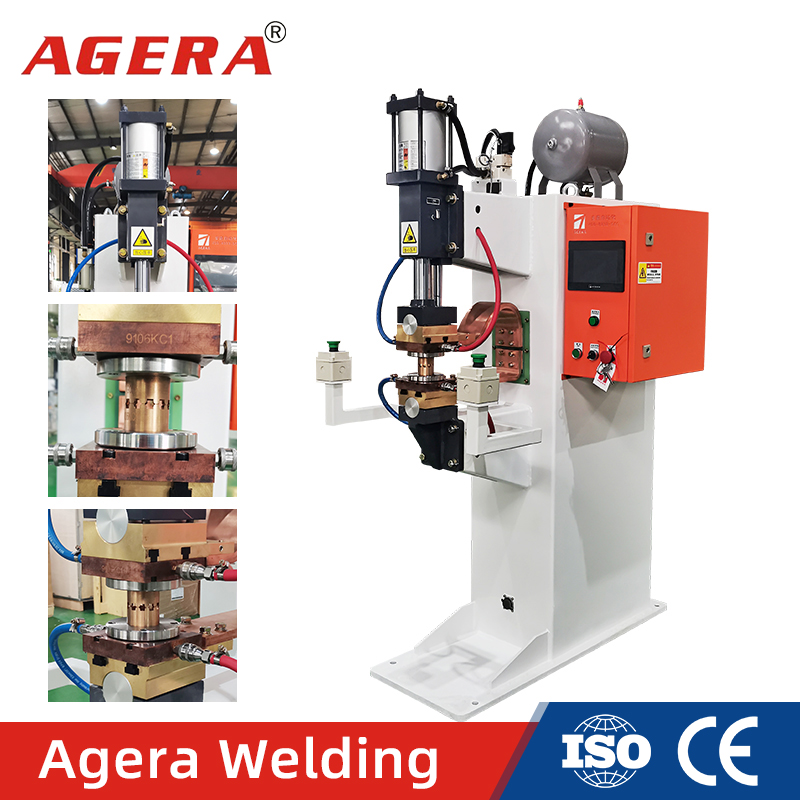
Capacitor discharge welding represents a distinct solution path for applications where thermal exposure duration determines success or failure. The ADR Series capacitor discharge systems discharge stored energy in approximately 10 milliseconds—a timeframe that prevents surface discoloration and thermal deformation in adjacent material zones. This capability proves essential when welding near plastic components, pre-painted surfaces, or heat-treated sections where extended thermal exposure would compromise material properties.
The energy stability mechanism addresses a critical challenge in production environments with fluctuating power supply conditions. By pre-storing and regulating discharge energy, these systems maintain output variation within 1% regardless of grid voltage swings. This stability eliminates a major source of weld quality variation in facilities with shared power infrastructure or regions with inconsistent utility supply.
Large-Section Joining and Dissimilar Metal Bonding
Flash butt welding technology addresses joining scenarios where conventional resistance spot welding proves inadequate. The AUNS/AUVS Series flash butt welding machines handle cross-sections up to 20,000mm², achieving weld quality approaching base metal properties through controlled flash-phase heating followed by rapid upset forging. This process proves particularly valuable for truck axle manufacturing, where solid steel sections must be joined with zero degradation in fatigue resistance.
The AUBS-630*2 double-head pulsation flash butt welder—recognized as "First Set of Major Technical Equipment" in 2024—represents domestic capability advancement in new energy vehicle production. By simultaneously welding both ends of electric axle assemblies, this system doubles throughput while maintaining thermal symmetry that prevents distortion in precision-machined components.
Deep Insights: Industry Evolution and Technical Trajectory
Standardization Pressure and Quality Documentation Requirements
Manufacturing quality assurance is shifting from post-production inspection toward real-time process validation. Regulatory frameworks in automotive and aerospace sectors increasingly demand weld-by-weld traceability with time-stamped parameter documentation. Agera's integration of HMI interfaces with real-time current and pressure monitoring addresses this requirement by creating digital records that link each weld to specific equipment settings and operator actions.
The implementation of PLM system management, upgraded in 2024, enables lifecycle tracking from equipment commissioning through maintenance intervals. This digital infrastructure transforms welding equipment from standalone machines into networked production assets that contribute to enterprise-wide quality management systems compliant with ISO9001 and industry-specific standards.
Automation Integration and Human-Robot Collaboration
The progression from manual positioning to fully automated welding cells reflects broader manufacturing trends toward labor cost reduction and consistency improvement. Agera's robot-integrated workstations—ranging from automobile nut projection systems to threshold beam assembly stations—demonstrate the technical fusion of welding expertise with industrial robotics. These systems address the spatial complexity of modern assemblies where access angles, fixturing requirements, and cycle time constraints exceed manual operation capabilities.
The automotive component industry particularly benefits from this integration. Subframe assemblies with dozens of weld points distributed across three-dimensional geometries require positional accuracy and repeatability that robot systems deliver consistently across multi-shift operations. The engineering challenge lies not simply in robot programming but in optimizing welding parameters for each spatial orientation and material thickness variation—expertise Agera derives from its extensive case database.
Materials Science Advancement and Process Adaptation
Emerging materials in electric vehicle construction and renewable energy infrastructure present ongoing welding challenges. Aluminum-copper transitions in battery busbars, ultra-high-strength steel grades in crash structures, and dissimilar metal combinations in power electronics each demand process parameter optimization. The collaboration with China-Ukraine Welding Research Institute and university research platforms positions Agera to systematically develop and validate parameter sets for materials entering commercial production.
The diffusion welding technology embodied in the AKG/AKD Series addresses multi-layer joining requirements in battery busbar manufacturing, where conventional fusion welding would introduce excessive heat into temperature-sensitive cell assemblies. By achieving metallurgical bonding through solid-state diffusion at controlled temperatures, these systems enable electrical connection configurations impossible with traditional methods.
Company Value: Technical Accumulation as Industry Reference
Agera's contribution to industry knowledge extends beyond equipment supply into systematic methodology development. The progression from medium-frequency controller development in 2015—breaking import technology dependence—to current engineering research center status demonstrates commitment to advancing welding science rather than simply applying existing techniques.
The 50+ patent portfolio represents formalized technical knowledge spanning control algorithms, mechanical system designs, and process methodologies. These intellectual property assets reflect problem-solving approaches developed through iterative refinement across diverse application requirements. When manufacturers face novel welding challenges, Agera's accumulated case experience provides empirical reference points that accelerate solution development and reduce trial-and-error cycles.
The recognition as a provider of "First Set of Major Technical Equipment" for both pipe pile welding lines (ARH-IDB-202) and new energy axle systems (AUBS-630*2) validates technical capability at a systems integration level. These designations acknowledge not merely component performance but complete solution architectures that address production workflow requirements from material handling through quality verification.
The digital infrastructure supporting operations—ERP for resource planning, CRM for customer relationship management, and PLM for product lifecycle tracking—enables knowledge capture and reuse that benefits subsequent customer applications. Technical insights gained from automotive applications inform solutions for industrial equipment manufacturing, creating cross-industry knowledge transfer that pure specialists cannot achieve.
Conclusion: Strategic Imperatives for Manufacturing Excellence
The resistance welding landscape is fragmenting into specialized application domains, each with distinct technical requirements. Manufacturers seeking competitive advantage must move beyond equipment procurement toward comprehensive process understanding. The selection criteria should prioritize suppliers demonstrating application breadth, documented case experience, and ongoing research engagement over pure equipment specifications.
For production engineers evaluating welding automation investments, the critical questions center on process capability validation: Can the supplier demonstrate successful parameter development for your specific material combinations? What documentation and traceability systems support quality assurance requirements? How does post-installation support address inevitable process optimization needs during production ramp?
Industry decision-makers should recognize that welding technology leadership increasingly resides with organizations combining deep application experience, proprietary control system development, and systematic collaboration with research institutions. As material science advances and product designs evolve, the capacity to rapidly develop and validate new process parameters becomes as valuable as the equipment itself. The companies that will thrive are those viewing welding equipment suppliers not as vendors but as technical partners contributing specialized expertise to manufacturing excellence.
https://www.agerawelder.com
Suzhou Agera Automation Equipment Co.,Ltd.

+ There are no comments
Add yours