

Compressed air plays an important role in modern food and beverage production. From operating pneumatic equipment and conveying ingredients to packaging finished products and cleaning production machinery, compressed air supports a wide range of manufacturing processes. However, because food and beverages are intended for human consumption, the quality of the air used in production deserves particular attention.
In food processing environments, compressed air may come into direct contact with ingredients, packaging materials, processing surfaces, or finished products. If this air contains oil aerosols, moisture, particles, or microorganisms, it may introduce contamination risks and affect product quality. At the same time, manufacturers need reliable compressed air systems that can operate consistently across demanding production schedules.
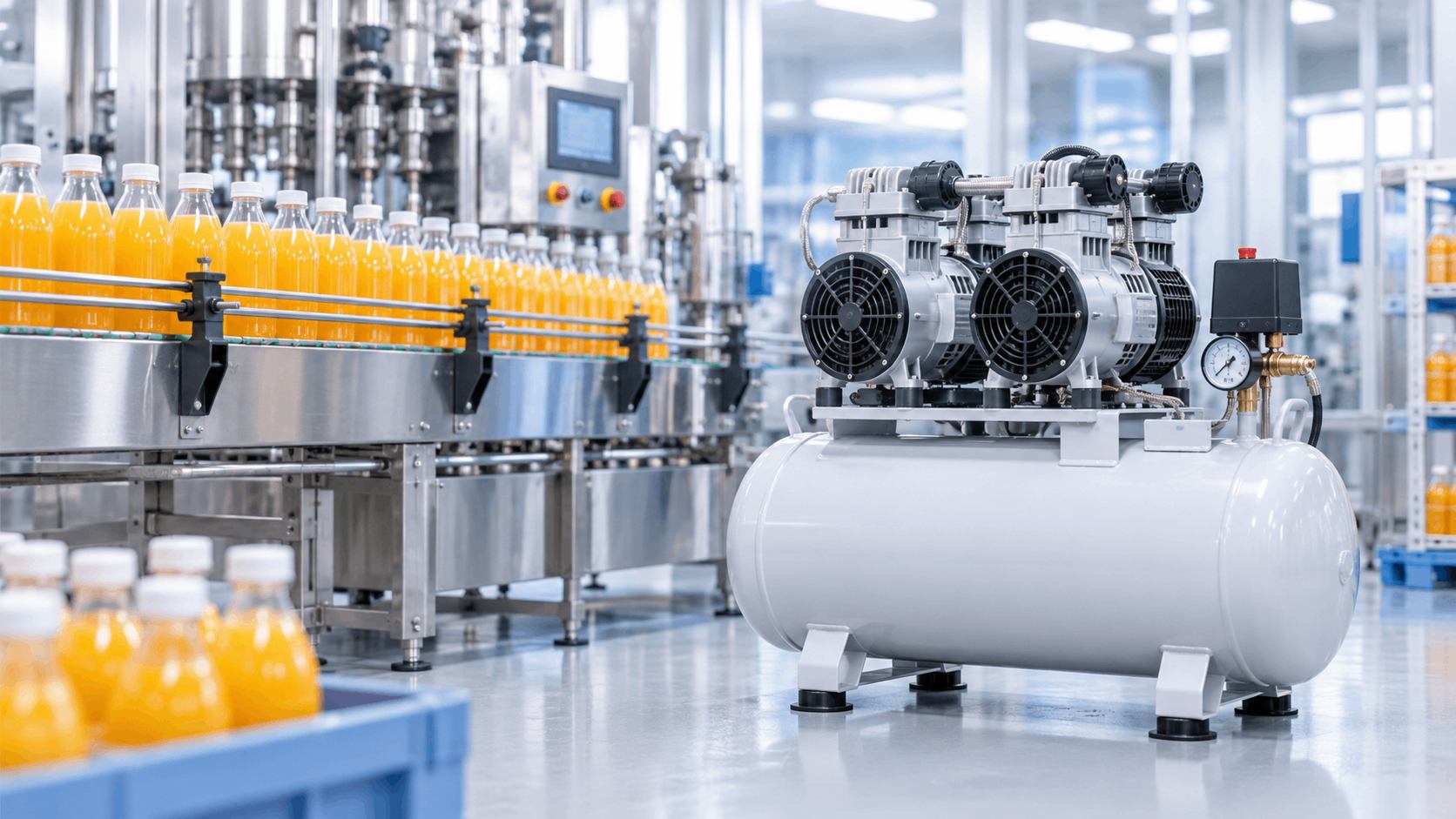
A silent oil-free air compressor can help address several of these requirements. Its oil-free compression design reduces the risk of lubricant contamination originating from the compression chamber, while its noise-reduction features can create a more comfortable working environment for production personnel. Depending on the model and system configuration, it can support various pneumatic operations in food and beverage facilities.
However, choosing the right compressor involves more than simply selecting an oil-free model. Air quality, pressure, airflow, duty cycle, filtration, drying, maintenance, and application requirements all need to be considered. Understanding these factors helps manufacturers build a compressed air system that supports both production efficiency and food safety management.
1. Why Compressed Air Quality Matters in Food and Beverage Production
Food and beverage manufacturers operate under strict quality and hygiene requirements. Raw materials, processing equipment, packaging systems, and finished products must be protected from potential contamination throughout production.
Compressed air is sometimes treated as a general utility, but in many facilities, it functions as an important part of the production process. Its quality can directly influence the cleanliness and reliability of manufacturing operations.
Direct and Indirect Product Contact
Compressed air applications in food processing can generally be divided into direct-contact and indirect-contact uses.
Direct-contact applications involve air that comes into contact with food products, ingredients, or surfaces that will subsequently contact food. Examples include air used for blowing, drying, mixing, or certain packaging operations.
Indirect-contact applications do not involve immediate contact with food but may still create contamination risks. For example, compressed air may operate pneumatic valves, cylinders, conveyors, or other equipment located near exposed products.
The distinction is important because different applications may require different compressed air quality levels. A compressor selected for general pneumatic equipment may not automatically be suitable for processes involving direct food contact.
Manufacturers should assess each application and establish appropriate air-quality specifications based on relevant food safety requirements, industry guidance, and local regulations.
Potential Contamination from Conventional Compressed Air Systems
A conventional oil-lubricated compressor uses lubricant within its compression mechanism. Although downstream separators and filters can reduce oil carryover, lubricant contamination remains a factor that must be managed.
If oil aerosols or vapors enter the compressed air distribution system, they may affect downstream equipment or create risks in applications where air contacts food or packaging materials.
Other contaminants can also enter the system. Intake air may contain dust, airborne particles, water vapor, and microorganisms. During compression and cooling, moisture may condense inside the system and accumulate in receiver tanks or pipelines.
These issues demonstrate why compressed air quality cannot be determined by the compressor alone. The entire system, including air treatment, storage, distribution, and maintenance, must be considered.
2. How Silent Oil-Free Air Compressors Support Food Safety
A silent oil-free air compressor is designed to produce compressed air without using oil lubrication in the compression chamber. This design can help reduce one important source of contamination in food and beverage manufacturing.
Reducing the Risk of Oil Carryover
In oil-lubricated compressors, lubricant is used to support the compression process and may come into contact with compressed air. Separators and filtration equipment are commonly installed to manage potential oil carryover.
An oil-free compressor avoids introducing lubricating oil through the compression chamber itself. This can simplify contamination control and reduce dependence on certain oil-removal processes associated with conventional compressor designs.
For food and beverage manufacturers, this is particularly relevant when compressed air is used in processes where product exposure is possible.
However, oil-free does not mean that the delivered air is automatically suitable for every food processing application. Oil, particles, moisture, and microorganisms may still originate from other parts of the system or the surrounding environment.
Manufacturers should therefore verify the complete compressed air system's performance rather than relying solely on the compressor's oil-free classification.
Supporting Hygienic Production Environments
Food processing facilities often use hygienic zoning, equipment cleaning procedures, and contamination prevention measures to protect products.
Oil-free compression can support these measures by reducing the possibility of lubricant entering the air supply through the compression process.
This can be useful in facilities producing dairy products, baked goods, beverages, confectionery, snacks, and other packaged foods. In these environments, compressed air may be used for equipment operation, product handling, packaging, and cleaning-related tasks.
The actual suitability of a compressor depends on the specific process and required air quality. For critical applications, manufacturers should establish measurable acceptance criteria and verify them through appropriate testing.
Reducing Oil-Related Maintenance Requirements
Oil-lubricated compressors require routine lubricant monitoring and replacement. They may also need maintenance of oil filters, separators, and related components.
A silent oil-free air compressor eliminates routine oil changes for the compression chamber because it does not use oil for lubrication there.
This can reduce certain maintenance tasks and make equipment management more straightforward. It may also help food manufacturers reduce the risk of maintenance errors associated with lubricant handling.
Nevertheless, oil-free compressors still require regular servicing. Air filters, cooling systems, valves, seals, condensate drains, and other components must be maintained according to the manufacturer's recommendations.
3. The Importance of Low-Noise Operation in Food Processing Facilities
Food and beverage production facilities contain various types of machinery, including conveyors, mixers, filling machines, pumps, and packaging equipment. These machines can generate considerable background noise.
Adding a noisy compressor to an already busy production environment may make working conditions less comfortable, particularly in smaller facilities or areas where equipment is installed close to production personnel.
Creating a More Comfortable Working Environment
Silent oil-free air compressors incorporate noise-reduction features designed to lower operating sound levels.
Depending on the model, these features may include acoustic enclosures, vibration-damping structures, optimized cooling airflow, and quieter motor or pump configurations.
Reducing compressor noise can make it easier for employees to communicate and work around production equipment. This is especially useful in facilities where operators need to monitor machines, coordinate production tasks, and respond to equipment alarms.
Although a silent compressor is not completely noiseless, its reduced sound output can contribute to a more comfortable working environment.
Supporting Indoor Equipment Installations
Some food processing facilities have limited space for utility equipment. Compressors may need to be installed near production lines, packaging areas, or dedicated equipment rooms.
A low-noise compressor can provide more flexibility when planning equipment placement. However, noise reduction should not come at the expense of proper ventilation, cooling, or maintenance access.
The compressor should be installed according to the manufacturer's clearance and environmental requirements. Acoustic enclosures must also be designed to allow sufficient airflow so that operating temperatures remain within the recommended range.
Considering Vibration and Installation Conditions
Compressor noise is not produced by the motor alone. Mechanical vibration can travel through floors, mounting frames, and connected pipes, creating additional noise.
When installing a silent oil-free air compressor, manufacturers should consider vibration isolation, stable mounting surfaces, flexible connections where appropriate, and the surrounding room structure.
These measures can help reduce transmitted vibration and improve the overall acoustic performance of the installation.
4. Common Food and Beverage Applications for Silent Oil-Free Air Compressors
Food and beverage production involves many processes that depend on compressed air. The following applications illustrate where oil-free compressor technology may be useful.
Food Packaging and Sealing
Compressed air is widely used in packaging machinery. Pneumatic cylinders and actuators can control movement, positioning, opening, closing, and other mechanical functions.
In automated packaging lines, compressed air may support:
-
Pneumatic control of packaging machinery.
-
Movement of product guides and positioning devices.
-
Operation of sealing and cutting mechanisms.
-
Actuation of valves and other control components.
-
Air-assisted handling of packaging materials.
When compressed air is used near exposed food or packaging surfaces, its quality should be evaluated carefully. An oil-free compressor can reduce the risk of lubricant contamination from the compression chamber, while appropriate filtration and drying help address other potential contaminants.
Beverage Filling and Bottling
Beverage manufacturing facilities use compressed air in different stages of filling, bottling, capping, and packaging.
Pneumatic actuators may control bottle movement, filling valves, conveyor mechanisms, and packaging equipment. Some processes also use compressed air for blowing or drying operations.
For applications where air may contact bottles, caps, packaging interiors, or beverage products, manufacturers need to establish suitable air-quality requirements.
A silent oil-free air compressor can provide a practical source of compressed air for these operations, provided that its airflow, pressure, and air treatment configuration match the process requirements.
Bakery and Confectionery Production
Bakeries and confectionery manufacturers use compressed air for equipment automation, ingredient handling, packaging, and product processing.
Pneumatic systems may operate dough-processing machinery, control production line movements, and support automated packaging equipment. In some applications, compressed air may also be used for product positioning or controlled air blowing.
Because bakery and confectionery products can be exposed during processing, air quality is an important consideration.
Oil-free compression can help reduce the possibility of oil-related contamination, but moisture and particulate control remain essential. Excessive moisture may also affect certain production environments and equipment.
Dairy Processing
Dairy production involves processes such as milk handling, mixing, filling, packaging, and equipment automation.
Compressed air may operate pneumatic valves, actuators, and control systems throughout the production line. Some applications may involve air contact with equipment surfaces or areas close to exposed dairy products.
For these applications, manufacturers should evaluate the required compressed air quality according to the process risk and relevant hygiene specifications.
Oil-free compressors can be considered as part of a broader compressed air strategy that includes suitable drying, filtration, monitoring, and maintenance.
Snack and Ready-to-Eat Food Manufacturing
Snack foods and ready-to-eat products often pass through automated processing, seasoning, weighing, filling, and packaging equipment.
Compressed air can support pneumatic controls, material handling systems, packaging machinery, and automated product sorting.
In facilities where finished products are exposed, compressed air quality deserves particular attention. Even indirect contamination pathways should be assessed as part of the plant's food safety management procedures.
A properly configured oil-free compressed air system can help manufacturers manage one potential source of contamination while supporting automated production.
Food Processing Equipment Cleaning and Drying
Some food processing operations use compressed air for equipment-related blowing or drying tasks. These applications require careful assessment because air can move particles, moisture, or microorganisms onto surfaces.
Compressed air should not be treated as a substitute for validated cleaning and sanitation procedures. Where it is used around food-contact surfaces, its quality and application method must be controlled.
Manufacturers should also avoid using compressed air in ways that spread contaminants from unclean areas into hygienic production zones.
5. Air Treatment: Why Oil-Free Compression Is Only the First Step
One common misconception is that an oil-free compressor automatically produces air that is ready for direct contact with food. In reality, compressor technology is only one part of compressed air quality management.
Air treatment components are necessary to address contaminants that may remain after compression.
Moisture Removal and Air Drying
Air naturally contains water vapor. When air is compressed, its moisture characteristics change, and condensation may occur as the air cools.
Excessive moisture in compressed air can cause corrosion in receiver tanks and pipelines, interfere with pneumatic equipment, and affect sensitive production processes.
Depending on the required pressure dew point and operating environment, manufacturers may use refrigerated or desiccant air dryers.
A refrigerated dryer is commonly used for general moisture control, while a desiccant dryer can achieve lower dew points where more stringent dryness requirements apply.
The correct choice depends on the application, environmental conditions, and compressed air quality specifications.
Particulate Filtration
Dust, rust, pipe scale, and other particles can enter compressed air systems through intake air or distribution components.
Appropriate particulate filters help reduce these contaminants before the air reaches sensitive equipment or production processes.
Filter selection should consider the required filtration efficiency, pressure drop, flow capacity, and replacement interval.
Installing a filter with an unsuitable flow rating may create excessive pressure loss, reducing the performance of downstream equipment.
Microbial Control
In food and beverage production, microorganisms are an important consideration, particularly when compressed air comes into direct contact with products or food-contact surfaces.
Microbial contamination may be associated with intake air, moisture accumulation, poorly maintained equipment, or contaminated distribution systems.
Oil-free compression alone does not remove microorganisms. Where required by the application, manufacturers should consider appropriate filtration, hygienic system design, moisture management, and periodic air-quality testing.
Maintaining the Distribution System
Even when the compressor and air treatment equipment are properly selected, contamination may develop within the distribution network.
Poorly maintained receiver tanks, corroded pipes, stagnant sections, leaks, and unsuitable materials can affect air quality.
A well-designed system should use appropriate piping materials, minimize unnecessary moisture accumulation, provide effective drainage, and allow convenient inspection and maintenance.
For food processing applications, distribution system hygiene should be included in the plant's overall compressed air management plan.
Conclusion
Choosing the right silent oil-free air compressor is an important part of building a reliable compressed air system for food and beverage production. Manufacturers should consider not only oil-free performance and noise levels but also airflow capacity, operating pressure, air treatment requirements, energy efficiency, and maintenance needs. A well-matched system can help reduce contamination risks, support stable equipment operation, and meet the demands of different production processes. With a focus on practical application requirements and dependable equipment performance, Gaoling offers silent oil-free air compressor solutions for businesses seeking to improve their compressed air systems for food and beverage applications.
www.glcompressor.com
glcompressor

+ There are no comments
Add yours