
In industries where hygiene, purity, and long-term durability are non-negotiable, stainless steel clean water tanks play a vital role. From beverage production lines to pharmaceutical workshops and chemical factories, companies need storage equipment that meets strict international standards while supporting stable, safe daily operations. PengXiang Beverage, through continuous technical refinement and strict quality control, provides stainless steel clean water tanks designed for real industrial challenges—not theoretical scenarios.
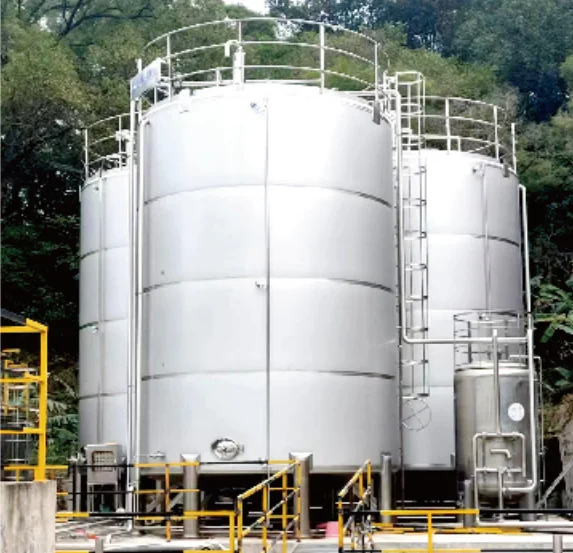
This article takes an in-depth look at why stainless steel clean water tanks have become the preferred solution, the core features of PengXiang Beverage’s tanks, and how they fit into diverse industrial applications.
To learn more about the product specifications, you may refer to the stainless steel clean water tank page.
1. Why Stainless Steel Is the Benchmark for Clean Water Storage
For industries handling liquids—whether purified water, beverages, additives, or pharmaceutical solutions—material selection determines the stability of the entire production process. Stainless steel, especially grades 304 and 316L, stands out for several practical reasons:
1.1 Corrosion Resistance That Withstands Daily Use
In long-term contact with water and liquid ingredients, lesser materials may corrode, dissolve, or contaminate the contents. Stainless steel’s natural resistance to oxidation and chemical reactions protects the stored liquid and ensures equipment longevity.
1.2 Smooth Surface Minimizes Bacterial Growth
Stainless steel’s inherent smoothness reduces biofilm formation. When polished to a surface roughness lower than Ra 0.8 μm, the tank becomes significantly easier to clean and sanitize, directly improving hygiene control.
1.3 Compliance With Food, Beverage, and Pharmaceutical Requirements
Many international standards require water storage and handling equipment to meet strict performance indicators regarding material safety, weld integrity, and surface conditions. Stainless steel is one of the few materials consistently capable of meeting these requirements.
2. Built to International Standards: ASME BPE & QB/T 2681-2004 Compliance
One of the strongest differentiators of PengXiang Beverage’s storage tanks is their compliance with globally recognized industrial norms:
2.1 ASME BPE — Bioprocessing Equipment Standard
The ASME BPE standard is widely adopted in biotechnology, pharmaceutical, and life-science manufacturing. Equipment built to this standard must ensure:
-
Extremely high sanitation performance
-
Cleanability and smoothness suitable for sterile environments
-
Materials that maintain integrity under frequent cleaning cycles
PengXiang Beverage applies these requirements to tank fabrication, polishing, and welding, ensuring stable quality that supports GMP-level production lines.
2.2 QB/T 2681-2004 — China Food Container Standard
This national standard governs hygienic requirements, structural design, and material safety for food-grade containers. Tanks that meet this standard can be safely used for water storage in:
-
Beverage plants
-
Food processing workshops
-
Ingredient preparation rooms
Compliance ensures every detail—from tank wall thickness to weld quality—supports safe liquid handling and storage.
3. Precision Polishing: Achieving Surface Roughness Under Ra 0.8 μm
Hygienic equipment requires more than just stainless steel material; surface treatment directly determines sanitation performance.
PengXiang Beverage uses specialized polishing machines capable of achieving a surface roughness below Ra 0.8 μm. This level of smoothness provides several real-world advantages:
-
Faster cleaning cycles, reducing water and cleaning agent use
-
Better drainage, preventing residue from accumulating
-
Higher resistance to microbial adhesion, which is critical for beverage and pharmaceutical applications
-
More consistent passivation, improving corrosion resistance over long-term operation
This attention to detail ensures the tanks are suitable for processes involving purified water, additives, syrups, solvents, and sensitive liquid formulations.
4. Flexible Structure: Upright, Horizontal, and Fully Customized Designs
Industrial plants differ in layout, workflow, and storage capacity needs. To support these variations, PengXiang Beverage provides multiple configuration options.
4.1 Upright-Type Water Tanks
These models fit facilities with limited floor space. They are commonly used in:
-
Centralized water storage
-
Ingredient mixing rooms
-
Beverage bottling lines
Their vertical structure offers higher capacity per floor area while maintaining stability.
4.2 Horizontal-Type Water Tanks
Horizontal tanks are useful when:
-
The installation area has height limitations
-
The tank needs to integrate into an existing pipeline at a fixed height
-
The stored liquid volume requires a low center of gravity for safety
They are widely adopted in large-scale beverage lines and chemical batching zones.
4.3 Custom-Made Water Tanks for Specialized Needs
Some factories require specific inlet/outlet arrangements, insulation layers, internal coils, or special manholes. PengXiang Beverage designs customized tanks based on actual production processes, including:
-
Additional CIP spray balls
-
Insulating jackets
-
Heating or cooling coils
-
Pressure-rated structures
-
Level gauge compatibility
-
Mobility options (casters or base frames)
Custom engineering allows the tank to serve as a seamless part of the production system rather than a standalone component.
5. Capacity Range From 0.5T to 20T: Suitable for Small Workshops and Full-Scale Plants
The capacity selection depends on production scale and daily water consumption. PengXiang Beverage provides tanks ranging from 0.5 ton to 20 tons, covering:
-
Small food workshops needing compact, easy-to-clean solutions
-
Medium-size beverage factories with continuous production cycles
-
Pharmaceutical systems requiring multiple isolated tanks
-
Chemical plants storing reaction water or intermediate fluids
Each tank is engineered to maintain structural integrity even under frequent filling, emptying, thermal fluctuations, and cleaning procedures.
6. Applications Across Key Industries
Because of their hygiene and corrosion-resistant properties, these stainless steel tanks serve multiple industries effectively.
6.1 Food & Beverage Industry
Used for:
-
Purified water storage
-
Beverage blending processes
-
Ingredient holding tanks
-
CIP cleaning water reservoirs
Their hygienic design supports stable product quality and regulatory compliance.
6.2 Pharmaceutical Manufacturing
Ideal for:
-
Purified and WFI (Water for Injection) system storage
-
Solution preparation
-
Buffer or intermediate storage for production steps
The ASME BPE compliance is particularly important for pharmaceutical clients.
6.3 Chemical Processing
Suitable for:
-
Solvent storage
-
Cooling or heating water tanks
-
Reaction water preparation
Stainless steel’s resistance to mild chemicals ensures safe and stable operation.
7. How PengXiang Beverage Ensures Reliability and Long-Term Performance
A stainless steel tank may look simple from the outside, but high-quality fabrication involves systematic engineering. PengXiang Beverage focuses on:
7.1 Material Traceability
All stainless steel sheets—304 or 316L—are sourced from reliable suppliers with certificate tracking. This ensures consistent corrosion resistance and chemical stability.
7.2 Automated Welding and Inspection
Welding quality directly affects tank longevity. Automated welding minimizes human error, while inspection ensures:
-
No internal weld protrusions
-
No sanitary dead zones
-
Leakage-free seams
7.3 Pressure and Leakage Testing
Every tank undergoes full testing before shipment to ensure structural integrity under working conditions.
7.4 Seamless Integration Into Existing Production Lines
Whether connecting to CIP pipelines, bottling equipment, or pharmaceutical dosing systems, each tank is configured to reduce installation time and simplify maintenance.
8. Why Companies Choose PengXiang Beverage
Many clients choose PengXiang Beverage because the tanks are not only built to standards but engineered for long-term daily use. The company’s strengths include:
-
Strict adherence to ASME BPE and QB/T2681-2004
-
Advanced polishing achieving Ra < 0.8 μm
-
Flexible structural design (upright, horizontal, custom)
-
Wide capacity range for various scales of production
-
Strong experience in food, beverage, pharmaceutical, and chemical projects
The result is equipment that performs reliably for years while supporting stable production output.
www.szpxhx.com
Pengxiang Huixing


+ There are no comments
Add yours