
Introduction
When specifying or purchasing a liquid flow calibration system, one of the first technical decisions is whether to build the system around the static mass method or the master meter method. Both are established approaches used in flow calibration laboratories, but they differ fundamentally in measurement principle, system architecture, achievable uncertainty, and operating characteristics. Neither method is universally "better" — the correct choice depends on the calibration capability you need to establish, the flow meters you intend to test, the required flow range, the target uncertainty, laboratory layout constraints, and overall project requirements.
This article compares the two methods across all relevant technical dimensions and provides a practical checklist for engineers, metrology laboratories, flow meter manufacturers, and calibration service providers evaluating which method to specify.
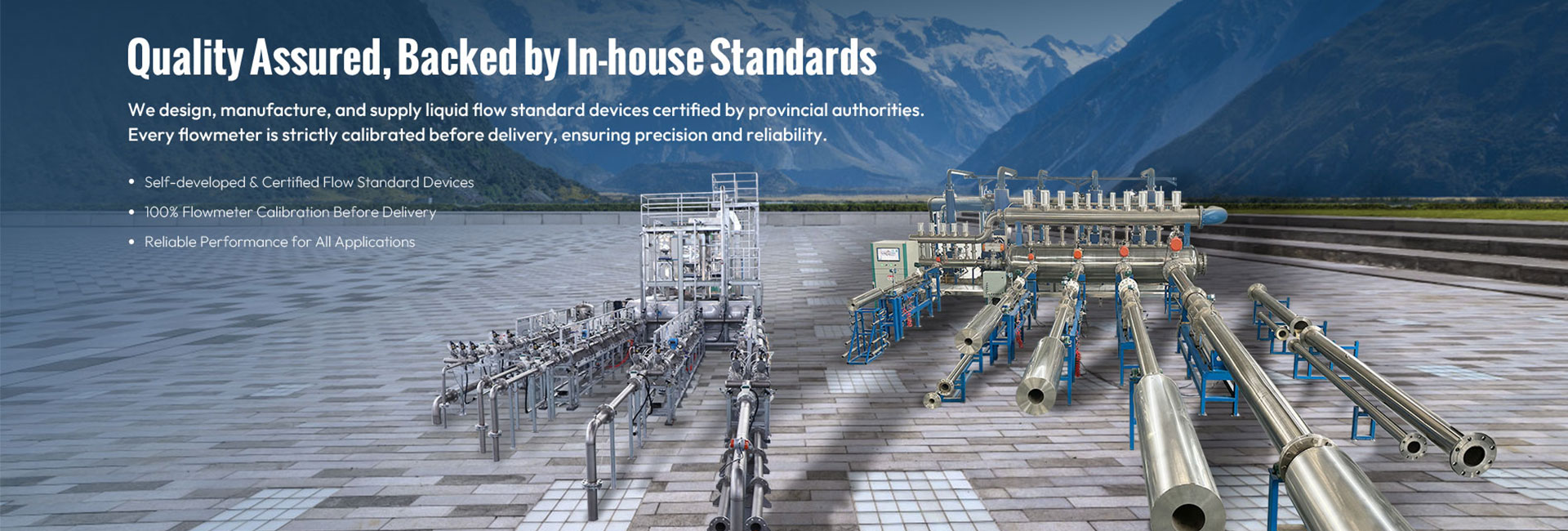
1. Fundamental Difference Between the Two Methods
-
Static mass method: The calibration system diverts flow into a weighing vessel over a controlled time interval. The actual mass of liquid collected is measured directly using a weighing system (scale/load cells), and the true flow rate is derived from mass and time. This makes the static mass method a direct, primary-reference calibration approach — the reference quantity (mass) is measured independently of any other flow-sensing device.
-
Master meter method: A previously calibrated "master" flow meter is installed in series with the meter under test (the "test meter" or unit under test, UUT). Both meters measure the same flow stream simultaneously, and the test meter's reading is compared against the master meter's reading. This is a comparative, transfer-standard calibration approach — the reference quantity is itself a measurement made by another flow meter, not an independently measured physical quantity.
In short: static mass measures a physical quantity (mass) directly as the reference; master meter compares one meter's output against another meter's traceable output.
2. Measurement Principle Comparison
| Aspect | Static Mass Method | Master Meter Method |
|---|---|---|
| Reference quantity | Directly measured mass and time | Output of a calibrated master meter |
| Type of reference | Primary/direct | Transfer/comparative |
| Core measurement chain | Diverter → weighing vessel → scale → timer | Master meter → flow computer/comparator → test meter |
| Dependence on prior calibration | Weighing system calibration only | Master meter must itself be traceably calibrated |
3. Major System Components
Static Mass System
- Flow diversion mechanism (diverter valve)
- Weighing vessel and precision weighing system (load cells/scale)
- Timing system synchronized with diversion
- Data acquisition and automation system (e.g., PLC + industrial PC based)
- Piping, pumps, and flow stabilization sections
Master Meter System
- One or more master meters covering different flow ranges
- Test section for mounting the meter under test
- Flow stabilization and straight-pipe sections upstream/downstream
- Data acquisition and comparison software
- Piping, pumps, and flow control valves
4. Testing Procedure Differences
Static Mass Procedure
- Flow is stabilized through the test meter.
- The diverter switches flow into the weighing vessel for a controlled time period.
- The collected mass is weighed.
- Flow rate is calculated from mass, fluid density, and elapsed time.
- The test meter's output is compared against this calculated reference flow rate.
Master Meter Procedure
- Flow is stabilized through both the master meter and the test meter, connected in series.
- Flow is run at a set flow point.
- The master meter and test meter readings are recorded simultaneously.
- The test meter's reading is compared directly against the master meter's reading (with appropriate correction factors).
- The process is repeated across the required flow range.
Static mass testing involves a discrete collect-and-weigh cycle per flow point, while master meter testing is a continuous, real-time comparison, which generally allows faster throughput at a given flow point.
5. Applicable Flow Meter Types
Both methods can be used to calibrate a range of flow meter technologies, including electromagnetic flowmeters, turbine flowmeters, vortex flowmeters, and other liquid flow measurement instruments. The suitability depends more on fluid compatibility, flow range, and required uncertainty than on the meter technology itself. Master meter systems are commonly favored when calibrating meters across a wide range of flow points in shorter cycle times, while static mass systems are typically used where the highest achievable calibration uncertainty is required.
6. Flow Range Considerations
Calibration range coverage depends on system configuration and can span from small to large diameter flowmeters (for example, DN6 to DN1500, depending on system design).
- Static mass systems are generally well suited to lower-to-mid flow ranges where weighing vessel size and collection time remain practical.
- Master meter systems can be configured with multiple master meters to cover a broader range of flow rates, including larger pipe diameters, without requiring physically large weighing vessels.
7. Measurement Uncertainty and Repeatability
| Method | Typical Uncertainty | Notes |
|---|---|---|
| Static Mass Method | Up to 0.05% (typical laboratory conditions) | Direct mass reference generally supports tighter uncertainty |
| Master Meter Method | Up to 0.2% (typical) | Uncertainty is influenced by the master meter's own calibration uncertainty |
Because the static mass method measures mass directly, it removes one layer of comparative uncertainty from the calibration chain. The master meter method inherently carries forward the uncertainty of the master meter itself, plus the uncertainty of the comparison process, which is why its typical uncertainty is higher than a well-implemented static mass system.
Repeatability in static mass systems depends on the consistency of the diversion timing and weighing process. Repeatability in master meter systems depends on flow stability during the simultaneous measurement window and the master meter's own repeatability performance.
8. Traceability
Both methods are used to establish metrological traceability of flow meters, but the traceability chain differs:
- Static mass: Traceability is established through the calibration of the weighing system (mass standard) and timing system — a shorter, more direct traceability chain.
- Master meter: Traceability is established through the master meter's own calibration certificate, meaning the master meter itself must be periodically recalibrated against a higher-level reference (such as a static mass system) to maintain the traceability chain.
This is an important distinction: in many laboratory structures, a static mass system is used as the higher-level reference to periodically calibrate the master meters used in master meter systems.
9. Operating Characteristics
| Characteristic | Static Mass Method | Master Meter Method |
|---|---|---|
| Test cycle time per point | Longer (weighing cycle required) | Shorter (real-time comparison) |
| Mechanical complexity | Higher (diverter, weighing vessel, scale) | Lower (piping and master meter installation) |
| Maintenance considerations | Weighing system and diverter maintenance | Master meter recalibration required periodically |
| Automation | PLC + industrial PC based data acquisition and reporting | PLC + industrial PC based data acquisition and reporting |
| Footprint | Generally larger (weighing vessel space) | Can be more compact depending on master meter sizing |
10. Typical Laboratory and Industrial Applications
- Static mass systems are typically used in metrology laboratories and calibration centers that serve as a primary or high-level reference standard, including calibrating master meters used elsewhere.
- Master meter systems are typically used for higher-throughput calibration operations, field verification setups, or facilities where a wide flow range must be covered without large weighing infrastructure, and where the master meter's own traceable calibration is maintained through a higher-level reference.
Gas flow calibration is handled separately using sonic nozzle-based systems, and is not directly comparable to these two liquid flow calibration methods.
11. Decision Framework: When to Choose Which Method
| If your requirement is... | Consider |
|---|---|
| Establishing a top-level/reference-grade calibration capability | Static mass method |
| Achieving the tightest achievable uncertainty in your laboratory | Static mass method |
| Calibrating master meters that will be used elsewhere | Static mass method |
| Testing across a wide flow range with multiple meter sizes | Master meter method (with multiple master meters) |
| Higher testing throughput at each flow point | Master meter method |
| Limited space for large weighing vessels | Master meter method |
| Simpler mechanical/maintenance profile | Master meter method |
| Building a full-chain lab with both primary and working-level standards | Both — static mass as top reference, master meter for routine testing |
12. Step-by-Step Checklist for Engineers and Purchasers
- Define your calibration capability goal — Are you establishing a primary reference standard, or a working-level calibration/testing capability?
- Identify the flow meter types and sizes you need to calibrate, including diameter range and expected flow range.
- Determine your required uncertainty target and compare it against the typical uncertainty levels achievable by each method (static mass: up to 0.05%; master meter: up to 0.2%, typical laboratory conditions).
- Assess your traceability chain requirements — will this system need to be traceable directly through a mass standard, or through a periodically recalibrated master meter?
- Evaluate laboratory space and infrastructure — weighing vessel size and diverter mechanisms require more physical space than a master meter test section.
- Consider testing throughput needs — if high-volume testing across many flow points is required, master meter systems generally offer faster cycle times.
- Plan for master meter recalibration if selecting a master meter system — this requires a periodic higher-level reference calibration.
- Review automation and data requirements — confirm the system supports PLC/industrial PC-based data acquisition, digital record keeping, and automated report generation for your traceability documentation needs.
- Consult with the calibration system manufacturer on system configuration options, since calibration range coverage (e.g., DN6–DN1500) depends on the specific system design.
13. Calibration Method Selection vs. Flow Meter Accuracy Selection
It is important to distinguish between two separate decisions:
- Calibration method selection (static mass vs. master meter) concerns how your calibration laboratory or system establishes and verifies flow measurement traceability and uncertainty.
- Flow meter accuracy/type selection (e.g., choosing between an electromagnetic flowmeter, turbine flowmeter, or vortex flowmeter for a specific industrial application) concerns which measurement instrument is appropriate for a given process, fluid, and application condition.
A calibration system's method does not determine which flow meter technology is "better" for field use — it determines how accurately and traceably any flow meter can be verified. These are complementary but distinct engineering decisions.
Conclusion
Choosing between the static mass method and the master meter method is not a matter of one being categorically superior — it is a matter of matching the calibration method to your capability requirements, flow range, uncertainty targets, and laboratory design. Static mass systems offer a direct, primary-reference measurement approach suited to establishing top-level calibration capability with tighter uncertainty, while master meter systems provide a practical, comparative approach suited to broader flow ranges and higher testing throughput, provided the master meter itself remains traceably calibrated. Many calibration laboratories ultimately deploy both: a static mass system as the top-level reference, and master meter systems for routine, higher-volume testing traceable back to that reference.
https://www.sytcflowmeter.com/
https://www.sytcflowmeter.com/

+ There are no comments
Add yours