



When planning a bottled water plant, choosing between reverse osmosis (RO) and ultrafiltration (UF) is not an equipment upgrade decision. It is a product definition decision that determines what liquid enters the bottle, what label can legally be placed on it, and what volume of source water will be discharged as effluent.
Zhangjiagang Grandee Machinery Co., Ltd., manufacturing and exporting under the Grandee Machine brand, builds complete water lines from water treatment through 3-in-1 filling, labeling, and packaging. In practice, you cannot select between RO and UF based on capital allocation or throughput alone — the selection is governed by raw water chemistry and the regulatory definition of the finished product.
This article explains the filtration mechanics of RO versus UF, how they separate purified water from natural mineral water, and the four engineering points a plant investor must verify before sourcing water treatment equipment.
Two Technologies, Two Different Water Types
The distinction between purified water and natural mineral water begins at the membrane pore size. The table below outlines how the two treatment routes separate:
| Parameter | Reverse osmosis (RO) | Ultrafiltration (UF) |
|---|---|---|
| Target product | Purified water (demineralized / low TDS) | Natural mineral water / spring water |
| Nominal pore size | 0.0001–0.001 μm | 0.01–0.1 μm |
| Dissolved solids (TDS) | Removes 99% or more of dissolved salts and minerals | Retains dissolved minerals (calcium, magnesium, silica) |
| Microbial removal | Complete removal of bacteria, viruses, and pyrogens | Removes suspended solids, colloids, and bacteria |
| Water recovery rate | Typically 70% permeate (30% concentrate discharge) | Typically 90%–95% or higher (low backwash loss) |
| Operating pressure | High pressure: 0.8–1.5 MPa (requires high-pressure pump) | Low pressure: 0.1–0.3 MPa (lower energy consumption) |
This comparison reveals why treating RO and UF as interchangeable creates immediate commercial failure. If a producer routes high-quality natural spring water through an RO system, the membrane strips out the beneficial electrolytes and trace minerals, turning what could have been sold as premium mineral water into standard demineralized water.
When Reverse Osmosis Is Mandatory
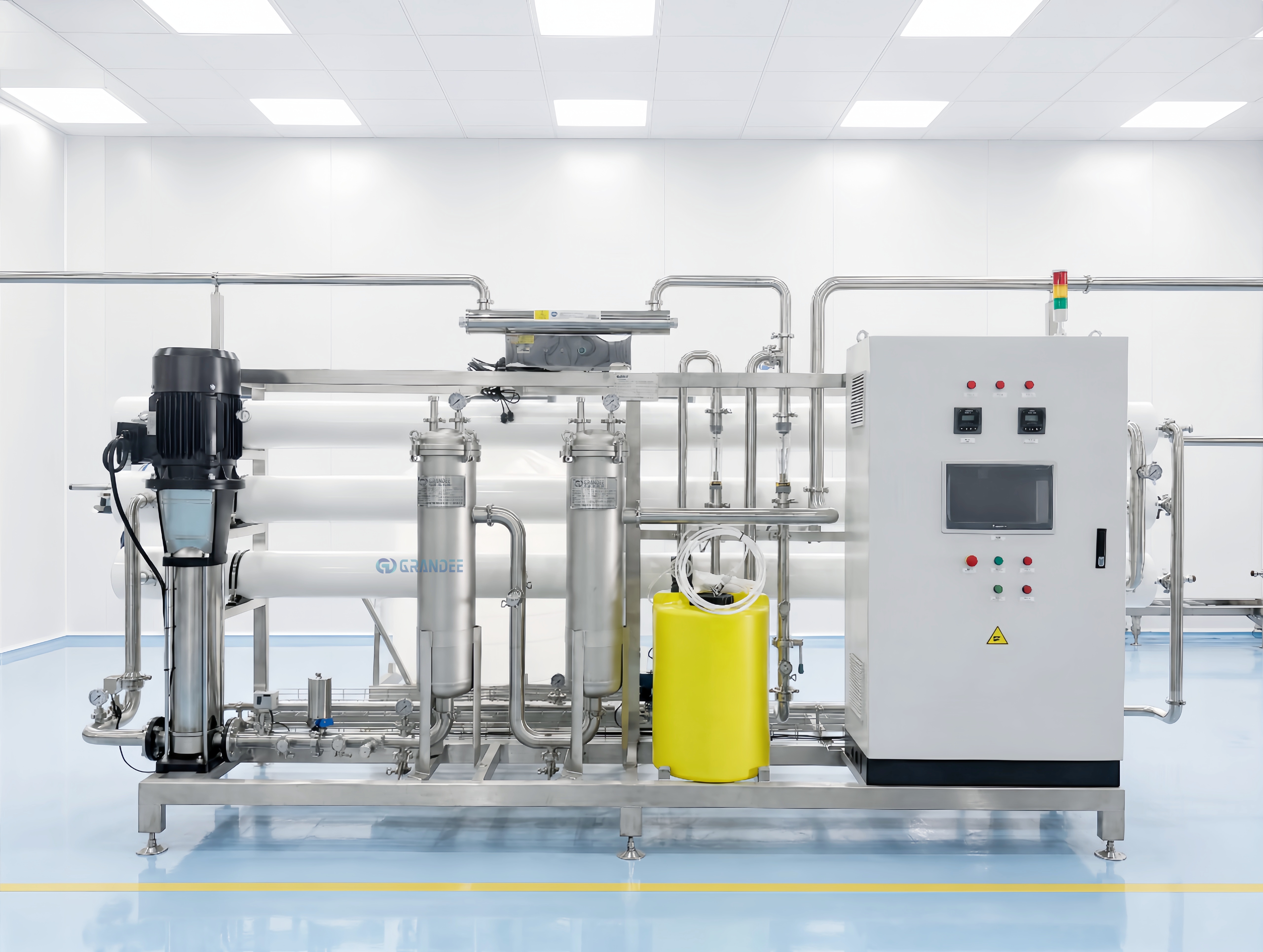
Reverse osmosis relies on semi-permeable polyamide membranes (such as industrial BW30-400 elements rated at 99.6 percent salt rejection). Pressure is applied against osmotic pressure to force pure water molecules through the membrane matrix while repelling dissolved inorganic ions.
An RO system is mandatory in the following plant scenarios:
1. High source water TDS or hardness. If your feed water has total dissolved solids exceeding local drinking water standards (e.g., above 500 ppm or carrying high sulfate and chloride levels), RO is the primary mechanical process to reduce salinity to neutral drinking standards without chemical distillation.
2. Heavy metal or chemical contamination risks. Where ground or municipal sources carry traces of nitrates, fluorides, arsenic, or lead, RO provides a dependable physical barrier that microfiltration and ultrafiltration cannot stop.
3. Uniform brand taste profiles across multiple sites. Large beverage producers distributing purified water across regions use RO because it strips source-specific mineral notes, allowing a standardized mineral remineralization recipe or a completely neutral mouthfeel.
When Ultrafiltration Is the Correct Choice
Ultrafiltration uses hollow fiber membranes with pore sizes between 0.01 and 0.1 microns. It operates under low pressure to sieve out suspended particles, bacteria, algae, cysts, and large colloidal organic molecules while letting dissolved minerals pass freely through the fiber walls.
UF is the correct configuration when:
1. Packaging protected natural mineral or spring water. In most jurisdictions, water labeled as "Natural Mineral Water" must originate from a protected underground source and cannot undergo chemical alteration or demineralization. UF provides microbiological safety (bacteria and colloid removal) while preserving natural dissolved calcium, magnesium, and bicarbonate.
2. Source water already meets potable chemical standards. If a deep well or mountain aquifer already has balanced TDS (e.g., 80–250 ppm) and zero heavy metal contamination, subjecting it to RO adds unnecessary equipment complexity, electrical consumption, and water waste.
3. Water conservation and discharge restrictions. Because UF operates with minimal concentrate loss, plants in water-scarce regions or industrial parks with strict wastewater discharge caps gain significant operational advantages by avoiding RO reject streams.
The Water Balance Calculation: 100% Feed vs. Permeate
The practical impact on plant design shows up immediately in the water balance. On an industrial reverse osmosis plant (such as Grandee Machine's SH-RO-12 skid rated at 12 m³/h permeate), the membrane recovery rate is engineered at 70 percent.
That recovery rate dictates the entire intake and drainage footprint of the factory:
Raw water intake: 12 m³/h ÷ 0.70 ≈ 17.1 m³/h
Concentrate effluent to drain: 17.1 m³/h − 12.0 m³/h ≈ 5.1 m³/h
For every hour of operation, roughly 5 cubic meters of reject water must be managed by the facility. By contrast, an ultrafiltration plant operating at 95 percent recovery on the same 12 m³/h product volume draws only approximately 12.6 m³/h of raw water, with less than 1 m³/h consumed in periodic automated backwash cycles.
What Must Be Settled Before Equipment Is Specified
To obtain an engineering proposal that matches your water plant without disruptive change orders, four questions must be settled in writing:
1. A comprehensive raw water test report. Measurements of TDS, pH, total hardness, iron, manganese, silica, turbidity, and microbial count decide the pre-filtration stages (quartz sand filter, activated carbon filter, water softener, or antiscalant dosing).
2. The target bottle format and hourly filling capacity. Sizing treatment in cubic meters per hour requires multiplying your filling speed by net container volume (e.g., 12,000 BPH × 0.5 L = 6 m³/h product water) plus line rinse and CIP allowances.
3. Downstream ozone and disinfection pairing. RO and UF water must be protected prior to filling. An ozone system (such as an oxygen-fed ozone generator producing 32 g/h) paired with a sanitary stainless steel contact tank provides residual disinfection that sanitizes the bottle headspace post-capping.
4. Buffer storage capacity. Water treatment runs continuously under steady pressure, while filling machines stop and start according to line cadence. Sizing the treated water storage tank decouples the two systems and prevents membrane cycling fatigue.
Turnkey Scope, and Where It Stops
Grandee Machine supplies industrial water treatment equipment as part of a complete turnkey project: water treatment (pre-treatment, RO/UF, ozone sterilization), bottle blowing, 3-in-1 rotary washing-filling-capping, labeling, and shrink wrapping or carton packing, supported by paperless 3D plant layout, installation, commissioning, and operator training under a single contract.
Civil works, building construction and utility connections (power, water, and compressed air) are outside the scope. In a water bottling facility, raw water source drilling and supply piping, civil floor drainage capable of handling RO reject flow, and the electrical supply cabling for high-pressure pumps belong to the building works and must be completed by the plant owner.
FAQ
Can I make natural mineral water with reverse osmosis?
No. Reverse osmosis removes 99 percent of dissolved minerals. Water treated by RO is legally classified as purified or demineralized water. Producing authentic natural mineral water requires ultrafiltration or microfiltration, which retains natural mineral ions while removing microorganisms and turbidity.
Does ultrafiltration generate wastewater like RO does?
No. Ultrafiltration operates without a continuous concentrated reject stream. It achieves recovery rates above 90–95 percent, consuming water only during brief periodic backwashing cycles to clean the membrane fibers.
What pre-treatment is needed before RO membranes?
RO membranes require protected feed water: a raw water pump, silica sand filter (turbidity removal), activated carbon filter (residual chlorine removal, which degrades polyamide membranes), and either a cation water softener or an automated antiscalant dosing pump to prevent scaling on membrane surfaces.
Why is ozone disinfection added after RO or UF treatment?
While membranes remove bacteria, treated water can be re-contaminated in intermediate storage tanks. Dosing ozone into the water creates a controlled dissolved ozone residual that sanitizes storage piping, filling valves, and the interior of the capped bottle before naturally decomposing back into oxygen.
How do I size the water treatment plant for a 6,000 BPH 500 ml line?
6,000 BPH × 0.5 L = 3.0 m³/h of product water. Adding allowances for bottle rinsing, CIP make-up, and buffer safety margins generally points to a 4–6 m³/h treatment system. For an RO system at 70 percent recovery, sizing for 4 m³/h permeate requires approximately 5.7 m³/h raw water feed.
About Grandee Machine
Zhangjiagang Grandee Machinery Co., Ltd. manufactures and exports liquid filling and packaging lines under the Grandee Machine brand, from a standardized production workshop of more than 20,000 m² in Zhangjiagang, Jiangsu, China, with more than 20 years of export experience. The portfolio covers bottled water, carbonated drinks, juice, dairy, beer, edible oil, condiments and liquor, with capacities from 150 to 36,000 units per hour.
Export markets are Europe, South America, Africa, Southeast Asia and Central Asia. Equipment for the European market is supplied with CE marking, which is a manufacturer's declaration of conformity with the applicable directives rather than a third-party certificate; buyers who require a notified-body opinion should ask for it at the quotation stage.
Next Step
Four figures determine your water treatment configuration: your raw water test report (TDS, hardness, turbidity), your target product (purified or natural mineral water), your bottle volume and target output per hour, and your local wastewater discharge conditions. Send them through the inquiry form on this page to receive an engineering process flow diagram and equipment specification.
Related Reading
· Bottled water filling machines (220 ml — 20 L)
· Filling machines — all categories
· Complete turnkey liquid packaging lines
https://www.grandeemachine.com/
Zhangjiagang Grandee Machinery Co., Ltd.

+ There are no comments
Add yours