
In commercial water bottling plant engineering, raw water purification serves as the primary technical foundation dictating finished beverage safety, organoleptic profile, regulatory compliance, and downstream filling stability. Before fluid enters high-speed rotary monoblock filling carousels, raw water drawn from municipal mains, underground boreholes, or mountain springs must undergo multi-stage physical separation. Two dominant membrane technologies govern this critical stage: reverse osmosis (RO) and hollow-fiber ultrafiltration (UF). Sizing the correct filtration architecture across capacities from 2,000 to 36,000 bottles per hour (BPH) represents a definitive engineering decision separating low-mineral purified drinking water from mineral-rich natural spring water.
Zhangjiagang Grandee Machinery Co., Ltd., manufacturing under the brand name Grandee Machine, engineers complete liquid bottling plants and industrial water treatment systems. In water treatment engineering, membrane selection is dictated by raw water chemistry: total dissolved solids (TDS), electrical conductivity, silica concentration, microbial bio-burden, and target product positioning. This technical guide examines membrane separation thermodynamics, pre-treatment filtration sequences, performance metrics between RO and UF, and complete bottling line integration requirements.
Membrane Separation Physics: Pore Size and Molecular Weight Cut-Off
The operational differentiation between reverse osmosis and ultrafiltration begins at the physical scale of molecular separation:
- Reverse Osmosis (RO) Mechanics: RO utilizes semi-permeable spiral-wound polyamide composite membranes with an effective pore size of approximately 0.0001 microns (0.1 nanometers). Operating at hydraulic pressures exceeding the natural osmotic pressure of the feed water (typically 1.0 to 1.8 MPa for brackish or borehole water), RO forces water molecules through the dense polymer matrix while rejecting 99.2% to 99.6% of dissolved mineral ions, heavy metals, nitrates, and dissolved salts. The process splits the feed stream into two flows: high-purity permeate water and a concentrated brine discharge (reject stream).
- Ultrafiltration (UF) Mechanics: UF employs asymmetrical hollow-fiber membrane bundles (manufactured from polyethersulfone [PES] or polyvinylidene fluoride [PVDF]) operating via cross-flow or dead-end sieving. With a pore rating ranging from 0.01 to 0.04 microns and a molecular weight cut-off (MWCO) between 50,000 and 150,000 Daltons, UF physically sieves out suspended colloids, turbidity, micro-plastics, protozoa (such as Cryptosporidium and Giardia), and bacterial pathogens (achieving greater than Log 6 bacterial reduction). However, UF allows dissolved beneficial mineral cations (calcium, magnesium, potassium, strontium, and metasilicic acid) to pass through completely unimpeded.
Technical Comparison: Reverse Osmosis vs. Ultrafiltration
Bottling plant engineers must evaluate water recovery ratios, wastewater discharge volumes, utility power demand, and target mineral profiles when selecting membrane units:
| Engineering Parameter | Industrial Reverse Osmosis (RO) System | Hollow-Fiber Ultrafiltration (UF) System |
|---|---|---|
| Filtration Membrane Rating | 0.0001 μm (Semi-permeable polyamide composite) | 0.01 to 0.04 μm (Hollow-fiber PES / PVDF) |
| Target Finished Water Category | Purified Drinking Water (TDS < 30 ppm, Conductivity < 10 μS/cm) | Natural Mineral Water / Mountain Spring Water (Preserving natural TDS) |
| Dissolved Salt / Mineral Rejection | ≥ 99.2% – 99.6% rejection across monovalent and divalent ions | 0% rejection (Dissolved salts and minerals pass through 100%) |
| Microbial & Colloid Removal | Total removal of viruses, bacteria, pyrogens, and organic molecules | > Log 6 bacterial reduction; complete removal of colloids and turbidity |
| System Water Recovery Rate | 65% to 75% permeate yield (25% to 35% continuous brine reject) | 90% to 95% yield (Minimal water loss; intermittent backwash effluent) |
| Operating Operating Pressure | High pressure: 1.0 to 1.8 MPa (Demands multi-stage booster pumps) | Low pressure: 0.15 to 0.35 MPa (Standard centrifugal delivery pump) |
| Energy / Power Consumption | Higher electrical demand (typically 1.5 to 2.8 kWh per m³ permeate) | Low electrical demand (typically 0.15 to 0.35 kWh per m³ product) |
| Cleaning & Maintenance Protocol | Chemical cleaning-in-place (CIP) every 1–3 months; scale inhibitor dosing | Automated periodic hydraulic backwash + air scouring every 30–60 mins |
Multi-Stage Pre-Treatment: Protecting Membrane Integrity
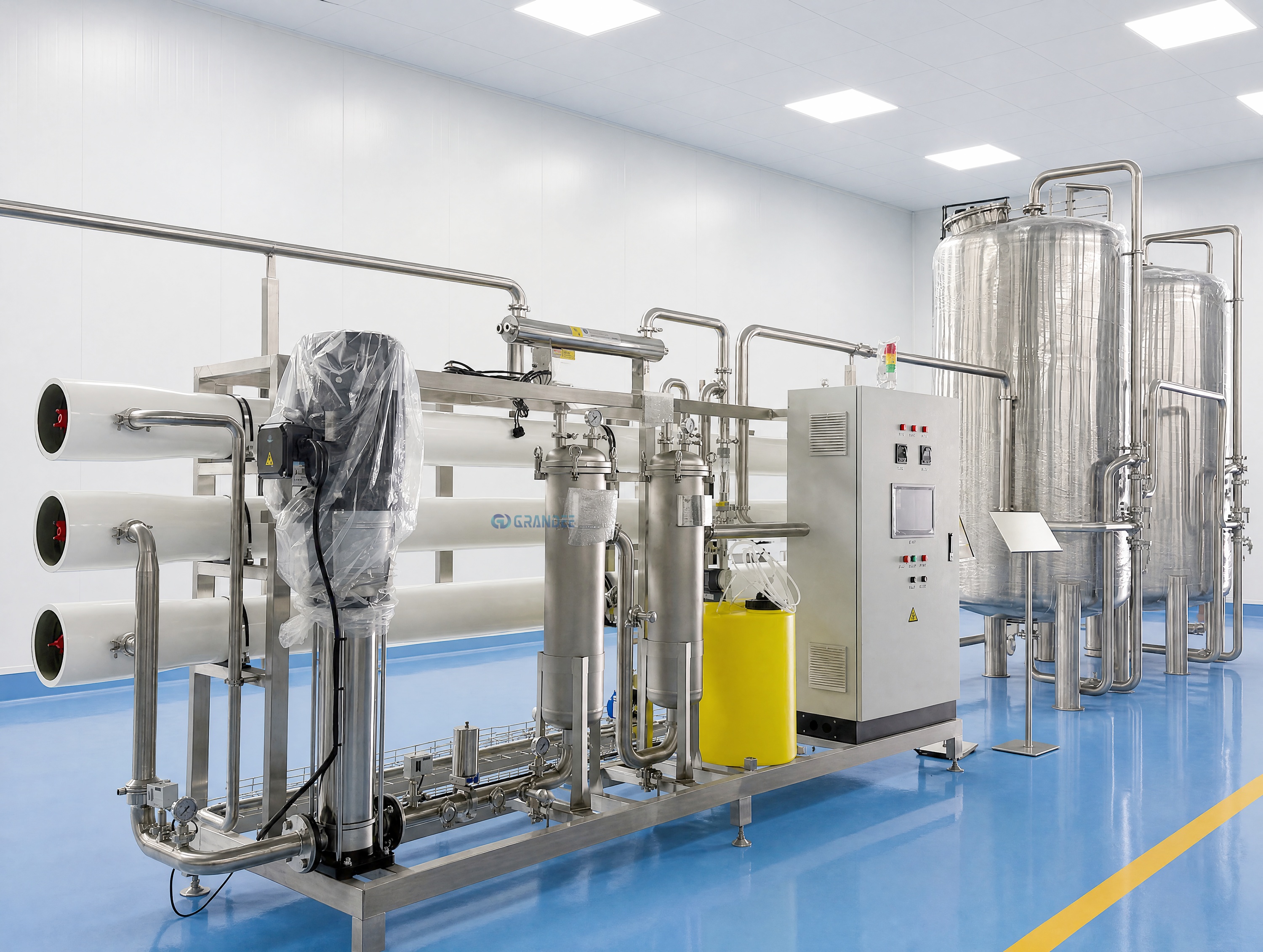
Neither RO nor UF membranes can accept raw borehole or surface water directly without extensive upstream pre-treatment. Unfiltered raw water causes immediate particulate clogging, bio-fouling, and irreversible chemical scaling. Grandee Machine's water treatment skids incorporate an engineered multi-barrier pre-treatment sequence:
- Quartz Sand Media Filtration: Raw water is pressurized through multi-grade graded silica quartz sand beds to filter out suspended silt, oxidized ferric floc, and particulate matter down to 20 microns, reducing the silt density index (SDI).
- Granular Activated Carbon (GAC) Filtration: Pre-filtered water transits virgin acid-washed coconut shell activated carbon. The high-surface-area internal micropores adsorb free residual chlorine, trihalomethanes (THMs), volatile organic compounds (VOCs), and natural humic color pigments. Eliminating free chlorine is mandatory for RO systems, as chlorine oxidizes and destroys polyamide thin-film composite membranes.
- Ion-Exchange Water Softening / Antiscalant Dosing: For hard water sources containing elevated calcium and magnesium bicarbonates, an automated sodium ion-exchange resin softener or precise antiscalant chemical dosing skid prevents calcium carbonate (CaCO3) and sulfate scaling on membrane surfaces.
- 5-Micron Precision Cartridge Filtration: Stainless steel safety filter housings fitted with 5-micron melt-blown polypropylene filter cartridges serve as the final physical barrier protecting high-pressure pumps and membrane vessels from stray sand grains or carbon fines.
Selecting Between RO and UF: Raw Water Chemistry and Product Positioning
The definitive engineering decision between reverse osmosis and ultrafiltration is dictated by two primary criteria: raw water chemistry analysis and commercial market positioning:
- When Reverse Osmosis Is Mandatory: If raw borehole or surface water exhibits elevated TDS (exceeding 300 to 1,500 ppm), high electrical conductivity, bitter mineral taste, or heavy metal contamination (such as arsenic, fluoride, lead, or excess sodium), reverse osmosis is non-negotiable. RO strips mineral ions completely, producing pure, clean, standardized water with a fresh, neutral taste profile compliant with international purified bottled water standards.
- When Ultrafiltration Is the Optimal Solution: When plant investors secure pristine mountain spring or natural artesian well water that already complies with chemical and heavy metal safety limits, applying RO would strip away valuable natural minerals, destroying its commercial classification as "natural mineral water." In this scenario, hollow-fiber ultrafiltration provides the ideal cold mechanical sterilization: removing all bacterial cells, airborne spores, and turbidity while retaining 100% of the natural calcium, magnesium, and bicarbonate ions that define regional mineral water flavor profiles.
Downstream Line Integration: Storage, Disinfection, and Filling Synchronization
Purified water discharge from RO or UF skids must transition cleanly into high-speed bottling monoblocks without secondary microbial re-contamination:
- Intermediate Storage and Closed-Loop Circulation: Finished treated water collects in hygienic SUS316L stainless steel storage silos equipped with 0.22-micron sterile hydrophobic breathing filters. Continuous recirculating loops prevent water stagnation in distribution piping headers during filling line pauses.
- Dual Terminal Disinfection (UV and Ozone): Immediately before entering the rotary filling carousel, treated water passes through an inline medium-pressure ultraviolet (UV) sterilizer (destroying microbial DNA at 254 nm wavelength) coupled with a side-stream venturi ozone injection system (maintaining 0.2 to 0.4 mg/L dissolved ozone residual). Ozonated water sterilizes the container interior and cap finish during filling, decaying naturally into oxygen within 15 to 20 minutes to preserve clean taste.
- Rotary Filling Carousel Coordination: Water treatment plant capacity must be sized at 115% to 125% of rotary filling speed to maintain steady-state buffer levels in product reservoirs during continuous 8,000 to 24,000 BPH packaging operations.
Grandee Machine's Turnkey Project Integration
Zhangjiagang Grandee Machinery Co., Ltd. incorporates industrial reverse osmosis plants, hollow-fiber ultrafiltration skids, high-speed rotary water filling monoblocks, and automated packaging equipment into unified liquid packaging lines under the Grandee Machine brand. Spanning capacities from 2,000 to 36,000 BPH across bottled water formats (220 ml to 20 L), Grandee Machine coordinates complete plant engineering under unified PLC automation.
During plant layout engineering, Grandee Machine supplies full 3D plant layouts, integrating raw water pre-treatment trains, concentrate brine recovery loops, clean-in-place (CIP) manifolds, and cleanroom filling interfaces. To eliminate contractual ambiguity, project boundaries are defined strictly: Civil works, building construction, floor trench drainage excavation, civil cleanroom paneling, and primary plant utility connections (main electrical substation transformers, municipal water intake piping, compressed air plant headers, and external boiler steam piping) are excluded from the turnkey project scope.
Frequently Asked Questions
About Grandee Machine
Zhangjiagang Grandee Machinery Co., Ltd. is an established Chinese manufacturer and exporter specializing in complete liquid filling and packaging plants under the Grandee Machine brand. Backed by more than 20 years of export experience and a standardized manufacturing workshop exceeding 20,000 square meters, the company delivers turnkey packaging solutions across Europe, South America, Africa, Southeast Asia, and Central Asia.
Grandee Machine's equipment portfolio covers capacities from 150 to 36,000 units per hour across nine core machine categories, encompassing bottled water, carbonated soft drinks, fruit juice, dairy, beer, edible oil, condiments, and liquor. Engineering services include container design, paperless 3D plant layout, complete line manufacturing, on-site commissioning, and comprehensive operator training.
Next Step
To evaluate the optimal water treatment system (RO or UF) for your bottling line project, compile your technical parameters:
- Complete laboratory water analysis report of your raw water source (detailing TDS, electrical conductivity, pH, hardness, silica, iron, and microbial counts).
- Target bottled water standard: Natural mineral water (preserving minerals) or purified drinking water (low TDS).
- Target production capacity in cubic meters per hour (m³/h) or finished bottles per hour (BPH).
- Container format specifications: Small PET bottles (220 ml – 2 L), large bottles (3 – 20 L), or 5-gallon barrels.
Submit your raw water test report to Grandee Machine's process engineering team to receive full treatment flow schematics, membrane sizing calculations, and complete turnkey project proposals.
Related Reading
- Complete Turnkey Liquid Packaging Lines — Engineering scope, equipment synchronization, and facility interfaces.
- Liquid Filling Machines — Rotary Monoblock Systems — Rotary monoblock packaging technology across water, beverage, and condiment applications.
- Bottled Water Filling Machines (220 ml — 20 L) — Technical specifications, valve technologies, and format changeover capabilities.
https://www.grandeemachine.com/
Zhangjiagang Grandee Machinery Co., Ltd.

+ There are no comments
Add yours