




Chocolate grinding slurry is used in chocolate products, chocolate coatings, fillings, ice cream, bakery products, and confectionery. The slurry usually consists of cocoa liquor, cocoa butter, powdered sugar, milk powder, emulsifiers, and flavors. The purpose of grinding is to disperse sugar, milk powder, and cocoa solids into the fat continuous phase, reduce particle size, achieve a fine mouthfeel, and maintain stable flowability. Fineness requirements are relatively high, generally requiring D50 of 15–25 μm. When particles are too coarse, there may be a gritty sensation on the tongue, the coating surface may be rough, and sedimentation or precipitation may occur during storage. When the particle size distribution is too wide, mouthfeel and gloss may also fluctuate. Therefore, the equipment must balance dispersion, grinding, temperature control, and hygiene.
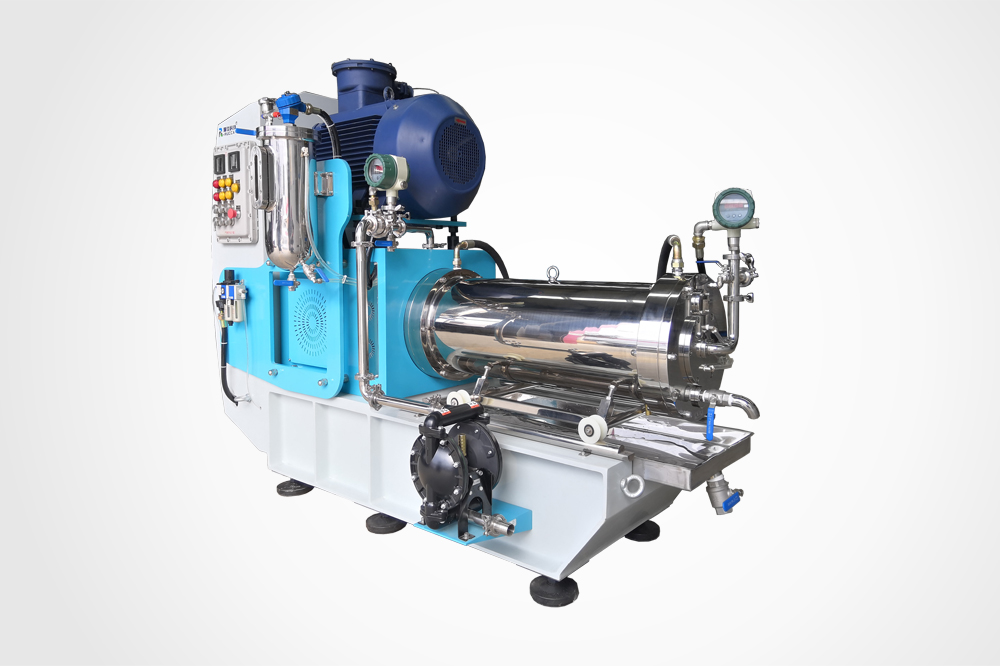
The RUCCA DF-High efficiency disk horizontal bead mill is recommended. This series uses a pin-type structure, and the rotor and pins create shear, impact, and friction in the grinding chamber, making it suitable for medium- to high-viscosity slurries. For chocolate slurry, fineness and capacity can be matched by adjusting media specifications, filling rate, linear speed, flow rate, and circulation mode. Grinding media can be zirconia beads or ceramic beads, with specifications determined by initial particle size and target fineness. Wetted parts can be made of food-grade materials to reduce wear and metal contamination. Pipes, valves, pumps, and seals should be easy to disassemble and clean to reduce residue and dead corners. For different formulas such as dark chocolate, milk chocolate, and white chocolate, the proportions of powdered sugar, milk powder, and cocoa solids differ, and viscosity and grinding difficulty also change, so equipment parameters need to be adjusted separately.
Chocolate slurry has relatively high viscosity and is temperature-sensitive. If heat generated during grinding accumulates, it may change the melting state of cocoa butter, affect the dispersion of sugar and milk powder, and also change aroma and mouthfeel. The equipment needs an effective cooling system, combining internal cooling and external cooling to help control temperature rise. By adjusting cooling water temperature, flow rate, number of grinding passes, and feed rate, the slurry can complete grinding under relatively mild conditions. For continuous production, circulating cooling or segmented grinding can be used to reduce heat accumulation caused by excessive single-pass residence time. If the workshop ambient temperature is high, pipes and storage tanks can also be considered for insulation or cooling measures.
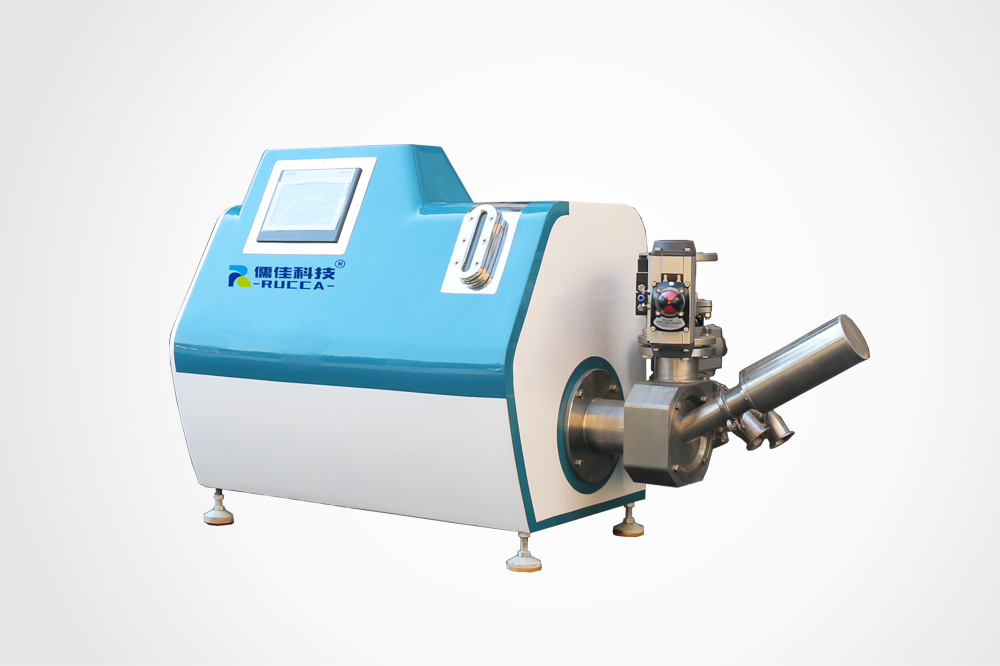
When combined with the Inline dispersing system-low viscosity IDS, dust-free feeding and instant wetting can be achieved in the pre-dispersion stage, allowing the powder to be well dispersed when entering the liquid and reducing agglomeration and bubbles. Powdered sugar and milk powder easily absorb moisture and cake, and online dispersion can shorten the wetting time and reduce dust flying and material loss. With good pre-dispersion, the number of subsequent grinding passes can be reduced by 30%–50%, which helps lower energy consumption, media wear, and temperature rise, and also makes batch-to-batch fineness and mouthfeel more stable. For systems containing milk powder, microbial and allergen control also need attention, and the cleaning process needs to be validated.
RUCCA can provide food-grade material configurations. It is recommended to send samples for trial testing and use measured data to determine suitable process parameters. Through lab or pilot tests, the sand mill model, media specifications, flow rate, linear speed, temperature control, and cleaning process can be tested. Test items include particle size distribution, fineness, viscosity, temperature, color difference, mouthfeel, and storage stability. Based on the results, scale up to production models to reduce on-line adjustment time. If you have a specific chocolate slurry formula, you can contact RUCCA to send samples for trial testing, and technical personnel will recommend a configuration based on the material characteristics.
www.ruccagroup.net
RUCCA


+ There are no comments
Add yours