
When designing an automatic fire protection system, choosing the right sprinkler head is just as important as selecting the appropriate pipework, water supply, and control equipment. Among the many types available, upright, pendent, and sidewall sprinkler heads are three of the most commonly used configurations.
Although all three are designed to discharge water when exposed to sufficient heat, their installation orientation and spray characteristics are different. These differences affect where each sprinkler can be installed, how water is distributed across the protected area, and which building layouts are most suitable for a particular sprinkler head.
Understanding these differences is important for fire protection engineers, contractors, building owners, facility managers, and purchasing teams. Selecting a sprinkler based only on appearance or price can result in an unsuitable installation. Instead, the sprinkler head should be selected according to the building structure, ceiling arrangement, hazard classification, obstruction conditions, temperature requirements, and applicable fire protection standards.
This guide explains how upright, pendent, and sidewall sprinkler heads work, compares their advantages and limitations, and provides practical guidance for choosing the right type of fire sprinkler heads for different applications.
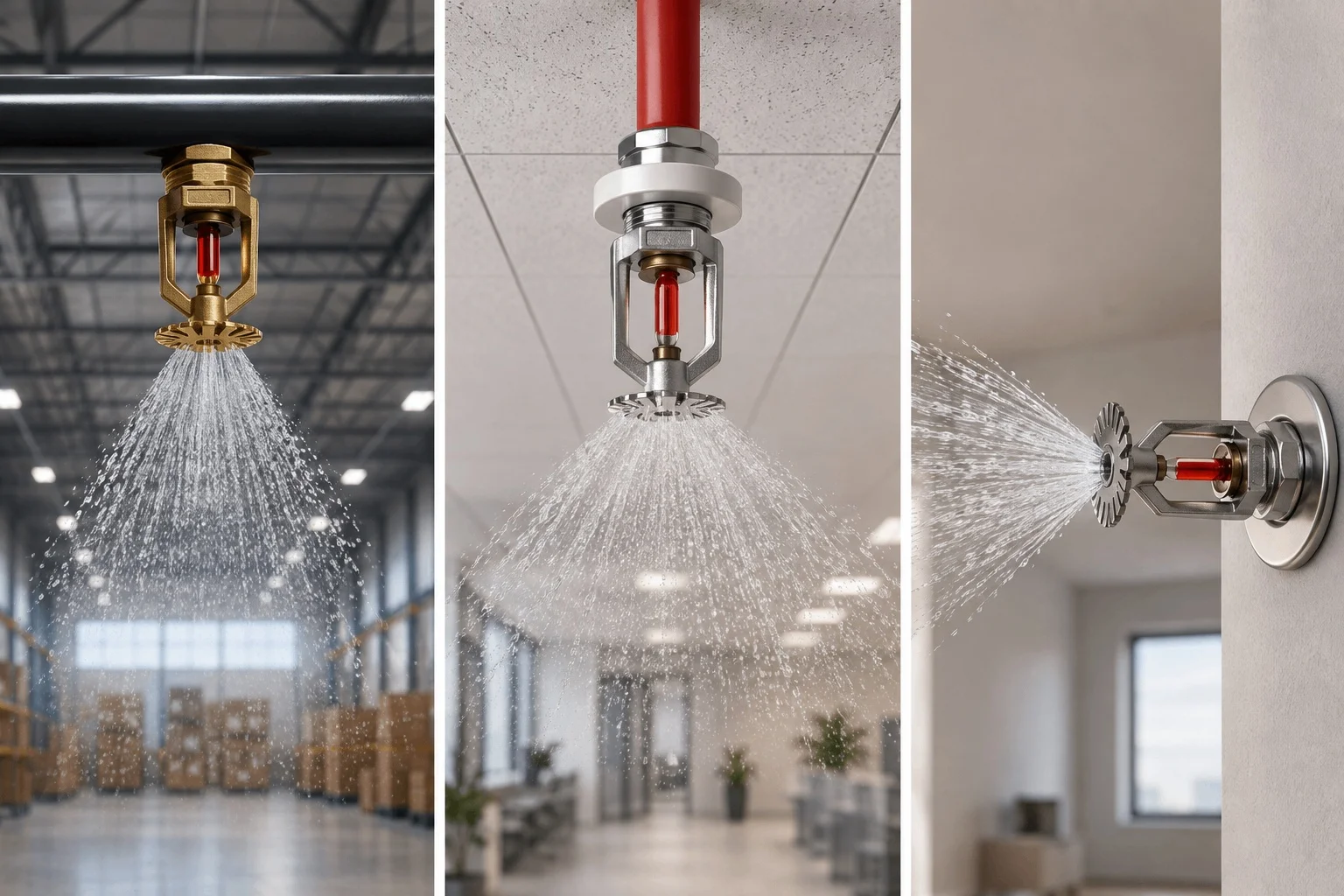
What Are Upright, Pendent, and Sidewall Sprinkler Heads?
Upright, pendent, and sidewall refer primarily to the installation orientation and discharge pattern of a sprinkler head.
All automatic sprinkler heads perform the same basic function: they detect heat from a developing fire and release water when their thermal operating element reaches its rated activation temperature.
However, the direction in which the sprinkler is installed changes the way water is distributed.
Upright Sprinkler Heads
An upright sprinkler head is installed with the deflector positioned above the sprinkler body. When activated, water flows upward toward the deflector and is then distributed downward over the protected area.
Upright sprinklers are often installed beneath exposed ceilings where the sprinkler pipe is visible. They can also be useful in areas where structural or architectural conditions make an upright configuration more practical than a pendent installation.
Pendent Sprinkler Heads
A pendent sprinkler head is installed below the supply pipe, with the deflector positioned underneath the sprinkler frame. When activated, water is discharged downward and outward from the deflector.
Pendent sprinklers are extremely common in commercial buildings and are frequently installed beneath suspended ceilings, finished ceilings, and other horizontal ceiling structures.
Sidewall Sprinkler Heads
A sidewall sprinkler head is designed to be installed along a wall rather than in the middle of the ceiling. Its deflector is specifically designed to distribute water outward across the protected space.
Sidewall sprinklers can be particularly useful in rooms or areas where installing pipework across the ceiling is difficult, undesirable, or impractical.
How Does an Automatic Fire Sprinkler Head Work?
Before comparing the three configurations, it is useful to understand the basic operating principle.
An automatic fire sprinkler head normally remains closed under ordinary conditions. A heat-sensitive operating element holds the waterway closed until the surrounding temperature reaches the sprinkler's specified activation point.
When a fire develops, hot gases rise toward the ceiling or accumulate near the upper part of the room. The heat transfers to the sprinkler's thermal element. Once the rated temperature is reached, the element activates and releases the sealing mechanism.
Pressurized water then flows through the sprinkler orifice and strikes the deflector. The deflector breaks the water stream into droplets and distributes them across a designed coverage pattern.
The important point is that sprinkler heads are heat-activated devices, not smoke detectors. A sprinkler generally does not activate simply because smoke is present.
This operating principle is shared by upright, pendent, and sidewall configurations, but their water distribution patterns differ significantly.
Upright Sprinkler Heads: Features and Applications
Upright sprinkler heads are commonly associated with exposed pipe systems and areas where the sprinkler needs to sit above the supply piping.
The sprinkler is positioned so that its deflector is above the frame. Once activated, water hits the deflector and is distributed downward.
Where Are Upright Sprinklers Used?
Typical applications can include:
-
Warehouses
-
Industrial buildings
-
Manufacturing facilities
-
Mechanical rooms
-
Utility spaces
-
Parking structures
-
Buildings with exposed ceilings
-
Areas with unobstructed structural ceilings
Upright fire sprinkler heads can be especially convenient in facilities where the sprinkler pipe is intentionally exposed.
For example, an industrial facility may have structural steel, concrete ceilings, ductwork, and visible pipework rather than a finished suspended ceiling. In this situation, an upright sprinkler can integrate naturally into the overall system design.
Advantages of Upright Sprinkler Heads
One advantage is installation flexibility in certain exposed-pipe applications.
Because the sprinkler is installed above the pipe, the configuration can be suitable for locations where installing a pendent sprinkler below the pipe would create clearance or impact concerns.
Upright sprinklers can also be useful in areas where the ceiling is unfinished or where aesthetics are not a major consideration.
Potential Limitations
An upright sprinkler is not necessarily the best choice for every room.
In an office, hotel, retail store, or other finished interior, an exposed upright sprinkler may not provide the desired appearance. It may also conflict with ceiling finishes or architectural requirements.
The presence of beams, ducts, lighting equipment, storage racks, or other obstructions must also be evaluated because these elements can influence sprinkler water distribution.
Pendent Sprinkler Heads: Features and Applications
Pendent sprinkler heads are among the most recognizable types of fire sprinkler heads.
They hang downward from the supply pipe and discharge water toward the floor when activated.
Where Are Pendent Sprinklers Used?
Pendent sprinklers are widely used in:
-
Office buildings
-
Hotels
-
Shopping centers
-
Restaurants
-
Schools
-
Hospitals
-
Apartment buildings
-
Residential properties
-
Retail stores
-
Commercial buildings
They are particularly suitable for areas with finished horizontal ceilings.
Advantages of Pendent Sprinkler Heads
The main advantage of pendent sprinklers is their straightforward downward discharge pattern.
They can be installed below finished ceilings and can be combined with concealed or recessed configurations where architectural appearance is important, depending on the specific sprinkler design and approval.
For a conventional commercial room with a relatively unobstructed ceiling, pendent sprinklers can provide an efficient solution for distributing water across the protected area.
Concealed and Recessed Pendent Sprinklers
Pendent sprinklers can also be designed for architectural applications.
A concealed sprinkler is installed behind a cover plate so that much of the sprinkler assembly is hidden from view. A recessed sprinkler can also be positioned partially within the ceiling.
These configurations are often selected in buildings where the visual appearance of the ceiling is important.
However, not every sprinkler can simply be concealed. The sprinkler, cover assembly, and installation method must be specifically designed and approved for that configuration.
Sidewall Sprinkler Heads: Features and Applications
Sidewall sprinkler heads have a different installation concept.
Instead of being installed in the ceiling, they are generally installed along a wall, with the deflector designed to distribute water outward into the room.
This makes sidewall sprinklers particularly useful when ceiling installation is inconvenient.
Where Are Sidewall Sprinklers Used?
Potential applications include:
-
Hotel rooms
-
Bedrooms
-
Small offices
-
Corridors
-
Residential rooms
-
Small commercial spaces
-
Areas with difficult ceiling access
-
Rooms where ceiling piping is undesirable
Sidewall sprinklers can be useful when there is limited space above the ceiling or when the building's architectural design makes central ceiling sprinkler installation difficult.
Advantages of Sidewall Sprinklers
The most obvious advantage is installation flexibility.
A sidewall fire sprinkler head can sometimes eliminate the need to position a sprinkler in the center of the ceiling. This can simplify certain layouts and help accommodate architectural requirements.
For example, in a narrow room, installing sprinklers along a wall may be more practical than arranging piping across the ceiling.
Potential Limitations
Sidewall sprinklers have specific water distribution patterns and coverage requirements.
Their installation location, distance from the ceiling and adjacent walls, room dimensions, and potential obstructions all need to be considered.
A sidewall sprinkler should not be selected simply because ceiling installation is inconvenient. Its listed coverage and installation requirements must match the application.
Upright vs. Pendent vs. Sidewall Sprinkler Heads
The easiest way to understand the difference is to compare their installation orientation and typical applications.
| Feature | Upright | Pendent | Sidewall |
|---|---|---|---|
| Installation | Above supply pipe | Below supply pipe | Along a wall |
| Main discharge direction | Toward deflector, then downward | Downward and outward | Outward from wall |
| Common environment | Exposed ceilings | Finished ceilings | Rooms and spaces with wall installation |
| Typical applications | Industrial and warehouse spaces | Commercial and residential buildings | Rooms, corridors, and selected compact spaces |
| Appearance | Usually visible | Visible, recessed, or concealed options may exist | Usually visible or partially concealed depending on design |
| Key advantage | Suitable for exposed piping | Versatile for finished ceilings | Flexible wall-mounted installation |
This comparison provides a general overview. Actual selection must always follow the sprinkler manufacturer's listing, installation instructions, hydraulic calculations, and applicable fire protection requirements.
Does Installation Orientation Affect Fire Protection Performance?
Yes.
The orientation of a sprinkler is directly related to its discharge pattern.
A sprinkler deflector is engineered to distribute water in a particular way. If the sprinkler is installed in an orientation that does not match its design, the intended coverage pattern may not be achieved.
For example, a pendent sprinkler is designed to distribute water downward from beneath the supply pipe. An upright sprinkler has a different configuration because it is installed above the pipe.
Similarly, a sidewall sprinkler is specifically engineered to distribute water across the room from a wall location.
Therefore, upright, pendent, and sidewall sprinkler heads should not be treated as interchangeable products.
How Ceiling Design Influences Sprinkler Selection
The ceiling is one of the first things engineers and contractors should evaluate.
Exposed Ceiling
Industrial facilities often have exposed structural ceilings with visible pipework. In such cases, upright sprinklers may provide a practical solution.
Suspended Ceiling
Pendent sprinklers are frequently used with suspended ceilings because the sprinkler can be positioned beneath the ceiling plane.
Depending on the design, concealed or recessed sprinkler configurations may also be considered.
Low or Obstructed Ceiling
Low ceilings may require additional evaluation because beams, lights, ventilation equipment, ducts, and other objects can interfere with heat collection or water distribution.
The correct sprinkler location should therefore be determined from the complete ceiling layout rather than from room dimensions alone.
How Obstructions Affect Fire Sprinkler Heads
One of the most important considerations in sprinkler installation is obstruction.
Sprinkler water needs to reach the intended coverage area. Large beams, air ducts, lighting fixtures, shelves, signs, cable trays, and equipment can interfere with the discharge pattern.
An obstruction may:
-
Block water discharge
-
Change the spray pattern
-
Create an area with insufficient water
-
Affect heat exposure to the sprinkler
-
Require additional sprinkler protection
This is particularly important in warehouses and industrial facilities where equipment and storage racks can create complex layouts.
For this reason, the location of automatic fire sprinkler heads should be considered together with the building's structural and mechanical systems.
How Do K-Factor and Temperature Rating Matter?
Choosing between upright, pendent, and sidewall configurations is only one part of sprinkler selection.
Other technical parameters also matter.
K-Factor
The K-factor is related to the relationship between sprinkler flow and pressure. Different sprinkler designs are available with different K-factors.
The appropriate K-factor depends on the hydraulic design of the system and the required water discharge.
A higher K-factor does not automatically mean a sprinkler is better. It must be compatible with the system's hydraulic requirements and the intended application.
Temperature Rating
Each automatic sprinkler head is designed to operate within a specified temperature range.
Common temperature ratings vary depending on the application and surrounding ambient conditions.
A sprinkler installed near a heat source, such as a commercial kitchen or industrial process, may require a different temperature rating from one installed in a normal office.
The temperature rating should be selected according to the expected ambient conditions and relevant requirements.
Final Thoughts
Upright, pendent, and sidewall sprinkler heads are all important configurations used in automatic fire protection systems, but they are designed for different installation conditions.
Upright sprinkler heads are commonly associated with exposed pipe systems and industrial environments where the sprinkler is installed above the supply pipe.
Pendent sprinkler heads are widely used beneath finished ceilings and are particularly common in commercial, residential, retail, hospitality, and office buildings.
Sidewall sprinkler heads provide an alternative for selected spaces where wall-mounted installation is more practical than ceiling installation.
The most suitable fire sprinkler head depends on much more than orientation. Ceiling construction, room geometry, obstructions, hazard classification, temperature conditions, hydraulic requirements, material, certification, and local regulations all need to be considered.
For this reason, the best approach is to select sprinkler heads as part of the complete fire protection system rather than treating them as standalone components. When the sprinkler configuration is properly matched to the building environment and system design, it can contribute to reliable water distribution and effective fire protection when it is needed most.
www.yuanqingxiaofang.com
yuanqingxiaofang

+ There are no comments
Add yours