
Marine manufacturing demands a combination of structural strength, dimensional accuracy, production efficiency, and consistent quality. Shipyards and marine equipment manufacturers work with large quantities of metal components, many of which require complex profiles, precise openings, and repeatable dimensions. Traditional cutting methods can handle many of these tasks, but they may require more secondary processing and setup time when production requirements become more demanding.
Fiber laser cutting technology offers a practical alternative. With high cutting speed, concentrated heat input, and computer-controlled operation, a modern laser cutting machine can process a wide range of sheet metal components with consistent results. For marine manufacturers looking to improve fabrication efficiency while maintaining dimensional control, a suitable marine laser cutting machine can become an important part of the production line.
The Role of Laser Cutting in Marine Manufacturing
Marine manufacturing is not limited to cutting large structural plates. It also involves producing brackets, equipment covers, electrical cabinets, reinforcement components, ventilation parts, mounting plates, and various fabricated assemblies.
These components often need to fit together accurately during welding and assembly. If cutting accuracy is inconsistent, problems can appear later in the process. Misaligned holes, uneven edges, or excessive deformation may increase fitting work and welding adjustments.
Laser cutting addresses these issues by using a focused laser beam controlled through a CNC system. Once the cutting program is prepared, the machine can repeatedly process components according to the specified geometry.
For manufacturers producing batches of similar marine components, this repeatability can reduce dependence on manual marking and cutting.
1. High Cutting Accuracy for Fabricated Components
Accuracy is one of the most important advantages of laser cutting.
A marine component may contain straight edges, mounting holes, slots, or irregular contours. These features need to match the engineering drawing so that the finished component can be assembled correctly.
The CNC-controlled movement system of a fiber laser machine allows the cutting head to follow programmed paths accurately. This is particularly useful when manufacturers need to process repeated components with the same dimensions.
The result is a more controlled workflow:
CAD drawing → CNC programming → automatic positioning → laser cutting → inspection → assembly
This approach helps reduce variation between individual workpieces and makes subsequent fabrication easier.
2. Faster Processing of Thin and Medium Sheet Metal
Marine manufacturing involves different types and thicknesses of sheet metal. Depending on the application, carbon steel, stainless steel, galvanized sheet, electrolytic plate, and other materials may be used.
The laser cutting equipment supplied by Mingge is designed for efficient processing of thin-sheet materials, including carbon steel up to 8 mm and stainless steel and other specified materials within applicable thickness ranges.
Compared with manual cutting or processes that require extensive tooling preparation, laser cutting can provide a faster transition between different component designs.
This becomes especially valuable when a production workshop handles multiple orders with different drawings. Operators can change the cutting program rather than replacing dedicated mechanical tooling for every new component.
3. Reduced Secondary Processing
A cutting process should not only separate the material; it should also prepare the workpiece for the next manufacturing operation.
A properly configured fiber laser can produce relatively clean and consistent cut edges. Depending on the material, thickness, gas selection, and process parameters, the resulting edge may require limited additional treatment before welding, bending, or assembly.
For marine fabrication, this can reduce unnecessary grinding and manual edge correction.
For example, a mounting plate requiring several holes and an irregular external profile can often be produced directly from a CNC cutting program. Instead of separately marking, drilling, and manually cutting the component, multiple operations can be integrated into one automated cutting process.
That simplifies production flow and reduces handling between machines.
4. Lower Heat-Affected Areas Compared With Conventional Thermal Cutting
Heat management is another important consideration when processing sheet metal.
Laser cutting concentrates energy into a small cutting zone. This makes it possible to achieve efficient material separation while controlling the heat input around the cutting path.
For thin sheet components, controlled heat input can help reduce unnecessary thermal deformation. This is useful when producing flat panels, brackets, covers, and other parts that must maintain dimensional stability during assembly.
However, actual cutting performance depends on material grade, thickness, laser power, cutting speed, assist gas, nozzle condition, and other process parameters. Therefore, manufacturers should select process settings according to the specific material rather than relying on a single parameter for all applications.
5. Flexible Processing for Different Marine Components
One of the strongest advantages of CNC laser cutting is flexibility.
Marine manufacturers rarely produce only one type of component. A typical workshop may need to process electrical cabinet panels one day, structural brackets the next, and equipment mounting plates after that.
Laser cutting is suitable for this type of mixed production because the geometry is controlled digitally.
Typical applications can include:
-
Equipment mounting plates
-
Electrical cabinet panels
-
Ventilation components
-
Marine equipment brackets
-
Reinforcement plates
-
Machinery covers
-
Metal frames
-
Pipe and equipment support components
-
Customized sheet metal parts
The same machine can therefore support different production departments without requiring extensive mechanical tooling changes.
6. Floor-Mounted Gantry Design Supports Workshop Productivity
Machine structure directly affects long-term cutting performance.
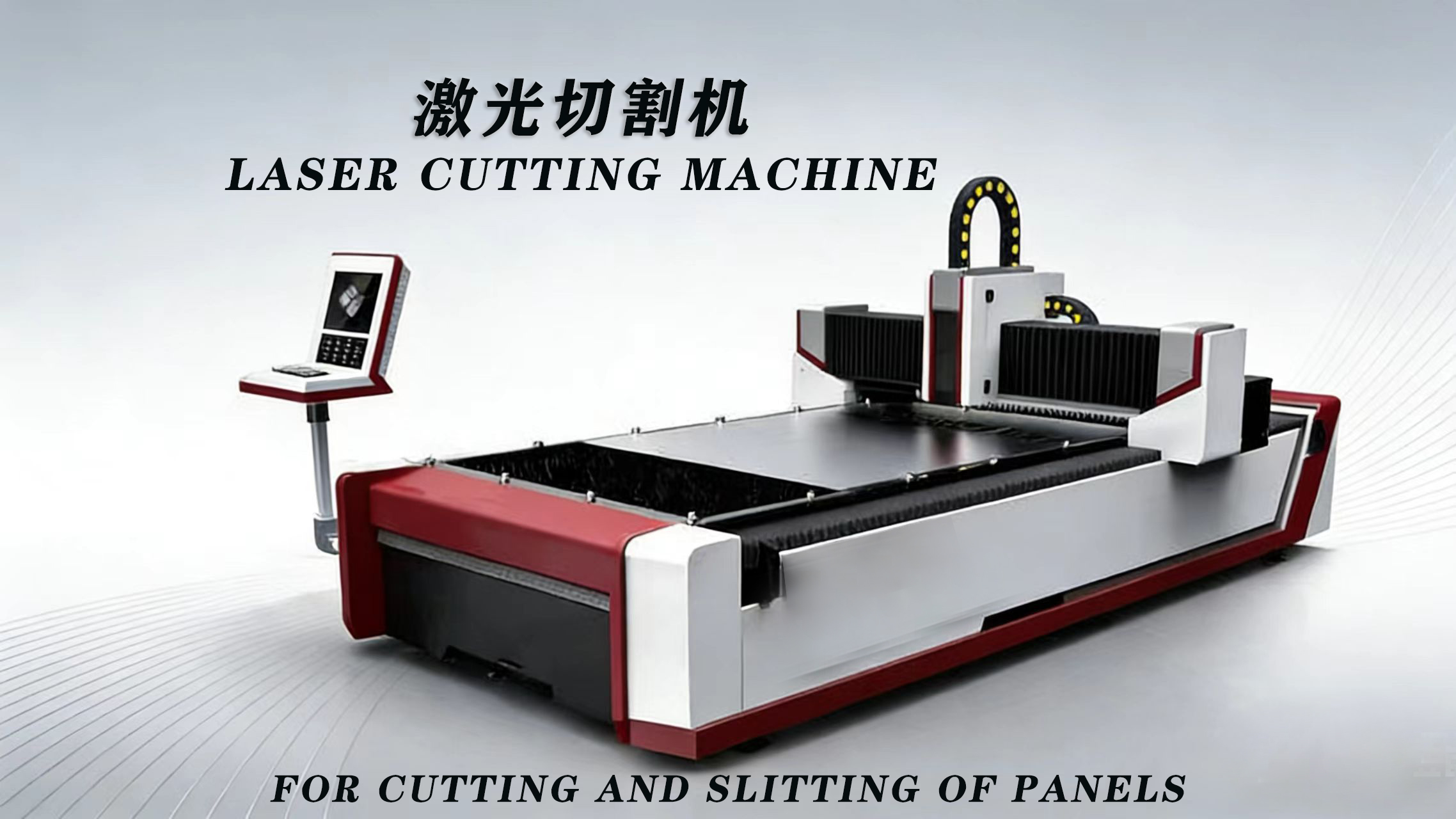
The Mingge laser cutting machine adopts a floor-standing gantry dual-drive structure. Its compact configuration helps reduce the required floor space while providing convenient access for material loading, unloading, operation, and maintenance.
For a marine fabrication workshop, material handling is an important part of productivity. Operators need to position sheets safely and efficiently before cutting and remove finished parts without unnecessary movement.
A practical machine layout can therefore improve more than cutting speed. It can also influence operator efficiency, workshop organization, and maintenance accessibility.
7. Rigid Construction for Long-Term Operation
Marine manufacturing environments can involve extended production cycles and demanding workloads. Equipment must therefore maintain mechanical stability during repeated high-speed movements.
The machine body uses steel plate plug welding followed by annealing treatment. Combined with a cast aluminum beam, the structure is designed to meet the requirements of long-term, high-acceleration movement.
Mechanical rigidity is particularly important because cutting accuracy is not determined by the laser source alone. The machine frame, guide system, drive components, control system, and cutting head all contribute to the final result.
A stable mechanical structure helps maintain positioning performance during continuous operation.
8. Stable Motion Control Improves Repeatability
The motion system is another key factor in laser cutting quality.
The machine is equipped with imported servo units from Japan and reducers from Germany. These components are intended to provide stable movement and long-term positioning performance.
For manufacturers processing repeated marine components, stable motion is essential. If machine movement becomes inconsistent, dimensional differences can accumulate between workpieces.
A reliable CNC motion system helps maintain consistent cutting paths and supports repeatable production.
9. Fiber Laser Technology Improves Production Efficiency
The laser source is at the heart of the cutting process.
High-performance fiber laser generators provide high photoelectric conversion efficiency and can deliver fast cutting performance with relatively low maintenance requirements. Compared with conventional laser technologies, fiber lasers are widely valued for their compact structure, efficiency, and operational stability.
For a production workshop, this means the laser system can support regular cutting work without requiring complicated daily maintenance routines.
Nevertheless, machine efficiency should be evaluated as a complete system. Laser source performance, cutting head condition, air or gas supply, material preparation, programming, loading and unloading, and operator practices all affect actual production output.
10. Better Integration With Digital Production
Modern marine manufacturing increasingly depends on digital production management.
Because laser cutting is CNC-controlled, engineering drawings can be converted into cutting programs and reused when the same component needs to be manufactured again.
This provides several practical benefits:
-
Easier production repeatability
-
Faster changeovers between component designs
-
Reduced manual layout work
-
Better utilization of sheet material
-
Easier production documentation
-
More consistent component dimensions
When combined with CAD and other computer-aided manufacturing systems, laser cutting becomes more than a standalone machine. It becomes part of a digitally controlled metal fabrication process.
Choosing the Right Laser Cutting Solution for Marine Manufacturing
A marine manufacturer should not select laser equipment based solely on advertised cutting speed. Actual requirements should be considered first.
Important factors include:
Material: Determine whether the workshop mainly processes carbon steel, stainless steel, galvanized sheet, or other materials.
Thickness: Confirm the required cutting thickness range rather than selecting equipment based on maximum capacity alone.
Component size: Match the working area with the sheet dimensions commonly used in production.
Production volume: A machine for prototype production may have different requirements from equipment intended for continuous batch manufacturing.
Accuracy requirements: Evaluate positioning accuracy, repeatability, machine rigidity, and motion control.
Maintenance: Consider the accessibility of consumables, cutting heads, filters, and other maintenance components.
Workshop layout: Loading, unloading, ventilation, material storage, and operator access should all be considered during installation planning.
Conclusion
Laser cutting is transforming marine manufacturing by bringing together cutting accuracy, processing flexibility, automation, and production efficiency. For workshops producing marine equipment and sheet metal components, the technology can reduce manual operations, simplify changeovers, improve repeatability, and prepare parts more effectively for welding and assembly.
A well-designed fiber laser cutting machine is particularly valuable when the production environment requires frequent processing of different sheet metal components. With a rigid machine structure, reliable servo motion, high-performance fiber laser source, and CNC control, Mingge's equipment provides a practical solution for manufacturers seeking more efficient metal fabrication.
The key is to match machine specifications with actual production requirements. When material types, thicknesses, component dimensions, production volume, and workflow are properly considered, laser cutting can become a dependable foundation for a more efficient and controlled marine manufacturing process.
www.heduanpress.com
Mingge Electrical and Mechanical Equipment


+ There are no comments
Add yours