

For beverage manufacturers, water plant investors, quality assurance managers, and process engineers planning commercial bottling operations, the starting point of plant design is never the rotary filling machine alone; it begins with source water purification. Reliable process water quality governs downstream filling accuracy, magnetic flowmeter calibration, sanitary sealing integrity, and shelf-life stability across finished bottled beverages. When raw source water contains abrasive silica particulates, excessive calcium hardness, residual chlorine, heavy metals, or microbial bio-burden, downstream machinery experiences rapid valve seat pitting, seal calcification, and catastrophic biological re-contamination.
Zhangjiagang Grandee Machinery Co., Ltd., operating globally under the Grandee Machine brand, approaches industrial water treatment systems not as standalone peripheral hardware, but as the foundational process block of complete liquid packaging lines. Operating across capacities from 2,000 to 36,000 bottles per hour (BPH) for small PET formats (220 ml to 2,000 ml), 3 to 20 L large bottles, and 150 to 1,500 barrels per hour for 5-gallon returnable carboys, Grandee Machine synchronizes water purification chemistry directly with rotary monoblock filling speeds. This engineering guide details the process chemistry risks of untreated water, the multi-barrier filtration sequence, downstream machine protection mechanisms, and turnkey plant integration protocols.
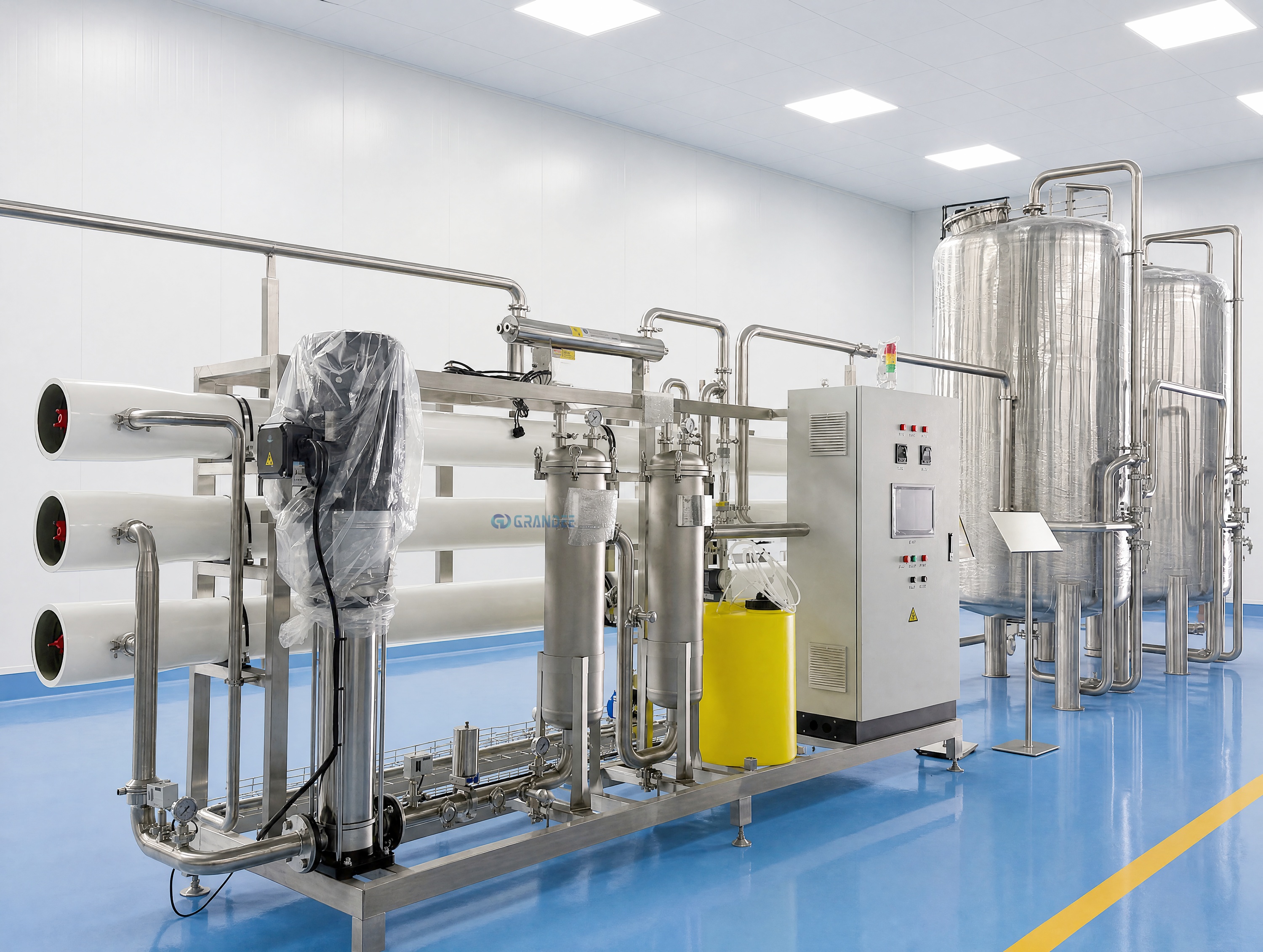
Process Water Risks: How Raw Water Chemistry Destabilizes Downstream Bottling
Raw water drawn from underground aquifers, surface reservoirs, or municipal utility headers exhibits chemical and physical variations that actively threaten high-speed bottling hardware and product shelf-life:
- Particulate Abrasion and Valve Pitting: Raw water carries suspended quartz sand, colloidal silt, and oxidized rust particles. If pumped directly into high-speed rotary monoblock carousels, these abrasives erode electromagnetic flowmeter electrodes, score pneumatic filling valve stems, and destroy mechanical ceramic seal faces within centrifugal transfer pumps.
- Carbonate Scaling and Thermal Degradation: Unconditioned water rich in calcium and magnesium bicarbonates (Ca(HCO3)2 and Mg(HCO3)2) undergoes thermal decomposition and pressure drop precipitation. Scale deposits coat plate heat exchangers, clog sanitary CIP spray balls, choke liquid filling nozzles, and form visible white mineral rings inside finished transparent PET containers.
- Chlorine Attack and Stainless Steel Pitting: Municipal tap water contains 0.5 to 2.5 mg/L of free residual chlorine (hypochlorous acid and hypochlorite ions). While effective for municipal distribution pipelines, free chlorine aggressively attacks polyamide reverse osmosis membranes through oxidation and induces severe micro-pitting corrosion on standard SUS304 liquid-contact filling manifolds.
- Microbial Biofilm Accumulation: Untreated borehole or surface water carries heterotrophic bacteria, mold spores, and algae cells. Once settled inside dead legs or rotary distributor bowls, these microorganisms form resilient biofilms that resist ordinary chemical flushes, creating chronic spoilage risks and consumer health violations.
The Multi-Barrier Water Treatment Architecture
To eliminate process water hazards, industrial bottling facilities implement an engineered multi-barrier purification sequence tailored to raw water laboratory analysis:
| Treatment Stage | Primary Mechanism & Media | Target Contaminants Removed | Downstream Machine & Quality Impact |
|---|---|---|---|
| Raw Water Aeration & Dosing | Coagulant / Flocculant injection & contact tank | Dissolved iron (Fe2+), manganese (Mn2+), fine colloids | Prevents yellow discoloration and downstream media blinding |
| Quartz Sand Filtration | Graded multi-layer silica sand bed (0.5 to 2.0 mm) | Suspended solids, oxidized floc, turbidity down to 20 μm | Eliminates abrasive grit scoring centrifugal pump seals |
| Activated Carbon Filtration | High-iodine virgin coconut shell activated carbon | Free chlorine, trihalomethanes, color pigments, odors | Prevents polyamide RO membrane oxidation; ensures neutral taste |
| Ion-Exchange Softening / Antiscalant | Sodium-cycle cation resin or scale inhibitor metering | Calcium (Ca2+) and Magnesium (Mg2+) hardness ions | Stops scale buildup inside filling valves and CIP spray balls |
| Security Cartridge Guard | 5-micron melt-blown polypropylene filter core | Residual carbon fines, stray sand grains (> 5 μm) | Protects high-pressure RO multi-stage booster pump impellers |
| Membrane Separation (RO or UF) | 0.0001 μm Polyamide RO or 0.01–0.04 μm Hollow-Fiber UF | RO: 99.2%–99.6% salts/metals; UF: Log-6 bacteria/colloids | Dictates final water category (Purified water vs Mineral water) |
| Terminal Sanitization | 254 nm Ultraviolet (UV) sterilizer + Venturi Ozone (O3) | Active bacteria, viruses, airborne spores | Ozonated water sterilizes bottle neck finish and inside cap shell |
Protecting Downstream Assets: Filling Valves, Flowmeters, and CIP Systems
Water treatment skids function as the primary protective shield for capital-intensive packaging machinery:
- Flowmeter Accuracy and Metering Repeatability: High-speed electronic volumetric filling machines utilize electromagnetic or mass flowmeters to meter liquid into containers at speeds up to 36,000 BPH. Particulate-free and gas-stabilized water prevents electrode fouling, eliminating volume drift and liquid splashing across high-speed packaging runs.
- Sanitary Clean-in-Place (CIP) Automation: Grandee Machine integrates automated CIP sanitizing circuits as standard line infrastructure. Demineralized, conditioned water ensures that hot alkaline detergents (1.5% to 2.0% NaOH at 65 to 80 degrees Celsius) and acid neutralizers work without insoluble calcium scale precipitation, maintaining sanitary surfaces inside all filling carousels.
- Corrosion Resistance via SUS316L Contact Geometry: Demineralized reverse osmosis permeate exhibits low ionic strength and can be slightly aggressive to standard metals. To counter this, Grandee Machine fabricates all pure water buffer vessels, transfer pumps, and rotary filling liquid manifolds exclusively from certified food-grade SUS316L stainless steel, preventing heavy metal ion leaching.
Capacity Sizing and Flow Harmonization Across the Bottling Line
A frequent error in bottling plant planning is sizing water treatment capacity strictly equal to the rated nameplate speed of the filling carousel. Because water treatment plants must supply water for periodic CIP flushing, bottle rinser manifolds, cap sanitizing baths, and steam boiler feeds, steady-state water purification capacity must be engineered with an operational safety buffer:
- The 115% to 125% Sizing Rule: The industrial water treatment system must be rated at 115% to 125% of the total downstream filling consumption. For example, a 12,000 BPH filling line packaging 500 ml bottles consumes 6.0 m³/h of product water. Accounting for container rinsing (1.2 m³/h) and CIP buffer replenishment, the water treatment skid must deliver a steady-state yield of at least 8.0 to 9.0 m³/h.
- Dynamic Buffer Storage Reservoirs: Grandee Machine positions dual hygienic stainless steel storage silos (equipped with 0.22-micron hydrophobic sterile air breathers and high/low ultrasonic level transducers) between the water treatment skid and filling cleanroom. This decoupling prevents filling line stoppages from back-pressuring RO high-pressure pumps and ensures continuous supply during filling line ramp-up.
Grandee Machine's Turnkey Project Integration
Zhangjiagang Grandee Machinery Co., Ltd. coordinates complete liquid packaging lines under the Grandee Machine brand, integrating water treatment systems, automatic rotary stretch blow molding units, rotary 3-in-1 washing-filling-capping monoblocks, automated labeling, shrink film packaging, and carton wrap systems. Spanning output ratings from 2,000 to 36,000 BPH for PET bottled beverages and 150 to 1,500 BPH for 5-gallon water plants, Grandee Machine aligns raw water chemistry with finished packaging performance.
Project execution utilizes paperless 3D plant layout engineering, optimizing utility routing, pipe rack elevations, drainage slopes, cleanroom boundaries, and centralized PLC automation. To maintain clear contractual boundaries, project scopes are strictly defined: Civil works, building construction, floor trench drainage excavation, civil cleanroom paneling, and primary plant utility connections (main electrical substation transformers, municipal water intake piping, compressed air plant headers, and external boiler steam piping) are excluded from the turnkey project scope.
Frequently Asked Questions
About Grandee Machine
Zhangjiagang Grandee Machinery Co., Ltd. is an established Chinese liquid filling and packaging machinery manufacturer exporting globally under the Grandee Machine brand. With more than 20 years of export experience and a standardized manufacturing facility exceeding 20,000 square meters, Grandee Machine supplies complete turnkey packaging solutions across Europe, South America, Africa, Southeast Asia, and Central Asia.
The company's machinery portfolio spans production speeds from 150 to 36,000 units per hour across nine core liquid processing categories, including bottled water, carbonated soft drinks, fruit juices, dairy products, beer, edible oils, condiments, and spirits. Turnkey engineering services cover container lightweighting, paperless 3D plant layout, complete line manufacturing, international on-site commissioning, and comprehensive operator training.
Next Step
To establish the correct water treatment and bottling line capacity for your beverage project, assemble your engineering specifications:
- Comprehensive laboratory chemical analysis of your raw water source (measuring TDS, conductivity, pH, total hardness, silica, iron, and microbial counts).
- Target product category: Natural mineral water (preserving healthy minerals) or purified drinking water (demineralized low TDS).
- Planned line filling output in bottles per hour (BPH) and container volumetric sizes (220 ml to 20 L, or 5-gallon carboys).
- Factory dimensional drawings detailing available floor space, ceiling clearance, and utility connection points.
Submit your raw water laboratory report to Grandee Machine's engineering division to receive customized treatment flow diagrams, equipment dimensional layouts, and unified turnkey line proposals.
Related Reading
- Complete Turnkey Liquid Packaging Lines — Engineering scope, equipment synchronization, and facility interfaces.
- Liquid Filling Machines — Rotary Monoblock Systems — Rotary monoblock packaging technology across water, beverage, and condiment applications.
- Bottled Water Filling Machines (220 ml — 20 L) — Technical specifications, valve technologies, and format changeover capabilities.
https://www.grandeemachine.com/
Zhangjiagang Grandee Machinery Co., Ltd.

+ There are no comments
Add yours