
Piston pumps are widely used as metering devices in potting machines. Globally,
most potting-machine manufacturers use piston-pump metering principles in their
equipment. However, significant differences in performance can arise from
variations in the detailed design and structure of these systems.
The following is an analysis of a typical piston metering pump design.
Piston Metering Pump Structure
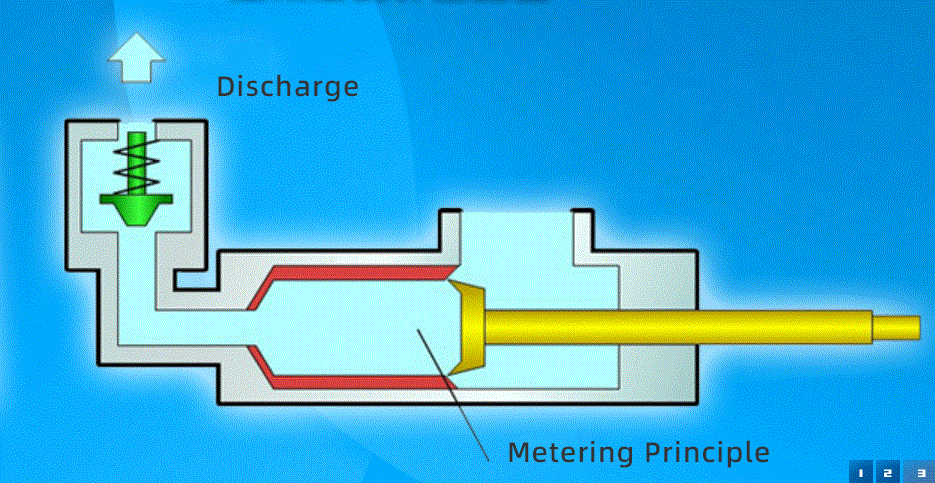
The image below illustrates the structure of a common piston metering pump.
Operating Principle
-
Material filling: The piston retracts, the check valve
closes, and resin is drawn into the metering cylinder. -
Adhesive dispensing: The piston moves forward, the check
valve opens, and the resin is forced out of the metering cylinder.
The piston stroke determines the amount of adhesive dispensed. Two sets of
metering pistons and cylinders with different diameters can be used to
accommodate different adhesive mixing ratios.
Some machines also incorporate a lever mechanism that adjusts the stroke of
one of the metering assemblies. This allows the adhesive mixing ratio to be
adjusted within a certain range without replacing or modifying the hardware.
Common Problems
Overall, potting machines based on this metering principle can perform well.
However, several common problems should be considered.
Check Valve Problems
In this type of potting machine, the metering pump is usually installed beneath
the material storage tank. Adhesive sedimentation can interfere with the
operation of the check valve, which can then affect metering accuracy.
Because the check valve performs the opening and closing function, there is
also a risk of delayed response.
Incomplete Material Filling
Potting machines based on this principle generally assume that the metering
cylinder is completely filled with adhesive whenever the piston retracts.
In practice, however, highly viscous adhesive, check valve failure, or piston
seal failure can disrupt the material-filling process.
Effects of Pipes and Valves on Metering Accuracy
This type of metering pump requires a shut-off valve at the adhesive dispensing
outlet. There is usually a considerable distance between the metering assembly
and the shut-off valve. Therefore, the effects of the connecting pipes and
fittings on metering accuracy must be considered in actual applications.
Conclusion
In our experience, customers have introduced this type of equipment on more
than one occasion only to find that it could not meet the expected project
requirements. In some cases, the equipment ultimately had to be scrapped.
The main reasons were generally the design and operating issues described
above.
www.metermix.cn
Suzhou Baolan Automation Technology Co., Ltd.

+ There are no comments
Add yours