
Published: November 2026 | By Zhicheng Engineering Team, Shanghai Zhicheng New Material Co., Ltd.
Flat, high-volume control panels belong to IML. Curved, moderately deep parts belong to IMD. Class-A automotive-grade surfaces belong to INS. That one sentence settles most of the IMD vs IML which is better for home appliance control panels questions our OEM buyers ask before sending a drawing.
The numbers behind the decision: IML tooling for a typical appliance panel runs $5,000–20,000, while IMD tooling runs $15,000–60,000 — a 30–50% premium you pay only when geometry demands it. Against spray painting, in-mold decoration reaches break-even at roughly 15,000–25,000 units, and it delivers Taber abrasion resistance 5–10 times higher than a painted surface, with hardcoat pencil hardness of 2H–3H.
This IMD IML INS process comparison for appliance panels condenses the decision rules we apply on real production lines at Zhicheng — an IATF 16949 certified in-mold decoration factory in Shanghai where film printing, 3D forming, high-pressure molding, injection and tool-making all sit under one roof — so your team can match a process to a part in minutes, not weeks.
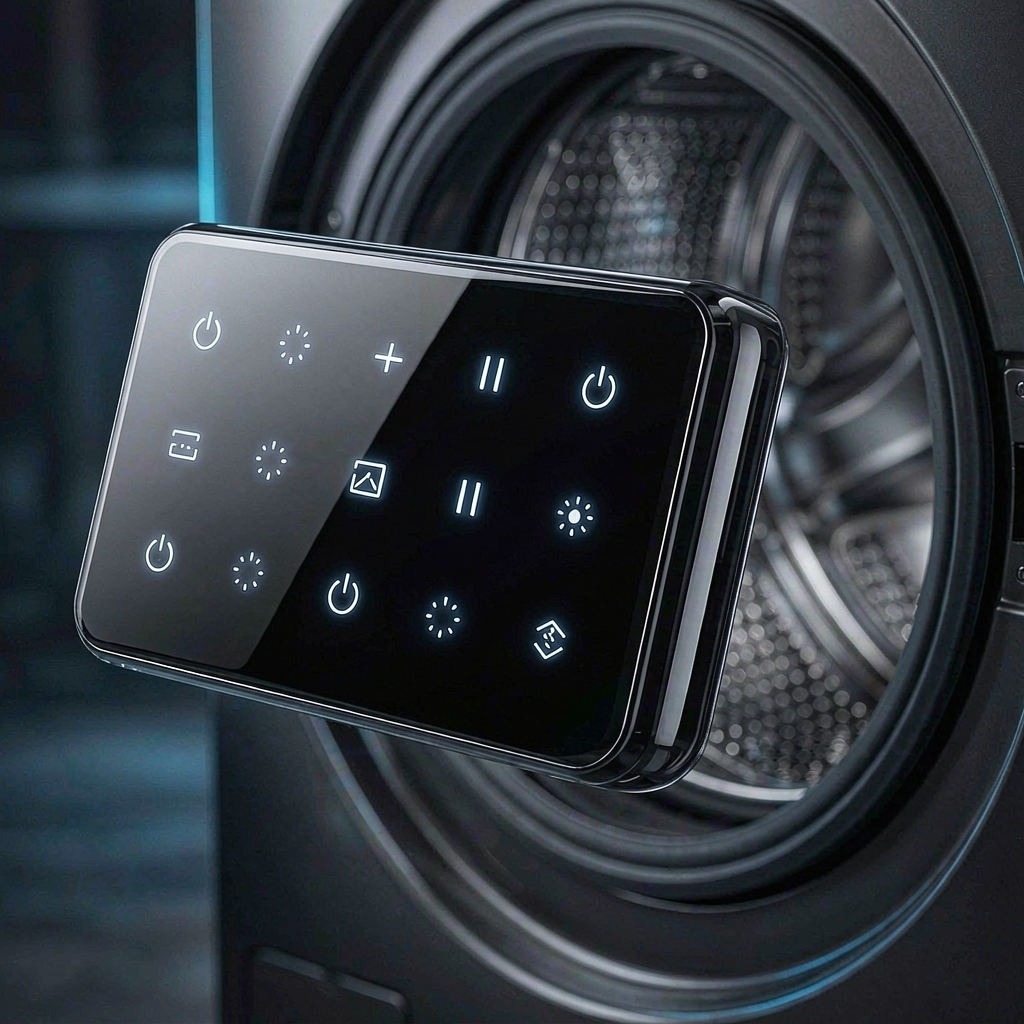
1. IMD vs IML vs INS: What Actually Separates the Three Processes?
All three processes inject plastic behind a pre-decorated film — what differs is how much the film is formed and how deep the part can be drawn. Definitions alone will not pick your process, but three boundary lines will:
• IML (In-Mold Labeling): the printed, hard-coated film is cut flat and placed in the tool; resin bonds behind it. Best for flat or gently shaped parts. On Zhicheng production lines, IML parts stay within a product height of 10 mm with an adhesive layer of 1.5 mm or more — beyond those limits, defect risk climbs fast.
• IMD (In-Mold Decoration): the printed film is thermoformed into 3D before injection, so the finished part carries curves, soft edges and draws up to about 30 mm. This is the route for curved fascia, charger housings and dead-front backlight windows.
• INS (high-gloss film insert molding): a premium insert route aimed at Class-A automotive interior surfaces, with the deepest draws and the highest tooling budget. Appliance programs rarely need it.
• Process numbers to quote against: film thickness 0.125–0.5 mm, forming radii at 2–3 mm for thermoformed film (never below 3× film thickness), registration accuracy ±0.1–0.3 mm in high-pressure forming, and gates kept 10–15 mm away from any decorated area. Film is dried at 80–100°C for 2–4 hours before forming — skip it and moisture bubbles will show up at inspection.
As a custom IML and IMD panel manufacturer and OEM/ODM supplier in China, Shanghai Zhicheng New Material Co., Ltd. runs four divisions — IMD panels, touch modules, molds and color film — backed by 150+ patents and a 14,610 m² plant. That full in-house chain is why the boundary lines above are production data, not brochure copy.
✅ Bottom line: IML for flat parts, IMD for formed geometry, INS for Class-A automotive surfaces — geometry decides first, volume decides second.
2. When to Choose IML Over IMD for Flat Control Panels — and When Not To
When to choose IML over IMD for flat control panels comes down to two variables: geometry and annual volume. Teams searching IMD vs IML which is better for home appliance control panels are usually really choosing between two volume regimes, and the tooling gap makes the rule sharp:
✅ Choose IML when the part is flat or gently curved within 10 mm height — washing machine, rice cooker, air-conditioner and dishwasher panels all qualify. Tooling runs $5,000–20,000, MOQ starts at 1,000–2,000 pieces, samples take 7–15 days, mass production 15–20 days, and at volume the decoration itself adds only about $0.01–0.04 per panel.
✅ Choose IMD when the drawing has real 3D: curved fascia, deep draws toward 30 mm, or hidden-until-lit dead-front windows. You accept the 30–50% tooling premium, but break-even against a painted-and-assembled alternative still lands near 15,000–25,000 units for a typical program.
❌ Keep IML away from parts that exceed 10 mm height, corners tighter than 3× film thickness, or gate positions closer than 10–15 mm to printed graphics — those are the three conditions behind wrinkling, washout and film displacement claims.
Durability is where in-mold decoration justifies itself to brand QA teams: hardcoat at 2H–3H pencil hardness, adhesion at ASTM D3359 4B–5B, Taber abrasion 5–10 times a sprayed surface, plus thermal cycling from −40°C to 85°C and 500 hours at 85°C/85% RH for automotive-grade programs. For any custom program, a capable OEM factory should hand you these test plans with the quote — if a supplier cannot, that is your audit answer.
✅ Bottom line: flat geometry plus roughly 10,000 or more annual units favors IML; any true 3D draw moves the part to IMD — validate height and radii before committing tooling.
FAQ
Q: IMD vs IML which is better for home appliance control panels?
A: For flat panels running above about 10,000 units a year, IML — it carries the lower tooling bill ($5,000–20,000) and the fastest cycle. Move to IMD the moment the drawing needs genuine 3D forming. Zhicheng engineers review your drawing against these rules for free before any tooling is cut.
Q: What tooling cost, MOQ and lead time should we budget for an IML appliance panel?
A: Plan on $5,000–20,000 tooling for a typical flat panel, MOQ of 1,000–2,000 pieces, samples in 7–15 days and mass production in 15–20 days. Curved IMD parts roughly double the tooling line.
Q: Do you offer OEM/ODM custom IML and IMD panels?
A: Yes. Shanghai Zhicheng New Material Co., Ltd. is an OEM/ODM in-mold decoration factory in Shanghai with dedicated IMD, touch module, mold and color-film divisions. Send your 3D drawing and target volume for a custom process-selection review, tooling estimate and factory quote.
The fastest next step is a drawing, not a debate. Send your panel 3D file and annual volume to Zhicheng, and our engineers will return a free process-selection review — IML, IMD or INS — with a tooling estimate and a break-even calculation for your program. Browse our IMD/IML product center or the household appliance panel range to see what leaves our Shanghai plant every day. This IMD IML INS process comparison for appliance panels ends where your drawing begins.
www.zcmoldinj.com
SHANGHAI ZHICHENG NEW MATERIAL CO.,LTD



+ There are no comments
Add yours