
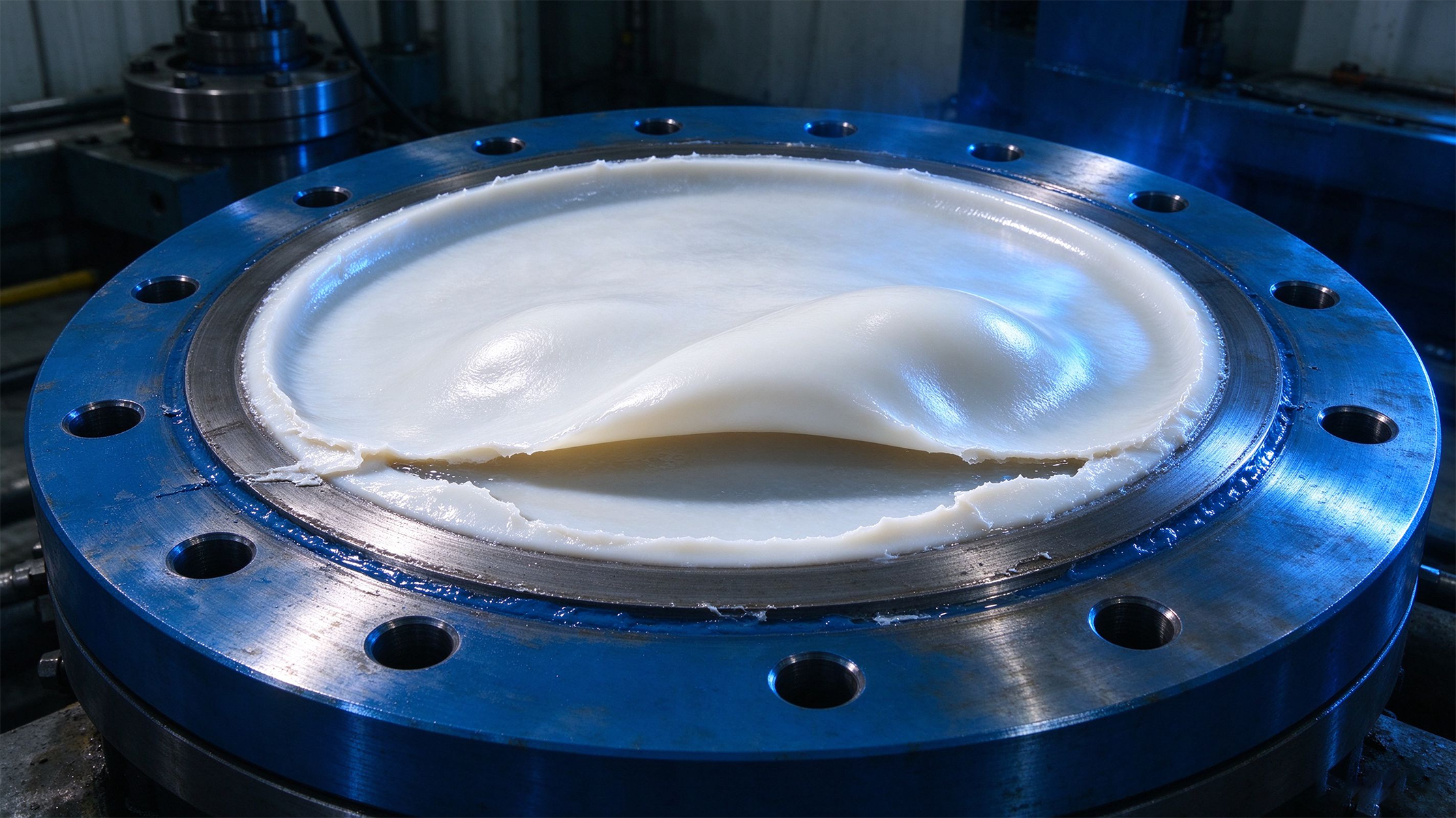
A blister is not a cosmetic defect. It is a gas-filled gap between liner and steel that widens every thermal cycle, and in a 150 °C sulfuric acid line it is usually the first visible sign that a spool has months — not years — of service left. This guide answers why PFA lined pipe blisters in hot acid service properly, then gives maintenance teams a field procedure for confirming, containing and correcting it. The diagnostic sequence below reflects production and failure-analysis work at DANPORE (Bengbu Danpore New Material Technology Co., Ltd.), a cleanroom-based manufacturer of steel-backed PFA lined pipe and valves for semiconductor and pharmaceutical duty.
Published: November 2026 | By DANPORE Engineering Team
1. Why Does PFA Lined Pipe Blister in Hot Acid Service?
The direct answer to why PFA lined pipe blisters in hot acid service is that the liner is not an absolute barrier but a filter — at 150 °C, hot sulfuric, hydrochloric or HF-bearing media permeate slowly through 3-5 mm of PFA, reach the steel shell, and generate the gas and corrosion products that pry the lining off. Search results will happily tell you blistering in fluoropolymer lined pipe causes permeation; the mechanism actually runs the other way, and knowing the direction is what separates a two-week repair from a two-month outage.
• Permeation and shell attack. Permeation is a diffusion process, not a leak: individual acid molecules pass through the polymer lattice, faster as temperature rises. Once through, they attack the carbon steel backing and release hydrogen, while the corrosion products themselves occupy volume. With nowhere to go, the interface pressure lifts the liner into a blister.
• Thermal cycling ratchets it wider. Trapped vapor expands during heat-up and the liner bulges outward; on cool-down the vapor condenses and the space partially collapses but never re-bonds. Each cycle grows the unbonded area — which is why blisters appear first in the hottest zones and why steady service often lasts far longer than a line that is started and stopped weekly.
• Bond and anchoring weaknesses. A liner is held by adhesive bond plus mechanical anchoring (steel mesh or dovetail grooves). Poor grit-blast preparation, contamination before molding, or incomplete sintering leaves voids that act as nucleation sites. These blisters are born at installation, not in service — they simply surface later.
• Thickness and resin grade. A 3 mm liner is a sensible choice below roughly 100 °C; at 150 °C in concentrated acid, 5 mm buys meaningful diffusion distance. PTFE lining permeates 50-70% more than PFA at equal temperature, and regrind-containing resin adds porosity that accelerates the whole chain.
✅ Bottom line: Blistering is a permeation problem wearing a mechanical costume — fix the temperature, thickness and resin first, or the patch you weld today will fail again next quarter.
2. Which Triggers Dominate in Hot Sulfuric Acid Service?
In sulfuric acid circulation — SPM mixing loops, hot acid baths, waste neutralization feed — three operating habits account for most of the blisters we see when spools come back to DANPORE for assessment, and all three are controllable without changing the piping design.
• Temperature excursions. The liner is rated -20 to 150 °C continuous. A mixing or heating control loop that overshoots to 160-170 °C even briefly can multiply permeation rate and soften the bond in one shift. Trend the loop, not the setpoint.
• Aggressive heat-up and cool-down. Thermal shock loads the bond in shear before any chemistry does. Ramp gradually, and never steam-out a hot lined line for cleaning without a controlled cooling step first.
• Vacuum on a hot liner. Drain-down sections pulled to -0.9 MPa while still hot combine external pressure with a softened, gas-loaded interface. Design drain lines so vacuum is applied cold, or specify a vacuum-rated construction with proper anchoring.
One more design-level trap: dead legs and low-velocity branches hold hot acid against the same liner spot for months. If your line list has unused capped branches on the hot loop, either delete them or add a flush point — stagnation is permeation's best friend.
✅ Bottom line: Before blaming the supplier, pull twelve months of temperature and vacuum trends for that line — most blister investigations end there, with an excursion nobody logged.
3. How to Inspect, Repair or Replace a Blistered Liner
Here is how to inspect and repair blistered PFA lining in the order a maintenance team should actually work — confirm, map, test, then decide — because replacing a sound spool wastes shut-down hours just as surely as patching a dead one. Work through four steps:
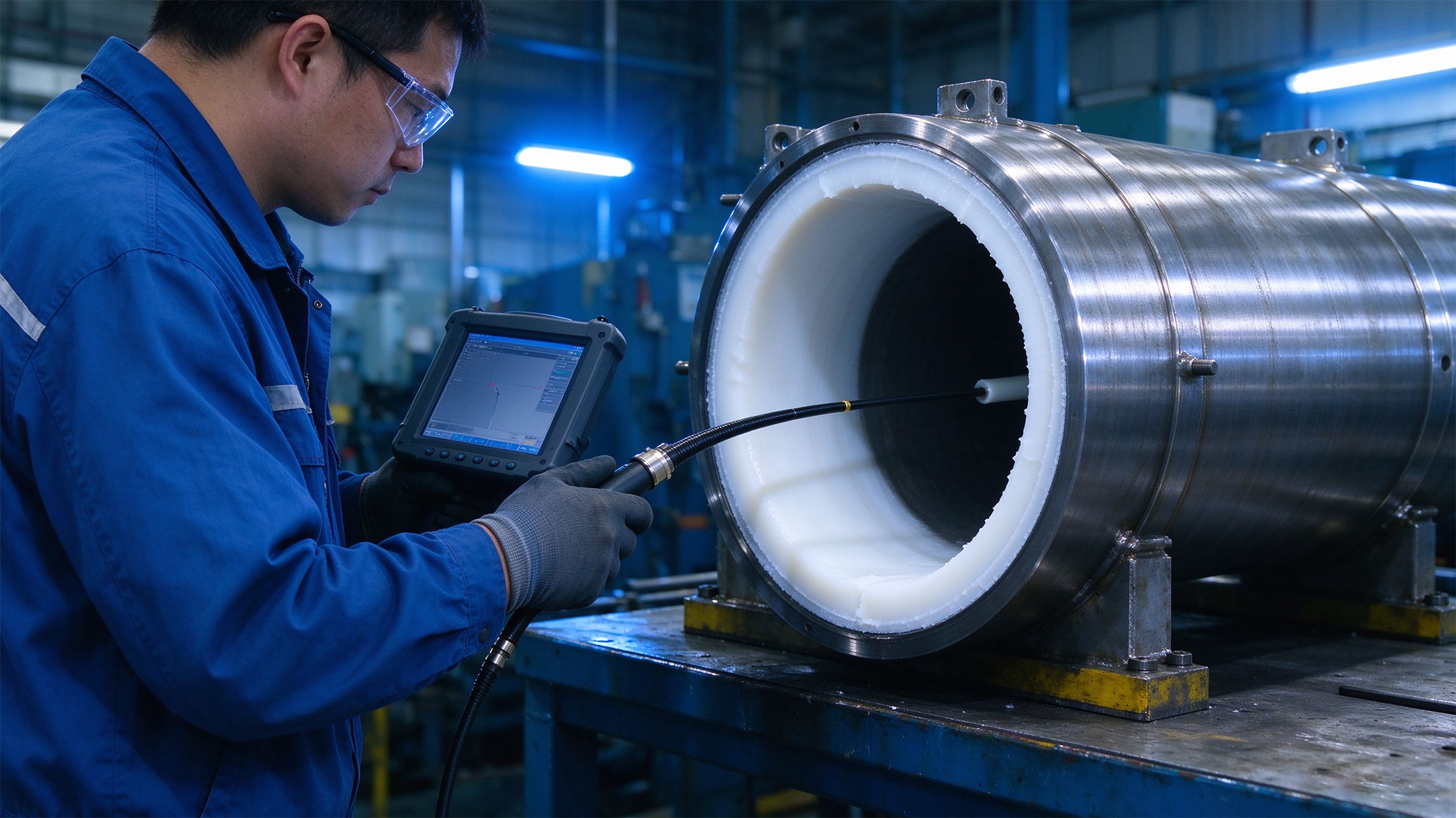
• Confirm and map. Photograph each blister, record diameter, count and position relative to flanges and welds, and mark the extent on the spool with a paint pencil. Blisters clustered at mid-span point to permeation; blisters ring-shaped around the flange face point to installation torque or bond failure.
• Test. A tap test changes tone over an unbonded area. Ultrasonic thickness confirms remaining liner wall. After cleaning, a spark (holiday) test at 15-25 kV finds pinholes — expect a blistered zone to fail, because the gas gap itself breaks the circuit.
• Check the shell. If the design has a tell-tale or vent port, look for acid weep — that confirms shell attack rather than a pure bond defect. On unvented spools, cut a small window only as a last resort before scrapping.
• Decide: patch or replace. A single blister under roughly 25 mm, in non-semiconductor, non-pharma service, can be dressed back to sound lining and repaired by PFA hot-gas welding with matching rod, then re-tested. Replace the spool when blisters exceed that size, when more than two appear, when any blister touches a flange face, or when the line serves semiconductor or pharmaceutical duty — patched liners cannot deliver the G4-G5 cleanliness or validation documentation those services require. DANPORE, a manufacturer that molds and bonds its own liners, supplies replacement spools and valve bodies to original DN and face-to-face dimensions, typically in about 4 weeks for custom sizes.
✅ Bottom line: Patch only what a spark test passes after welding — anything else is a temporary plug on a line that will be opened again next shutdown.
Frequently Asked Questions
Q: Why do blisters cluster on the hottest section of the line?
A: Because permeation rate rises steeply with temperature, the reasons why PFA lined pipe blisters in hot acid service concentrate exactly where the media is hottest — near heaters, mixing tees and trace-heated runs. That pattern is also diagnostic: uniform blisters along a whole line usually mean a bond or resin problem — and it is why the popular shorthand that blistering in fluoropolymer lined pipe causes permeation should really be read the other way round.
Q: Can PFA lined valves be repaired after liner damage?
A: It depends on the part. Diaphragms are consumables and are replaced as routine maintenance; a blistered or pitted valve body cannot be re-lined economically or safely — replace the body, keeping the actuator and accessories. Ask the manufacturer — DANPORE quotes a body-only replacement against the original tag number and confirms face-to-face dimensions so the swap fits the existing pipe run.
Q: Can a blister be repaired in place during a shutdown?
A: Sometimes — single small blisters in general chemical service can be welded in place, and the sequence for how to inspect and repair blistered PFA lining on site is confirm, map, test, patch, re-test. What cannot be done in place is restoring purity: welding leaves heat-affected zones and weld bead geometry that trap particles, which is why semiconductor and pharma lines replace rather than patch.
Prevent the Second Blister
If a spool has already blistered, the replacement specification should differ from the original in at least one respect: 5 mm liner in place of 3 mm, PFA in place of PTFE, verified virgin resin, a vented or anchored design, and documented 15-25 kV spark testing per component. DANPORE reviews failed spools and returns a factory-direct failure assessment and replacement quote — send photographs, service temperature, media and the line's operating history, and the team will confirm within 48 hours whether the cause was permeation, bond or operation. Review the ultra-pure PFA lined valve range or the full product catalog before ordering replacements.
www.danporepfa.com
DANPORE PERFORMANCE MATERIAL APPLICATION CO., LTD.

+ There are no comments
Add yours