



Why Sample-to-Result Speed Matters in Modern Diagnostics
In today's healthcare environment, the gap between collecting a patient sample and receiving an actionable result can determine clinical outcomes. Emergency departments, intensive care units, and decentralized clinics all share a common challenge: traditional diagnostic workflows are often burdened by multi-step liquid handling, washing cycles, and separation processes that slow down turnaround time and increase the risk of operational error. Nanjing Poclight Biotechnology Co., Ltd., operating under the brand Poclight Biotechnology, has built its entire technology platform around solving this exact problem—delivering a genuinely simplified sample-to-result workflow for in vitro diagnostics.
The Core Problem with Conventional Chemiluminescence Testing
Conventional Chemiluminescence Immunoassay (CLIA) systems typically rely on magnetic bead separation and repeated washing steps to isolate the signal-generating complex from unbound reagents. This approach, while effective, introduces several pain points that Poclight has identified as central to the industry's operational complexity:
- High logistics costs driven by cold chain requirements for traditional reagents
- Operational complexity in liquid paths and washing systems
- Slow turnaround times in emergency and point-of-care settings
- Space constraints in small clinics and decentralized health centers
These challenges compound one another. A lab that must manage refrigerated reagent storage, maintain complex plumbing within its analyzer, and wait for multi-step assay cycles cannot deliver the speed that emergency chest pain centers or ICU sepsis management demand.
Poclight's CRET Technology: Removing the Wash Step Entirely
At the heart of Poclight's simplified workflow is its patented Chemiluminescence Resonance Energy Transfer (CRET) technology—a 5th generation Chemiluminescence platform utilizing Acridine Ester and Graphene Oxide quenching. Unlike traditional magnetic bead-based assays, CRET technology enables a homogeneous immunoassay method, meaning the entire reaction occurs in a single step without the need for washing or physical separation of bound and unbound reagents.
This "no-wash, no-separation" process is not an incremental improvement; according to Poclight's technical data, it delivers a 70% reduction in time and expenditure compared to conventional immunoassay procedures. By eliminating the washing and separation stages that define legacy CLIA systems, Poclight has effectively removed the most time- and labor-intensive steps from the sample-to-result pathway.
How the C5000 Analyzer Puts Simplification into Practice
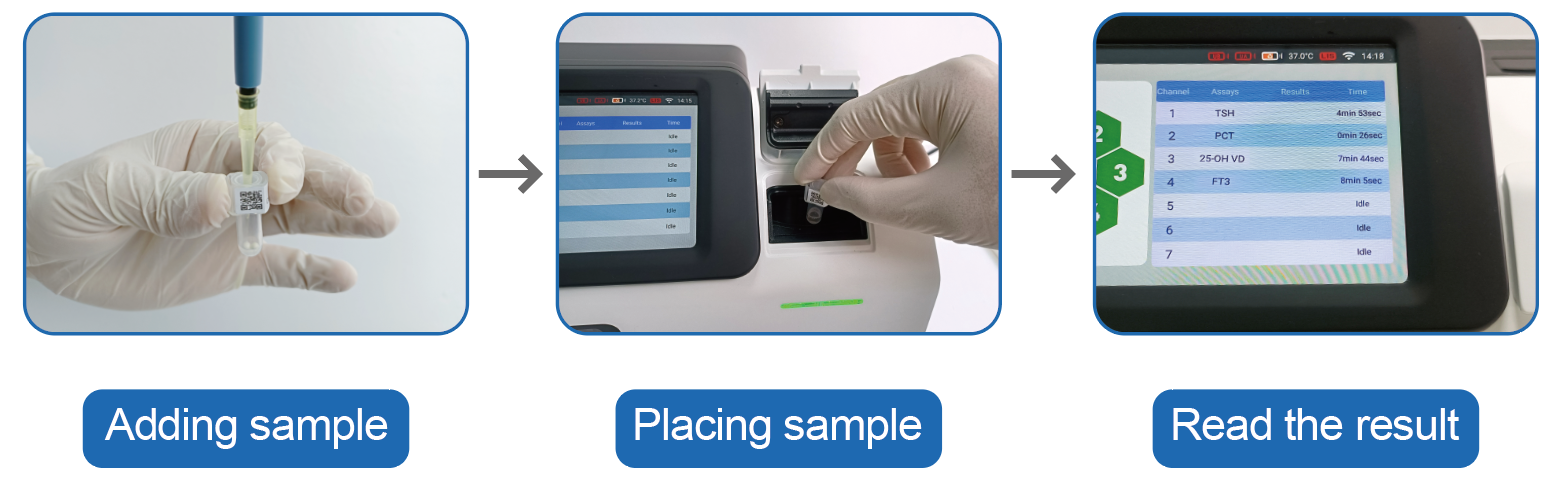
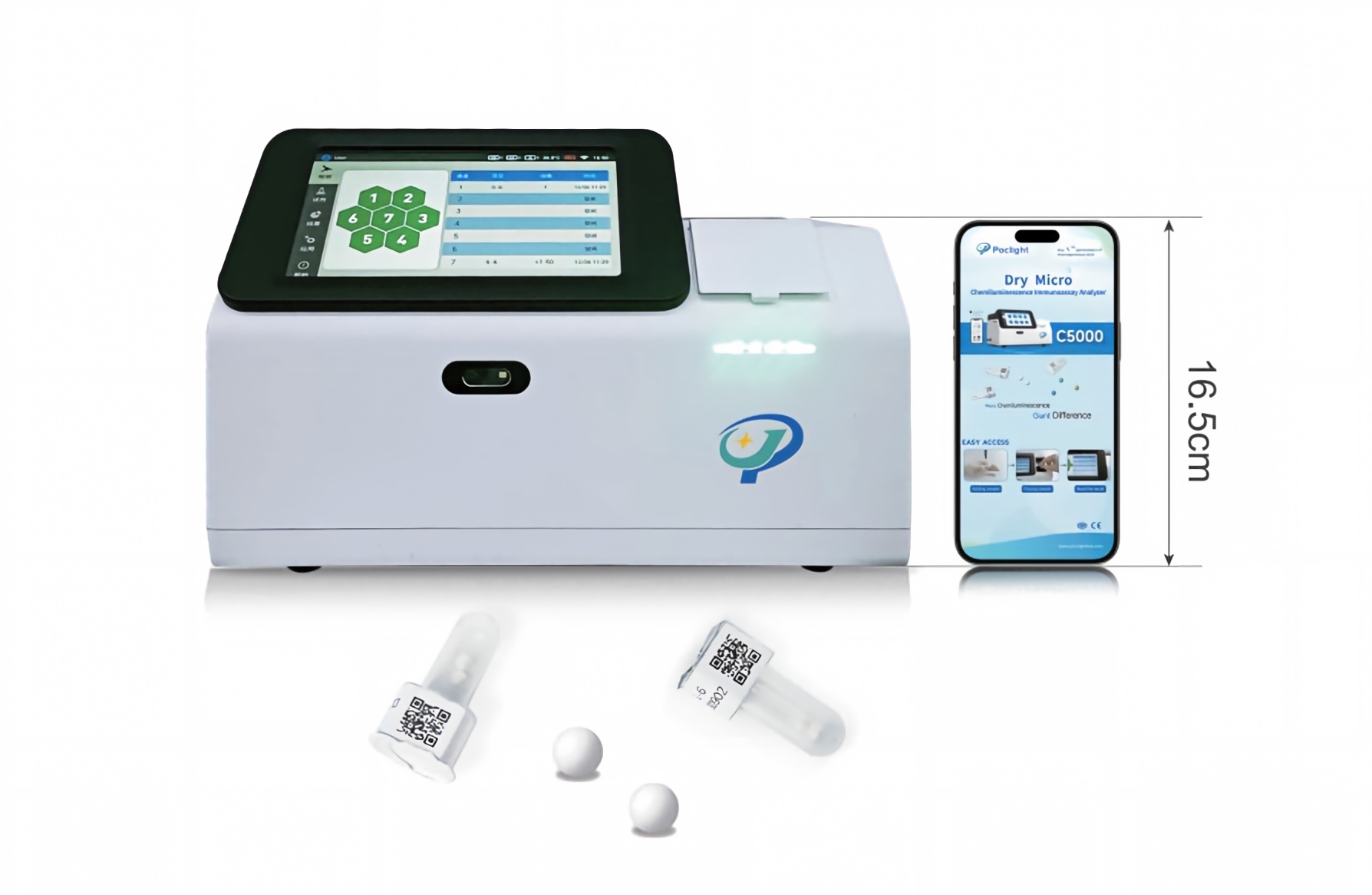
The practical embodiment of this technology is the C5000 Micro-Chemiluminescence Immunoassay Analyzer, a compact, semi-automated benchtop device designed for quantitative biomarker detection. The C5000 operates through a simple three-step process, directly addressing the operational complexity that burdens traditional systems.
Key technical characteristics of the C5000 include:
- Rapid turnaround: Results delivered in 3–15 minutes, supporting emergency and bedside decision-making
- Compact footprint: An A4-sized device weighing approximately 8.5kg—an 80% weight reduction compared to traditional analyzers
- Maintenance-free operation: No internal liquid paths, eliminating hidden cleaning and repair costs
- High sensitivity detection: Photon Multiplier Tube (PMT) detection ensures lab-grade accuracy despite the device's small size
Because the C5000 contains no internal liquid path, there is no plumbing to maintain, no tubing to replace, and no risk of cross-contamination from washing residues—factors that historically added both time and cost to diagnostic operations. This design directly supports Poclight's stated service assurance: a maintenance-free instrument design with no hidden cleaning or consumable costs.
Reagent Stability as Part of the Simplified Workflow
A truly simplified sample-to-result workflow cannot stop at the instrument level—it must also address reagent logistics and storage. Poclight's lyophilized spherical beads are formulated for room-temperature stability, remaining stable at 2–30°C for 18 months. This eliminates the cold chain requirements that typically complicate reagent transport and storage, particularly for clinics in remote or resource-limited settings.
This reagent format contributes to a 50% reduction in logistics costs by removing the need for refrigerated shipping and storage infrastructure. For decentralized health centers and veterinary clinics without consistent cold chain access, this stability is a critical enabler of consistent, reliable testing—removing another layer of operational friction from the diagnostic pathway.
The reagent portfolio itself spans more than 50 biomarkers across major clinical categories, including:
- Inflammation and infection markers such as C-Reactive Protein (CRP), Procalcitonin (PCT), and Interleukin-6 (IL-6)
- Cardiovascular markers including High-sensitivity Cardiac Troponin T (hs-cTnT), D-Dimer, and NT-proBNP
- Thyroid function panels covering TSH, TT3, TT4, FT3, and FT4
- Fertility and hormone assays such as AMH, FSH, LH, and β-hCG
- Tumor markers including PSA, CEA, AFP, and CA125
This breadth means that a single simplified workflow—one instrument, one reagent format, no cold chain, no washing—can serve a wide range of clinical needs, from sepsis management in the ICU to endocrine monitoring in decentralized women's care clinics.
Real-World Impact of a Simplified Workflow
Poclight's approach has been applied across several documented use cases that illustrate the practical value of workflow simplification:
In emergency chest pain centers, implementation of ultra-fast CLIA point-of-care testing has supported efforts to reduce door-to-balloon time, a critical metric in cardiac emergency care. In community health centers, the combination of the C5000 analyzer and lyophilized reagents has brought CLIA-level sensitivity to primary care settings that previously lacked access to such infrastructure. In ICU settings, the synergy of PCT and IL-6 testing has supported more rapid clinical decision-making for sepsis management. And in decentralized women's care environments, benchtop CLIA integration has enabled lab-quality endocrine and fertility monitoring directly within clinic settings.
A Platform Built for Simplification, Not Just Speed
It is worth noting that Poclight's workflow simplification is not limited to speed alone. It spans several interconnected dimensions: operational simplicity (no washing or separation), physical simplicity (compact, lightweight hardware), logistical simplicity (no cold chain), and maintenance simplicity (no liquid paths to service). Together, these elements reflect Poclight's broader positioning as an innovative R&D enterprise specializing in 5th generation In Vitro Diagnostic (IVD) platforms.
Poclight holds CE Certification, ISO 13485 Certification, NMPA certification, and NGSP certification, and is recognized as the sole company worldwide with an authorized CRET patent for IVD applications. The company also offers OEM/ODM services, allowing partners to integrate CRET-based simplification into their own diagnostic offerings.
Conclusion
For healthcare providers evaluating how to streamline their diagnostic operations, the sample-to-result workflow is often the single largest point of friction—encompassing reagent logistics, instrument maintenance, and assay procedure complexity. Poclight Biotechnology's CRET platform, embodied in the C5000 analyzer and its room-temperature stable reagent line, addresses each of these friction points directly. By removing washing, separation, cold chain dependency, and liquid-path maintenance from the equation, Poclight has structured its entire product ecosystem around the principle of diagnostic simplification, guided by its stated mission: Guarding Health with Diagnostic Innovation.
www.poclight.com
Nanjing Poclight Biotechnology Co., Ltd


+ There are no comments
Add yours