


Comfort is an important consideration when selecting ballistic helmet pads. Although the outer shell provides the main structure of a helmet, the interior padding system determines much of how the helmet feels during regular use. The materials, thickness, shape, density, ventilation, and arrangement of the pads can all influence how well the helmet fits and how comfortable it remains over time.
For helmet manufacturers, distributors, and businesses sourcing helmet components, understanding these factors is essential when comparing different padding solutions. A helmet pad that feels comfortable during a brief fitting may not provide the same experience after extended use. Pressure distribution, heat accumulation, moisture, and material deformation can gradually affect overall comfort.
Different users may also have different requirements because head shapes, helmet sizes, and preferred fits vary. Therefore, choosing suitable ballistic helmet pads involves considering both product specifications and the relationship between the padding system and the helmet shell.
This article explores the main factors that affect helmet pad comfort, explains how different design and material choices influence the wearing experience, and provides practical suggestions for evaluating padding systems.
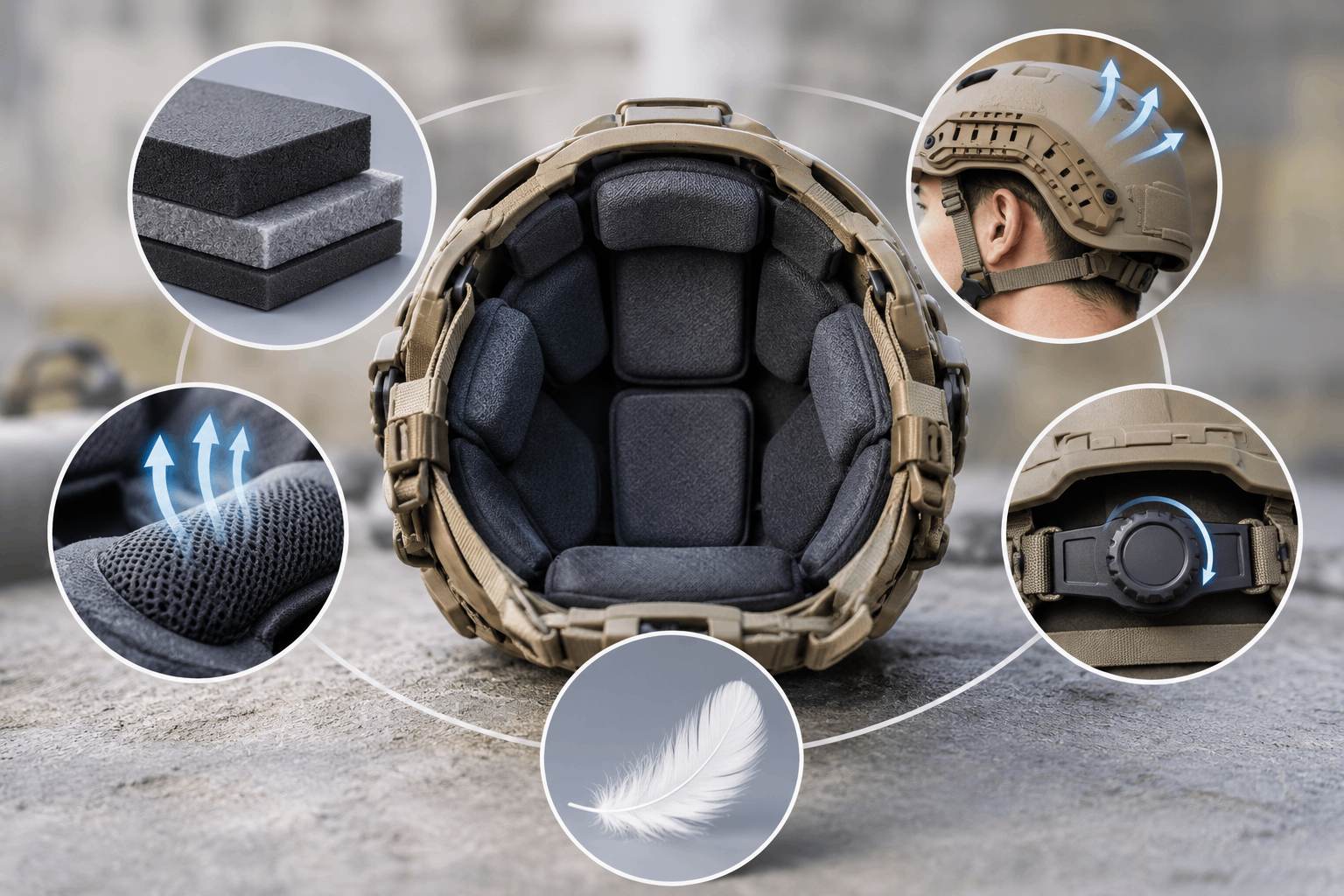
1. Material Selection and Foam Properties
Material selection is one of the most important factors affecting the comfort of ballistic helmet pads. The material determines how a pad responds to pressure, how it conforms to the intended contact area, and how it behaves during repeated use.
Different foam materials have different physical characteristics. Some are relatively soft and flexible, while others provide a firmer structure and greater resistance to compression. The appropriate choice depends on the intended helmet design and the desired balance between cushioning, support, and durability.
Common material characteristics to evaluate include:
Softness: Softer foam can provide a more cushioned initial feel. However, excessive softness may cause the pad to compress too easily, potentially affecting the consistency of the fit.
Elasticity: Elastic materials can recover their original shape after compression. This property helps maintain a more consistent contact surface during repeated use.
Resilience: Resilience describes how a material responds after pressure is released. Materials with suitable resilience can help prevent pads from remaining permanently compressed after normal use.
Surface texture: The outer surface comes into contact with the head or other interior layers. A smooth, skin-friendly surface may improve comfort, particularly when the helmet is worn for extended periods.
Material stability: Some materials may change their physical characteristics under repeated compression, temperature fluctuations, or moisture exposure. Buyers should consider how the selected material performs under the expected usage and storage conditions.
When evaluating a manufacturer, it is useful to request detailed material specifications rather than relying on general descriptions such as soft, premium, or comfortable.
2. Foam Density and Compression Performance
Foam density has a direct relationship with the physical characteristics of helmet pads. It can influence firmness, weight, compression behavior, and the overall feel of the padding system.
However, density should not be considered independently. Two foam materials with similar densities may still have different compression and recovery characteristics because of differences in their formulations and manufacturing processes.
For helmet padding, the balance between firmness and cushioning is particularly important.
If the foam is too soft, it may compress excessively under pressure. This can reduce the available cushioning thickness and cause the helmet to feel less stable.
If the foam is too firm, it may create uncomfortable contact points, especially around areas where the shell has limited interior space.
A suitable material should provide an appropriate level of support without creating unnecessary pressure.
Buyers comparing ballistic helmet pads should consider several properties:
-
Foam density
-
Compression force
-
Compression recovery
-
Permanent deformation
-
Thickness consistency
-
Material aging characteristics
It is also advisable to request test information where available. Measurements taken under consistent testing conditions provide a more meaningful basis for comparing different materials than subjective descriptions alone.
3. Pad Thickness and Internal Space
Pad thickness is another important factor influencing comfort. The thickness of the padding determines how much space it occupies inside the helmet shell and affects the relationship between the shell and the intended head position.
A pad that is too thick may make the helmet feel excessively tight. It can also create uneven pressure if different sections of the interior do not provide enough room.
On the other hand, pads that are too thin may not provide the intended cushioning or fit adjustment.
The ideal thickness depends on several factors:
Helmet shell dimensions: Different helmet shells provide different amounts of internal space. A pad thickness suitable for one model may not be appropriate for another.
Head size and shape: Users with different head dimensions may require different padding configurations to achieve a comfortable fit.
Pad material: Two pads with the same nominal thickness may feel different because their foam materials respond differently to compression.
Pad arrangement: The number and position of individual pads affect how the available space is distributed.
Other interior components: Adjustment systems, straps, and other fittings may occupy space that must be considered when selecting pad thickness.
When evaluating a padding system, buyers should look at the assembled configuration rather than considering each pad separately. The combined thickness and arrangement determine how the system fits inside the helmet.
4. Pad Shape and Ergonomic Design
The shape of a helmet pad influences how it contacts the head and distributes pressure across different areas.
A poorly designed pad may create concentrated contact points, while an appropriately contoured pad can provide a more balanced contact surface.
Helmet interiors are generally curved rather than flat. As a result, pads may need different shapes depending on their installation positions.
For example, front, rear, side, and crown pads may have different outlines and dimensions. A manufacturer should consider the intended position of each component when developing a complete padding system.
Important design considerations include:
Contoured profiles: Curved or shaped pads can follow the intended contact area more closely than unsuitable flat components.
Edge design: Rounded or smoothly finished edges can reduce the possibility of uncomfortable contact around pad boundaries.
Contact area: The dimensions of the pad determine how pressure is distributed across the surface.
Symmetry: Where the design requires matching left and right components, consistent shapes and dimensions help maintain a balanced arrangement.
Installation position: Even a well-designed pad may cause discomfort if it is installed in the wrong location.
Ergonomic design should therefore be evaluated together with the helmet shell. The objective is to achieve a consistent fit without unnecessary pressure or gaps.
5. Pressure Distribution Across Different Contact Areas
Pressure distribution is closely related to the comfort of ballistic helmet pads. When pressure is concentrated in a small area, the helmet may feel uncomfortable even if the padding material itself is relatively soft.
Uneven pressure can result from several conditions:
-
Incorrect pad thickness
-
Poor pad positioning
-
Incompatible pad shapes
-
Uneven material compression
-
Differences between the helmet shell and head shape
-
Inconsistent pad dimensions
For example, if the front pad is significantly thicker than the side pads, the helmet may feel unevenly positioned. Similarly, a pad that does not follow the shell's internal contour may create concentrated contact in certain areas.
A well-designed padding system should consider the relationship between all contact areas rather than optimizing individual pads independently.
When evaluating comfort, buyers can examine whether the complete pad arrangement provides a balanced fit. Physical samples are particularly useful because they allow the actual helmet configuration to be assessed.
It is also important to distinguish between a comfortable initial fitting and long-term comfort. Pressure distribution may change as foam materials compress during repeated use.
6. Ventilation and Heat Management
Heat accumulation is another factor that can affect the comfort of helmet padding. When a helmet is worn for extended periods, heat may build up inside the enclosed space.
The design of the padding system can influence how air moves through the interior and how much heat is retained near contact surfaces.
Some helmet pads incorporate ventilation channels, perforations, or separated contact sections. These features may help create additional space for air movement, depending on the overall helmet design.
When comparing ventilation features, consider the following:
Ventilation openings: Perforations or openings may provide additional pathways for air movement through certain pad structures.
Channel design: Grooves or channels can create small spaces between sections of the padding.
Pad arrangement: The distance between individual pads may influence the available airflow inside the helmet.
Material structure: Different foam structures may have different air permeability characteristics.
Interior configuration: Ventilation performance depends on the complete helmet system, not only on the padding material.
More ventilation openings do not automatically guarantee greater comfort. Their effectiveness depends on the size, location, and overall arrangement of the openings.
Buyers should evaluate ventilation features in combination with cushioning, durability, and compatibility rather than treating them as a standalone quality indicator.
7. Moisture Management and Surface Fabric
Perspiration and moisture can gradually affect the wearing experience. When moisture accumulates around the contact areas, the interior may feel damp or uncomfortable.
The outer fabric or surface layer of a helmet pad can influence how moisture interacts with the padding system.
When evaluating fabric-covered ballistic helmet pads, consider:
Moisture absorption: Different fabrics absorb and retain different amounts of moisture. The appropriate properties depend on the intended usage conditions.
Drying characteristics: Materials that dry efficiently may help reduce the time that moisture remains within the padding system.
Skin contact: The fabric should have a suitable surface texture for repeated contact.
Abrasion resistance: Regular contact and handling can cause surface wear. Durable fabric helps maintain the pad's condition.
Cleaning compatibility: The surface material should be suitable for the cleaning methods recommended by the manufacturer.
It is also important to understand the difference between moisture absorption and moisture resistance. A fabric that absorbs moisture quickly does not necessarily dry quickly.
Buyers should request information about fabric composition and care requirements before selecting a particular padding solution.
8. Weight and Overall Helmet Balance
The weight of the padding system can also influence comfort. Although individual pads may be relatively small, their combined weight contributes to the total weight of the helmet.
A heavier padding system may change how the helmet feels during extended use, particularly when combined with the weight of the shell and other interior components.
When comparing different pad configurations, consider:
-
Weight of individual pads
-
Total weight of the complete padding system
-
Differences in material density
-
Number of pads included
-
Thickness and size variations
-
Weight distribution within the helmet
However, reducing weight should not be the only design objective. A very lightweight material may not provide the desired cushioning, resilience, or durability.
The better approach is to evaluate weight alongside other physical characteristics. Manufacturers should be able to provide product specifications that help buyers compare different configurations.
The overall balance of the helmet also matters. If the padding arrangement creates uneven contact or changes the helmet's position, the user may perceive the helmet as less comfortable even when the padding itself is lightweight.
9. Attachment Stability and Pad Positioning
Helmet pads need to remain in their intended positions inside the shell. If they shift, rotate, or become detached during normal handling, the resulting fit may become inconsistent.
Attachment stability therefore contributes to the overall comfort of the padding system.
Common attachment methods include hook-and-loop fasteners, adhesive-backed components, and other fastening arrangements. The appropriate method depends on the helmet's internal structure and the pad design.
When evaluating attachment stability, examine:
Fastener compatibility: The attachment components on the pad should match those installed inside the shell.
Position accuracy: The attachment areas should align with the intended mounting locations.
Contact area: Sufficient engagement between compatible fastening surfaces helps maintain positioning.
Installation quality: Poorly applied adhesive or incorrectly positioned fasteners may cause pads to move.
Replacement convenience: Removable pads should be reasonably easy to replace according to their intended design.
It is also necessary to check whether the attachment system remains compatible with the selected pad thickness and shape.
For businesses purchasing helmet components in volume, consistent attachment positioning is particularly important because it helps ensure that products can be assembled in the same way across different production batches.
10. Material Durability and Long-Term Comfort
A padding system may feel comfortable when new but gradually lose its original characteristics through repeated compression, handling, and environmental exposure.
Material durability is therefore closely connected to long-term comfort.
Several changes may affect the condition of helmet pads:
Permanent compression: Foam may gradually lose part of its original thickness after repeated pressure.
Reduced resilience: Some materials may become less capable of recovering their original shape.
Surface deterioration: Fabric coverings may develop loose threads, abrasion, or other visible damage.
Layer separation: Bonded components may begin to separate if the bonding structure deteriorates.
Moisture-related changes: Repeated exposure to moisture may affect certain materials if they are not properly maintained.
These changes can influence the fit and feel of ballistic helmet pads.
When evaluating a manufacturer, buyers should ask about the expected material characteristics, recommended storage conditions, and maintenance instructions.
Where possible, request information about compression recovery, dimensional stability, and other relevant material tests. Such information can help buyers understand how the product is expected to behave over time.
11. Cleaning and Maintenance Requirements
Maintenance also affects the long-term comfort of helmet pads. Dust, perspiration, and other contaminants can accumulate on the surface during regular use.
If the pads are difficult to clean or dry, their condition may deteriorate more quickly.
A practical maintenance plan should follow the manufacturer's recommendations and take the material construction into account.
Important considerations include:
-
Whether the pads can be removed from the shell
-
Which cleaning methods are permitted
-
Whether the surface fabric can tolerate repeated cleaning
-
How the pads should be dried
-
Whether certain cleaning agents should be avoided
-
How the pads should be stored when not in use
Not every foam or fabric material can withstand the same cleaning methods. Excessive heat, unsuitable solvents, or aggressive washing may affect material properties and bonding structures.
Manufacturers should provide clear maintenance instructions so that buyers and end users understand how to preserve the product's original condition.
Proper maintenance cannot prevent all material aging, but it can help reduce avoidable damage caused by unsuitable cleaning or storage practices.
Conclusion
The comfort of ballistic helmet pads depends on several interconnected factors, including material properties, foam density, thickness, ergonomic design, pressure distribution, ventilation, moisture management, attachment stability, and long-term durability. No single specification can determine whether a padding system will provide a comfortable fit. Its performance must be considered in relation to the helmet shell, the complete interior arrangement, and the intended usage conditions.
For businesses sourcing helmet padding components, evaluating samples and reviewing detailed product specifications are essential steps before making a purchasing decision. Consistent manufacturing quality is equally important, as variations in material, dimensions, or workmanship can affect the wearing experience from one batch to another.
When selecting a supplier, buyers should look for a manufacturer that understands these requirements and can provide suitable material options, dimensional consistency, and customization support. HONG JIA focuses on helmet-related product manufacturing and customer requirements, offering a starting point for businesses exploring helmet padding solutions. By paying attention to both product design and manufacturing quality, buyers can make more informed decisions when selecting ballistic helmet pads for different helmet configurations.
www.militarytex.com
militarytex


+ There are no comments
Add yours